
Section 01
Category 1: The Pilgrim
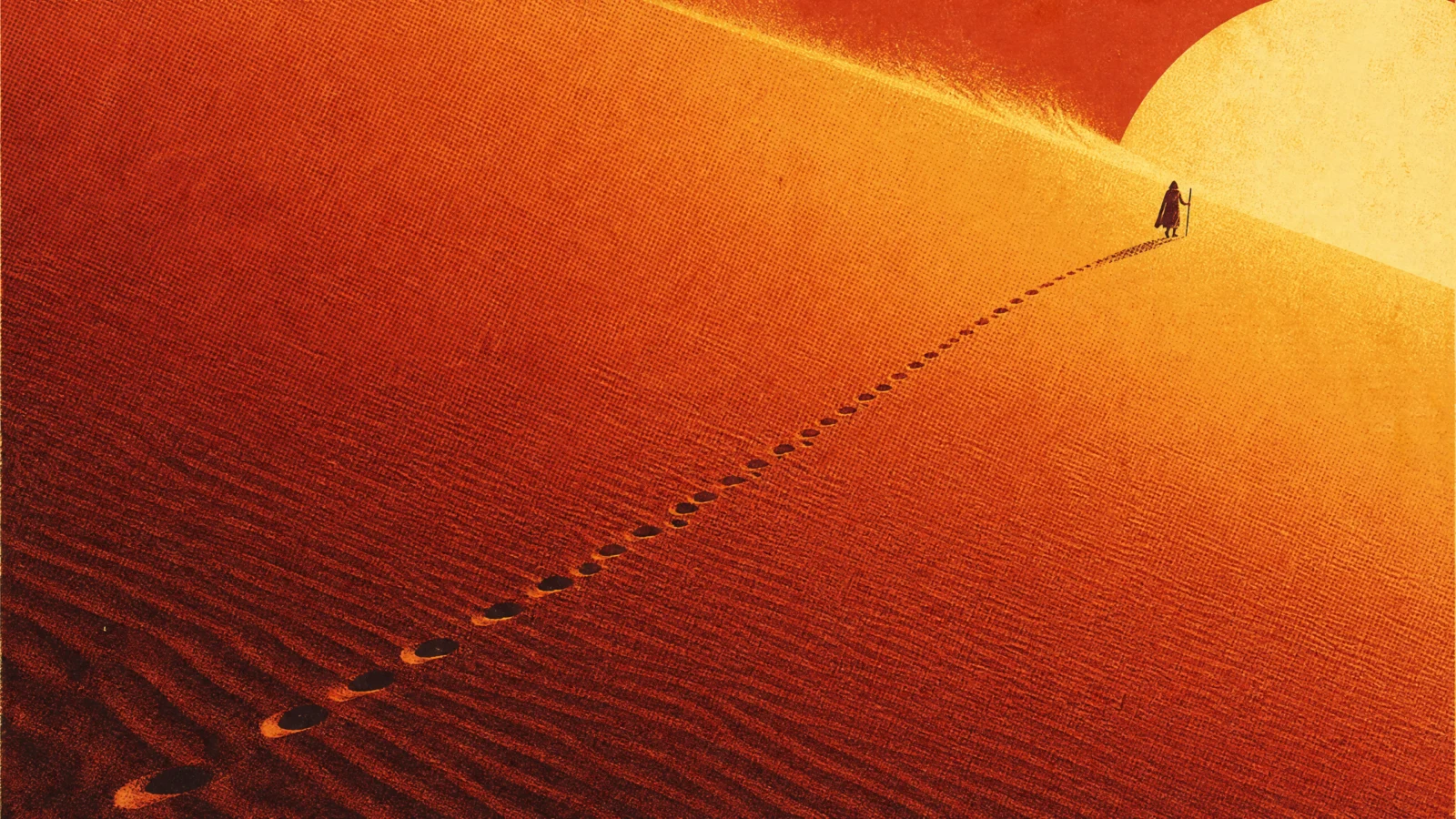
One lone traveller. A dead world. A sun too big for the sky.
This vault builds retro screen-print sci-fi artwork. Think vintage science fiction paperback covers reborn as gallery prints: flat colour blocks, halftone grain, four colours per frame, and one tiny figure against something enormous. Every prompt in this category tells a chapter of the same journey, and every image is built 16:9 and animation-ready, so these frames become video episodes later.
All 6 prompts run on GPT Image 2 on OpenArt. Paste them exactly as written, then use the swap guide below to make them yours.
How These Prompts Work
Every prompt in Vol.17 is built on the same seven-block spine. Learn the spine once and you can rebuild any prompt in this vault into anything you want.
SCENE sets the world. One environment, described in one or two lines. This is your biggest swap lever: change the salt flat to a frozen sea or a glass desert and everything else still works.
FIGURE is the traveller. Always a silhouette, always small, always with one thin rim of light. The silhouette is not a limitation, it is the trick. Because there is no face, no outfit detail, and no identity, the model never breaks character consistency, and the viewer projects themselves into the figure. Keep your figures as silhouettes and this style never fails you.
SCALE ANCHOR is the sentence that forces the size relationship. AI models constantly render figures too big. This block exists purely to fight that. It always compares the figure against the biggest thing in frame: smaller than a sun ray, barely taller than a carved step. If your figure ever renders too large, this is the block you strengthen.
LIGHT EVENT is the real main character of every image. A giant sun, a rising planet, a beam through a storm. In this style the light source does the emotional work, so it always gets its own block and it is always described as an event, not a mood. "A blade of golden light cuts across the mountain face" renders. "Dramatic lighting" does not.
DEPTH is what makes these frames animation-ready. Three named planes: sharp foreground texture, crisp midground with the figure, soft background with the light event. Plus one airborne element (dust, mist, sand) drifting between the planes. Flat illustration with no depth fights video models later. This block is why our frames will animate cleanly when we turn this vault into episodes.
PALETTE is the strictest rule in the vault. Four colours maximum, named exactly, flat colour separation. This single constraint is most of the style. The moment a fifth or sixth colour creeps in, the image stops looking like a screen print and starts looking like generic AI art.
PRINT FINISH is the texture layer: halftone dot grain, screen-print misregistration, paper texture, matte poster finish. This block is identical across all 36 prompts in Vol.17 and it should stay identical in your remixes. It is the vault’s signature. Change everything else, keep this.
MOTION SEED is the forward-thinking block. It freezes one moment of motion into the still image: a cloak snapping in wind, sand pouring off a dune. In the image it adds life. Later, when we animate these frames, the motion seed becomes the animation instruction. You are designing the video shot inside the image prompt.
The Swap Rules
To remix any prompt in this category:
- Swap SCENE and LIGHT EVENT freely. These two carry the story. A new location plus a new light event is effectively a brand new artwork.
- Swap the FIGURE’s action, keep the silhouette. Walking becomes climbing, standing becomes kneeling. Never add face detail, never add bright clothing colours.
- Adjust SCALE ANCHOR to your new scene. Always compare the figure to the largest object in your new frame.
- Rebuild PALETTE as exactly four named colours. Three darks or mids plus one hot or cold accent is the formula. Name real colours, not "warm tones".
- Never touch PRINT FINISH. It is the series signature.
- Always write a MOTION SEED. One frozen action, one moving element. Your image gets life now and an animation plan later.
Prompt 1: The Long Walk

The opening chapter and the purest expression of the style. One figure, one sun, one line of light. The composition is doing exactly one thing: making you feel how small the traveller is. Notice how the sun is described with a size instruction ("fills a third of the sky") rather than an adjective. Sizes render, adjectives drift.
What to steal from this one: the light path. "Its light laying one long bright path across the salt flat toward the figure" connects the light event to the figure physically. Whenever your light source and your figure feel disconnected, build a bridge of light between them.
Swap ideas: frozen lake instead of salt flat with cold palette. Ash field after a fire with grey and one ember orange. City ruins horizon with the sun behind broken towers.
Prompt 2: The Rest

The quiet chapter. Every vault needs contrast, and after a walking image you need a still one. The figure sits, and the sky does the moving. This prompt introduces the second sky object of the series, a ringed planet, and shows you the two-light technique: a cold main light (the planet) against one warm accent (the horizon afterglow). Two temperatures in one frame is the fastest way to make a limited palette feel rich.
What to steal from this one: the temperature split. Cold dominant light plus one thin warm line. You can run this in any scene and it always reads cinematic.
Swap ideas: sitting on a cliff over a fog sea. Resting against a fallen statue’s hand. Campfire version, swap the planet’s cold light for firelight and invert the temperature split.
Prompt 3: The Crossing
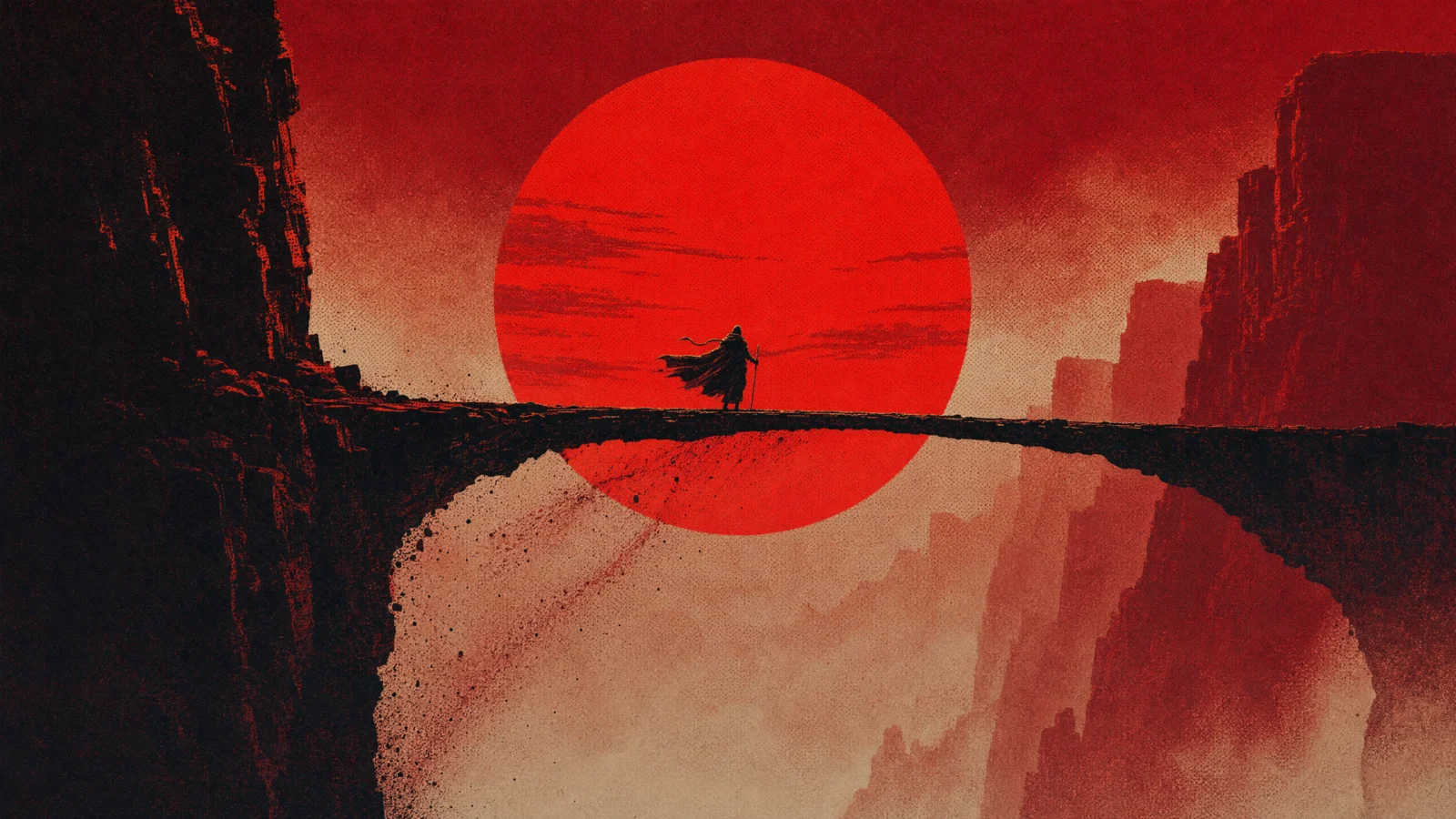
The tension chapter, and the boldest composition trick in the category: the figure crosses directly in front of the sun’s face, pure silhouette on a lit disc. This is a classic graphic design move and the model lands it because the prompt states the geometry plainly: "the figure and the stone span cross its face as pure silhouette." When you want a striking composition, describe the geometry, not the drama.
What to steal from this one: silhouette-on-disc. Put any subject between the camera and a giant lit circle (sun, moon, portal, screen) and you get an instant poster.
Swap ideas: rope bridge between two towers. A causeway through water with the sun’s reflection doubling the disc. A ladder up a cliff face crossing a pale moon instead.
Prompt 4: The Storm Wall
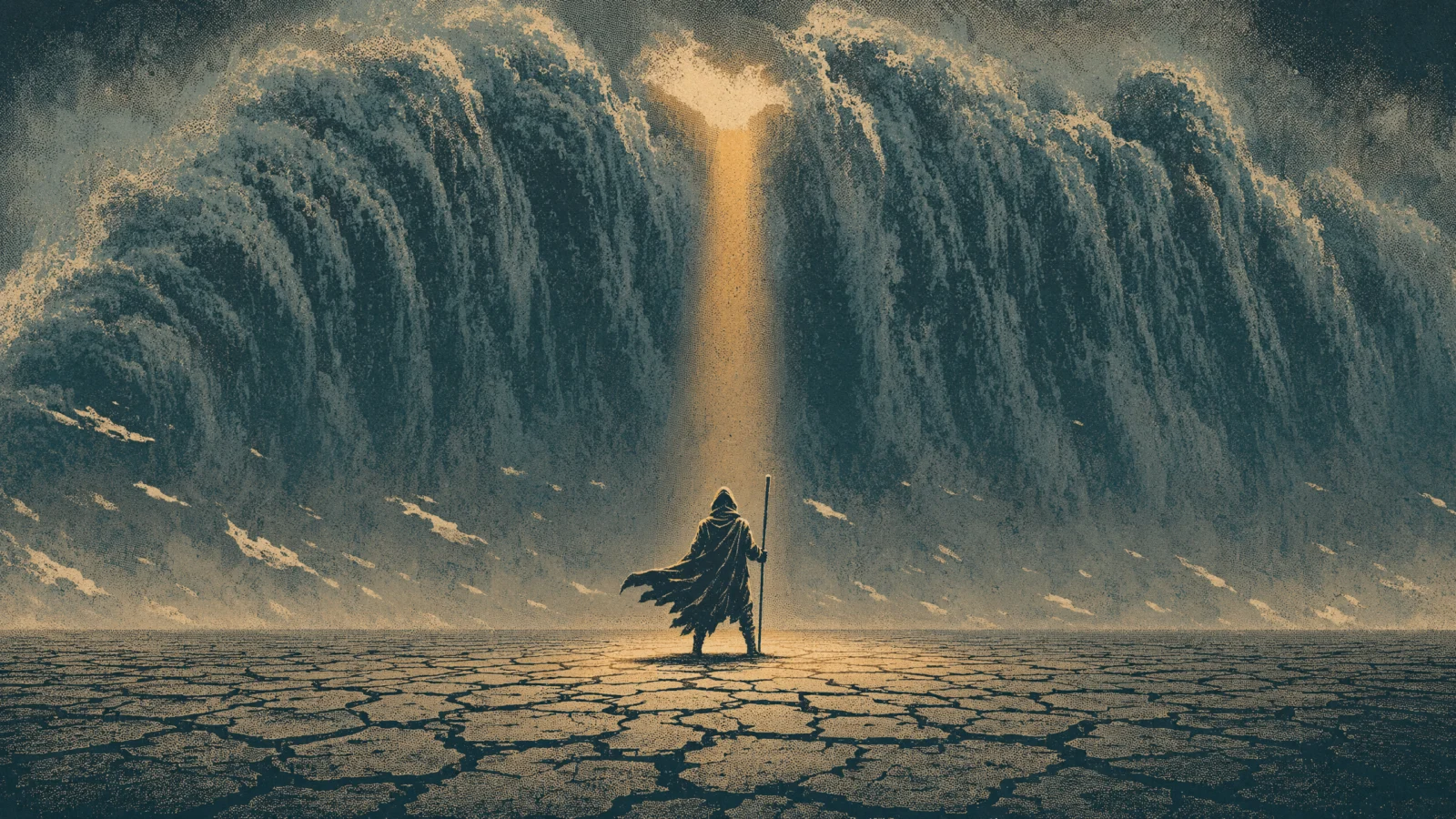
The power chapter. This is the prompt where the environment becomes an antagonist. Two techniques carry it. First, the storm is given a shape, "curling like a frozen wave," because AI renders vague weather as fog; a named shape renders as a wall. Second, the single light beam landing on the traveller. One warm beam in a cold frame instantly marks the figure as the subject and adds hope to a threatening image. That beam is the emotional turn.
What to steal from this one: the one-beam spotlight. Any time your figure is getting lost in a busy frame, cut one beam of accent light onto them and only them.
Swap ideas: tidal wave instead of dust storm. A wall of glacier ice mid-collapse. Swarm version, a wall of birds or machines, keep the beam.
Prompt 5: The Follower
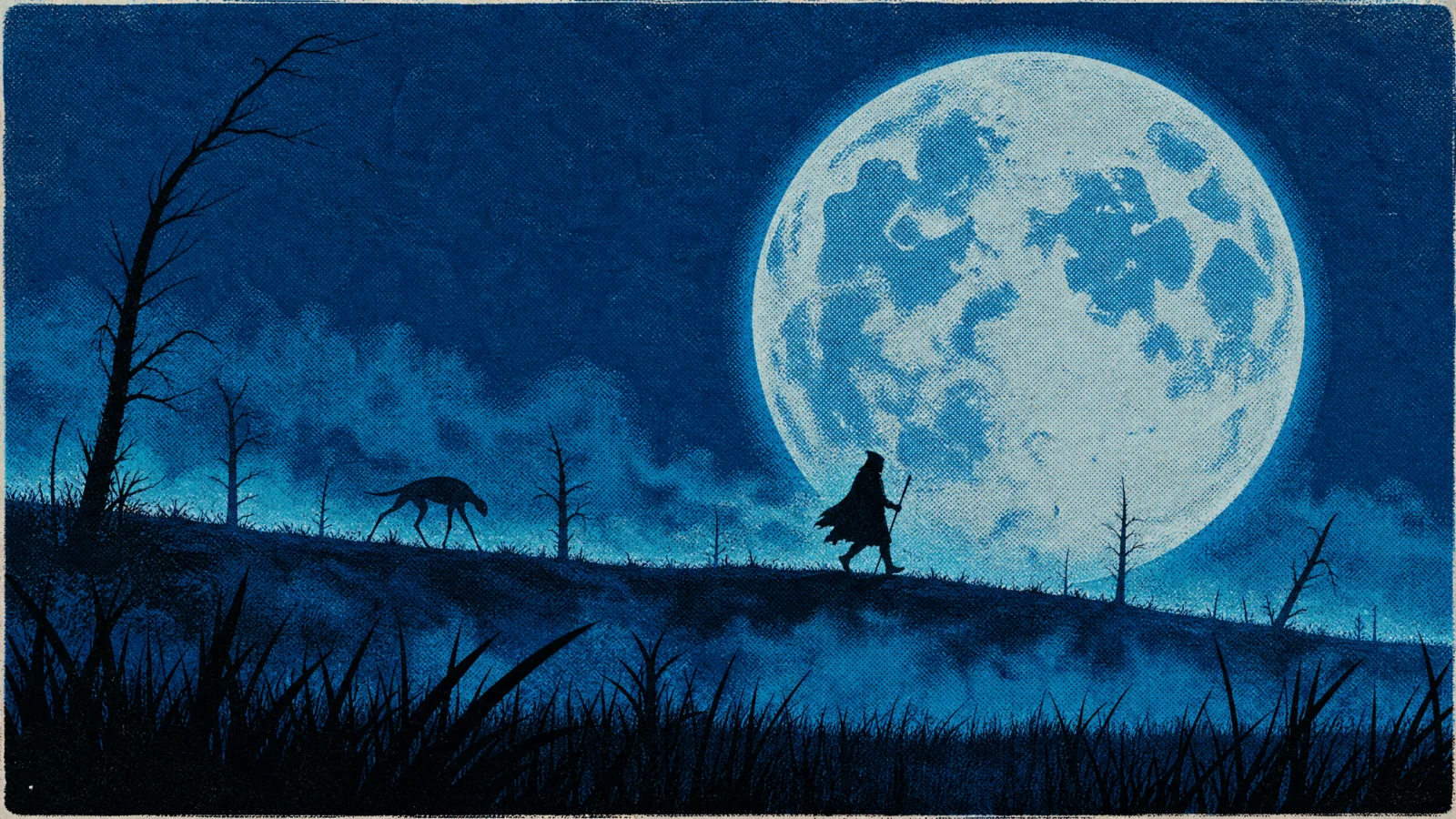
The story chapter. Adding a second figure changes everything, and this prompt shows how to do it without breaking the style: the second figure is also a silhouette, described by shape only ("a four-legged creature with too-long limbs"), and connected to the first by rhythm ("matching the traveller’s pace"). Wrong proportions on a silhouette are unsettling in exactly the right way, and the mist drifting between the two figures turns empty distance into tension.
What to steal from this one: describe creatures by silhouette and proportion, never by species detail. "Too-long limbs" does more work than three sentences of anatomy, and the model cannot ruin what it never has to draw.
Swap ideas: the creature walking ahead as a guide instead of behind. A drone hovering at matched pace. A child-sized second silhouette for a completely different emotional read.
Prompt 6: The Arrival
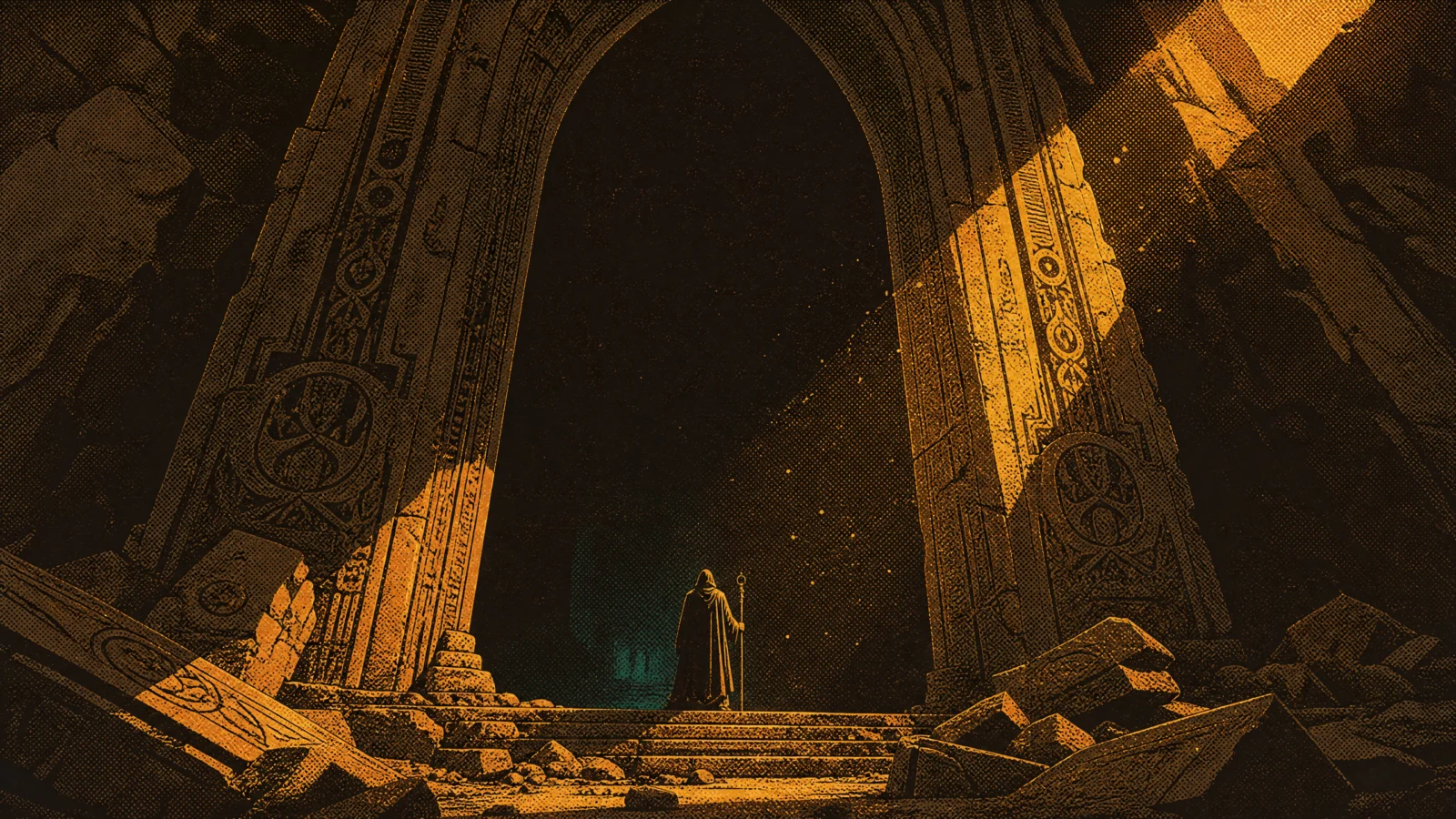
The closing chapter and the most architectural prompt in the category. Everything the vault teaches lands here: extreme scale ("the figure fits inside the arch a hundred times over"), a light event with a named shape ("a blade of late golden sunlight cuts diagonally"), and a story hook for the next category, the faint teal glow deep inside the dark. That glow is one accent colour doing the work of an entire plot.
What to steal from this one: the mystery accent. Place one small cold light deep inside your darkest area. It pulls the eye, implies a story, and costs you nothing but one palette slot.
Swap ideas: a colossal door in a glacier. The open mouth of a giant statue. An elevator shaft into the earth with the glow rising from below.
Fixes If A Render Drifts
- Too glossy or 3D: the PRINT FINISH block got overpowered. Move it directly under the first line of the prompt and add "risograph print style" at its start.
- Extra colours creeping in: move the PALETTE block above SCENE. Position in the prompt equals priority in the render.
- Figure too big: strengthen SCALE ANCHOR with "occupying less than one twentieth of the frame height."
- Flat and lifeless: your DEPTH block lost its airborne element. Every frame needs dust, mist, or sand drifting between planes.
- Face appearing on the figure: add "hood shadow fully covering the face" to FIGURE and keep "faces visible" in DO NOT.
Next Step
Category 2: The Colossus is next. The traveller found the gate. Now we build what is on the other side: megastructures, buried monuments, and ruined giants, and the scale gets even bigger.
Tools used in this lesson:
OpenArt powers everything we build with GPT Image 2. Code DigiAI gets you 15% off plus 100 free credits: https://openart.ai/?via=digiAI
Creative Fabrica Studio for design assets and print mockups, free trial plus bonus credits:
https://www.creativefabrica.com/studio/ref/24136043
insMind for quick edits and cutouts, free credits here: https://www.insmind.com/
Section 02
Category 2: The Colossus
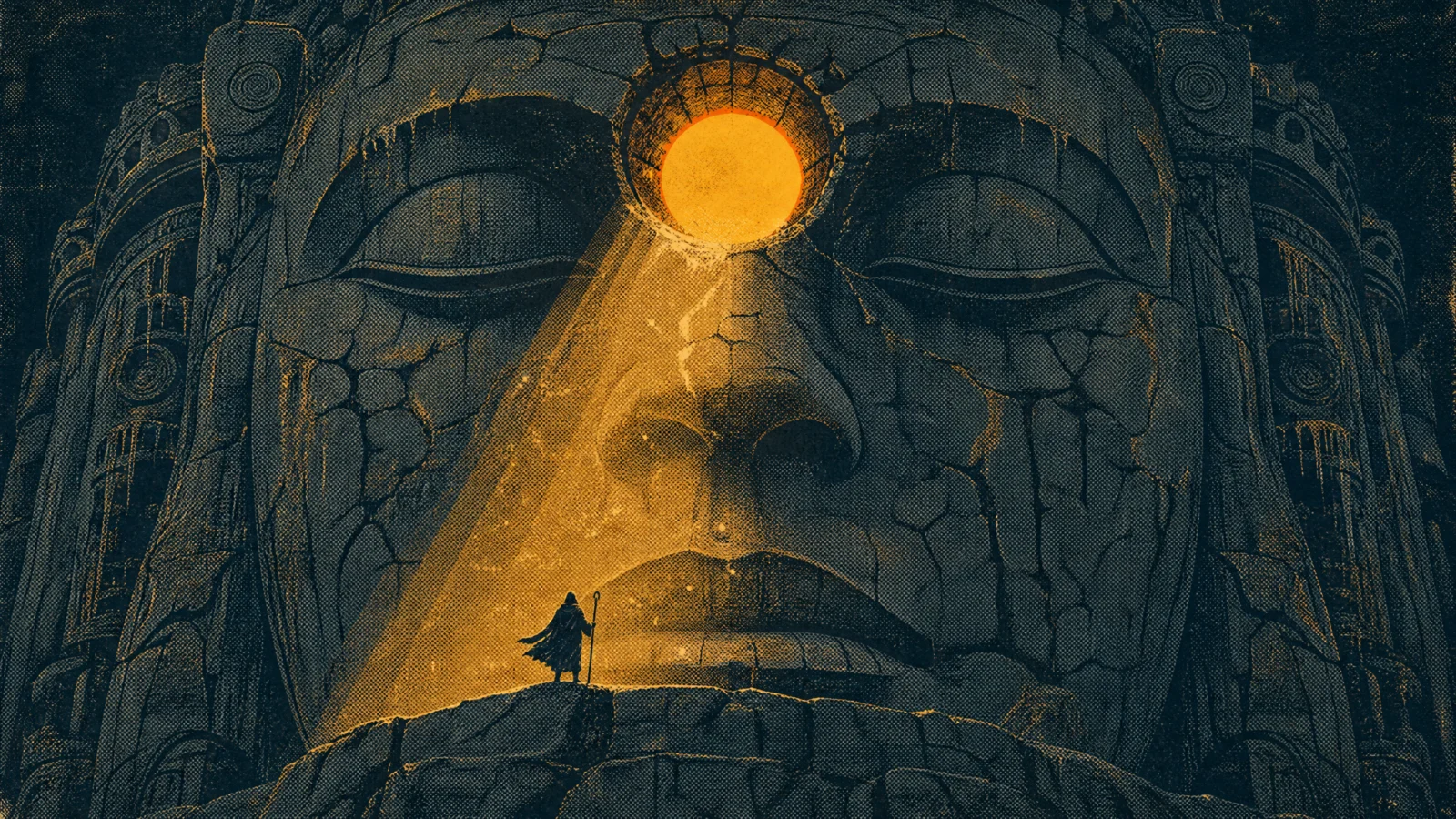
Through the gate, the world gets bigger.
Category 1 taught you the traveller. Category 2 teaches you the giants: megastructures, buried monuments, hanging cities, and one colossus that refuses to stay a ruin. The traveller stays tiny in every frame, but now the subject is the thing that dwarfs them. This is the category where you learn to make AI render true monumental scale, which is one of the hardest things to get out of any image model.
All 6 prompts run on GPT Image 2 on OpenArt, 16:9, animation-ready. Same seven-block spine as Category 1. If you have not read the "How These Prompts Work" section on the Pilgrim page, start there. This page builds on it.
What This Category Teaches
Category 2 is a masterclass in one skill: forcing scale.
AI models constantly shrink big things. Ask for a colossal statue and you get a garden ornament. The prompts in this category beat that with three techniques working together, and once you see them you can apply them to anything:
Comparison anchors. Every SCALE ANCHOR in this category compares the traveller to a small part of the big subject, never to the whole. "Smaller than the statue’s eyelid." "Smaller than a single dark window." "Smaller than the carved base ring of a single pillar." Comparing to a sub-part multiplies the implied size, because the viewer’s brain does the rest of the math. This is the single most reusable trick on this page.
Frame overflow. Big things must break the frame. The ceiling is "lost above the frame," the face "runs the full width of the frame," the city "spans the whole width of the sky." If a structure fits comfortably inside your composition, it reads as a model on a table. Let the frame cut it.
Sub-part counting. "A thousand such steps." "Dark windows by the thousand." "A hundred travellers." Numbers of repeated parts give the model a density instruction and give the viewer a scale ladder to climb. One line, massive effect.
Steal all three for any prompt where something needs to feel enormous: buildings, ships, creatures, machines.
The Swap Rules for This Category
Same spine as Category 1, with two extra rules for monumental work:
- Swap the structure, keep the geometry. A hall of pillars can become a hall of engine columns. A stone ring can become a broken dam. What must survive the swap is the geometric idea (rows, circle, stairway, suspension), because the geometry is what composes the frame.
- Always anchor scale to a sub-part. When you invent your own colossus, write your SCALE ANCHOR against its smallest named detail: a rivet, a step, a window, a fingernail. Never "the traveller is small next to the giant structure." That line does nothing.
- Everything else follows the Category 1 rules: silhouette figure, four named colours, PRINT FINISH untouched, MOTION SEED always written.
Prompt 1: The Hall of Pillars
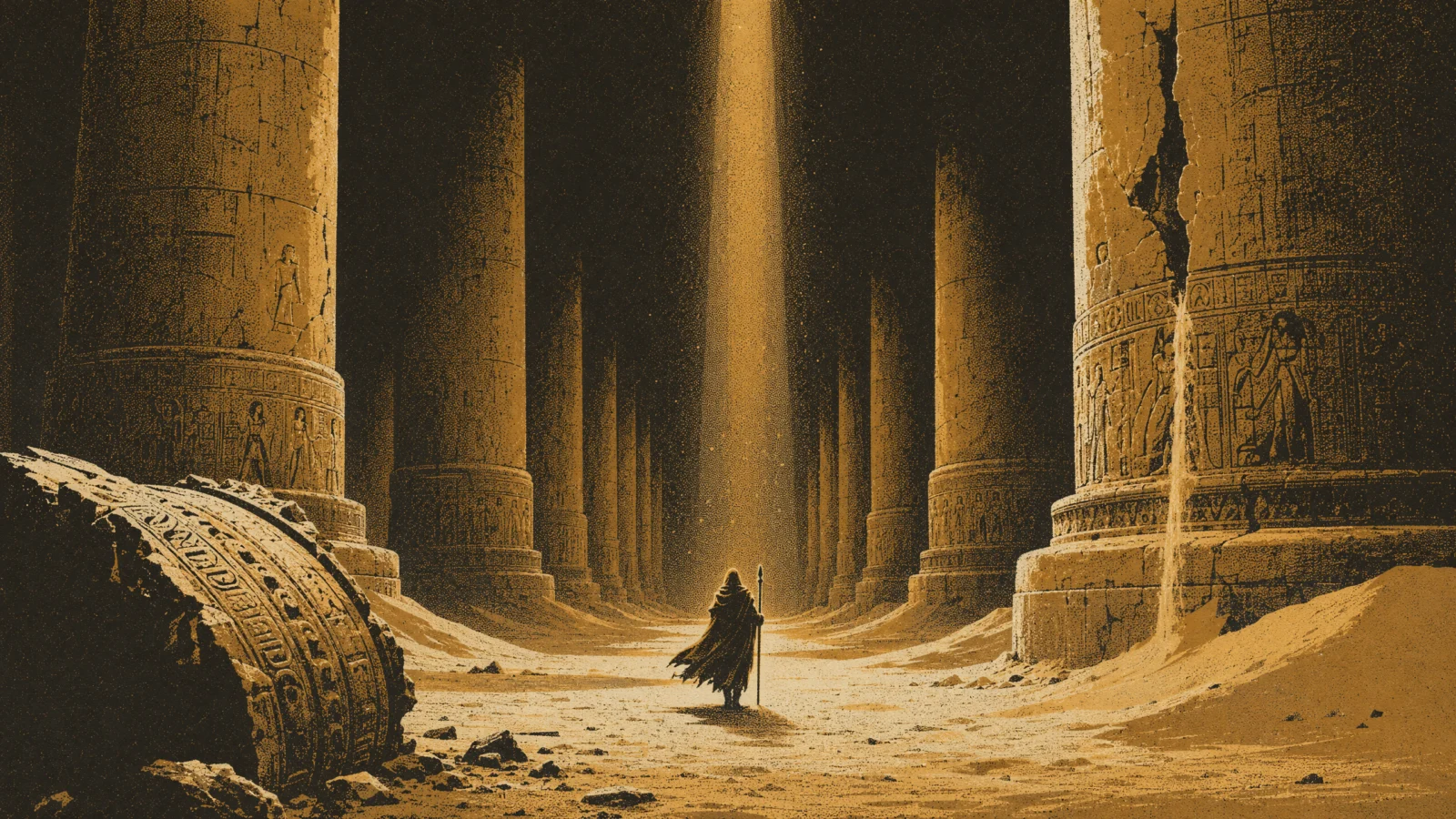
The interior chapter, and the direct continuation of The Arrival from Category 1. The traveller walked through the gate; this is what is inside. The composition trick here is light as a path: blades of daylight land in fading intervals down the aisle, each pool one step deeper into the dark. The lighting literally draws the route the traveller will walk, which pulls the viewer’s eye the same direction. When you need to lead an eye through depth, place repeating light pools at decreasing intensity.
What to steal from this one: the fading interval. Any repeated element (lights, arches, pillars, windows) rendered at decreasing brightness or size builds instant depth and story direction.
Swap ideas: a hall of colossal rusted engine columns in a dead ship. A flooded pillar hall with the traveller wading, light blades hitting the water. A library version, shelves instead of pillars, each shelf a cliff face.
Prompt 2: The Sleeper in the Sand
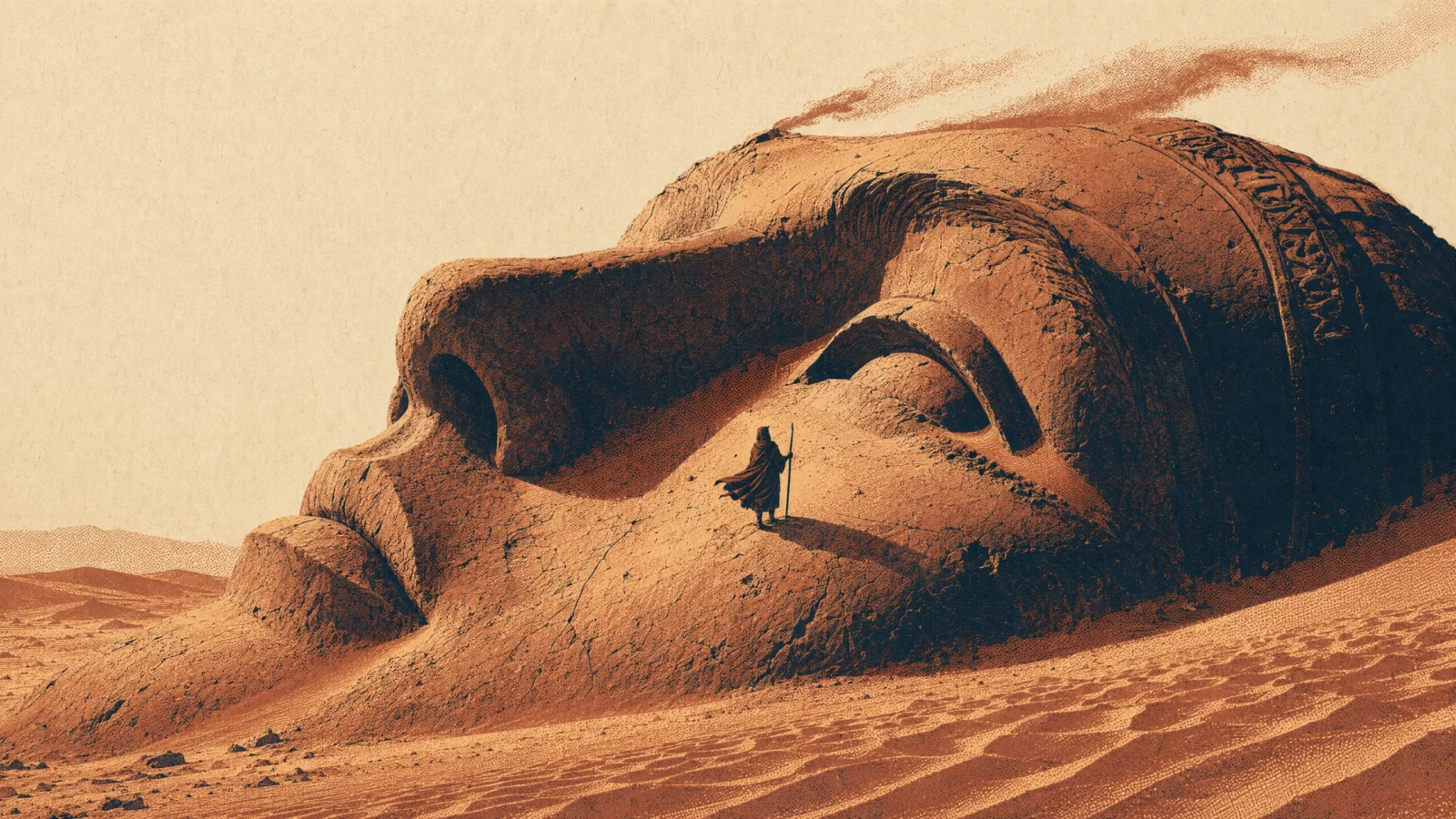
The mortality chapter. A fallen giant statue, face in profile, half swallowed by desert. The technique to study is raking light on carved detail: the low sun crosses the face from frame left, and every feature (nose, brow, lips) casts its own long shadow band. Side-light is how you make stone read as stone. Overhead light flattens carving; raking light carves it twice.
Also note where the traveller stands: on the statue’s cheekbone, not beside it. Placing the figure on the colossus instead of next to it forces physical contact between the scales, and the size reads instantly.
What to steal from this one: put your small figure on the big subject. Standing on the hand, the roof, the eyelid. Contact beats proximity every time.
Swap ideas: a fallen giant robot head with one dead eye lens. A whale skeleton breaching the dune instead of a statue. A colossal crown half buried, the statue’s head long gone.
Prompt 3: The Stairway
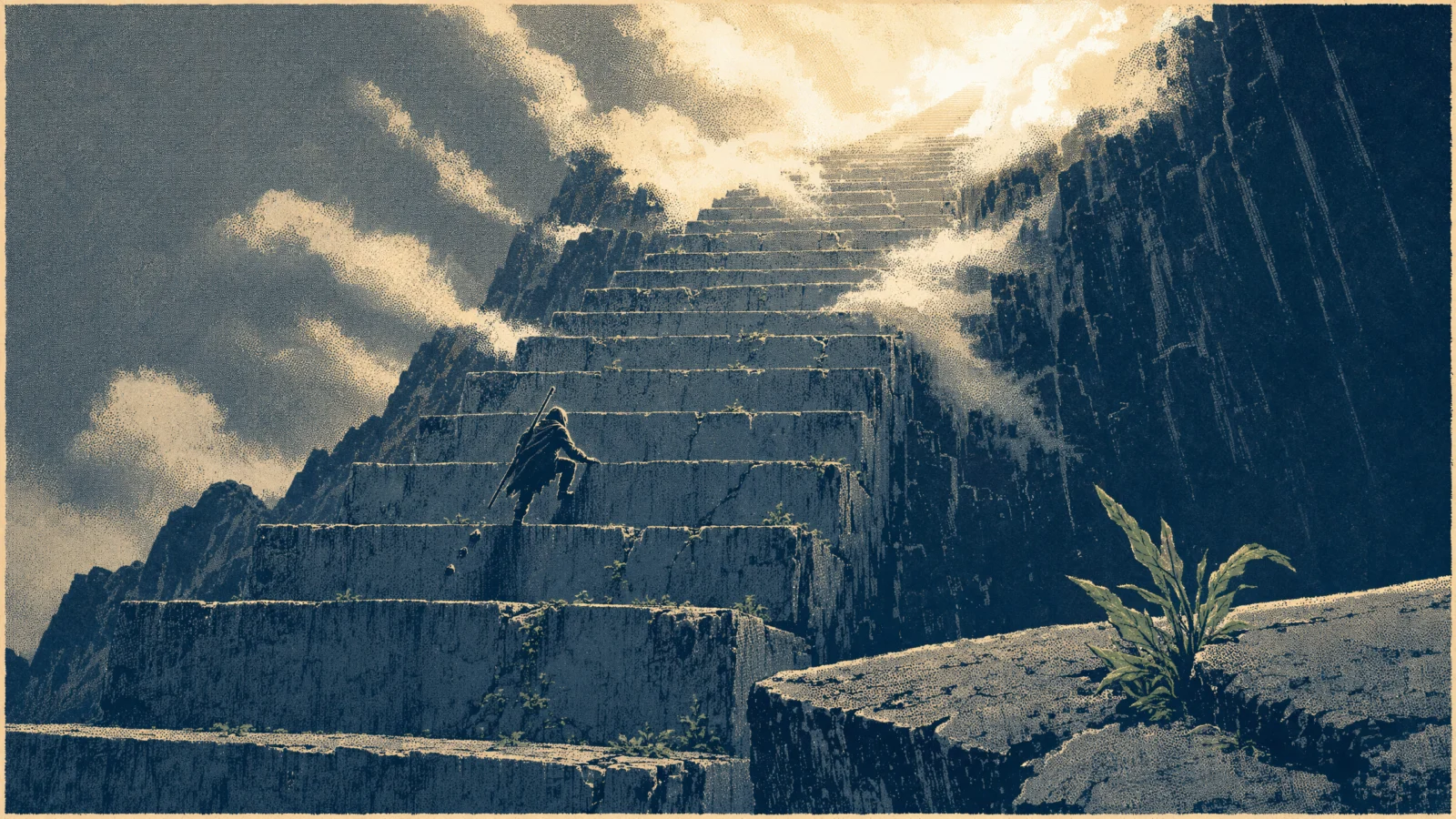
The endurance chapter. One geometric idea, a stairway where each step is taller than a person, carried by one light idea, glow bleeding down from a burning cloud layer. This prompt teaches the hidden light source: the sun never appears, only the cloud it burns behind. Hiding the source and showing its effect is more atmospheric than showing the source, and it gives you a natural brightness gradient down the frame, bright at the top, cold at the bottom, matching the emotional structure of a climb.
Note also the fourth palette slot spent on "one muted sage green in the cracks." One tiny life colour inside a dead palette makes the whole world feel real without breaking the four-colour rule.
What to steal from this one: the hidden source gradient, and the one-life-colour trick for dead worlds.
Swap ideas: a spiral stair wrapping a colossal tree trunk. Steps carved into a glacier with blue ice glow. A ladder of chains up a fortress wall, same hidden light above.
Prompt 4: The Broken Ring
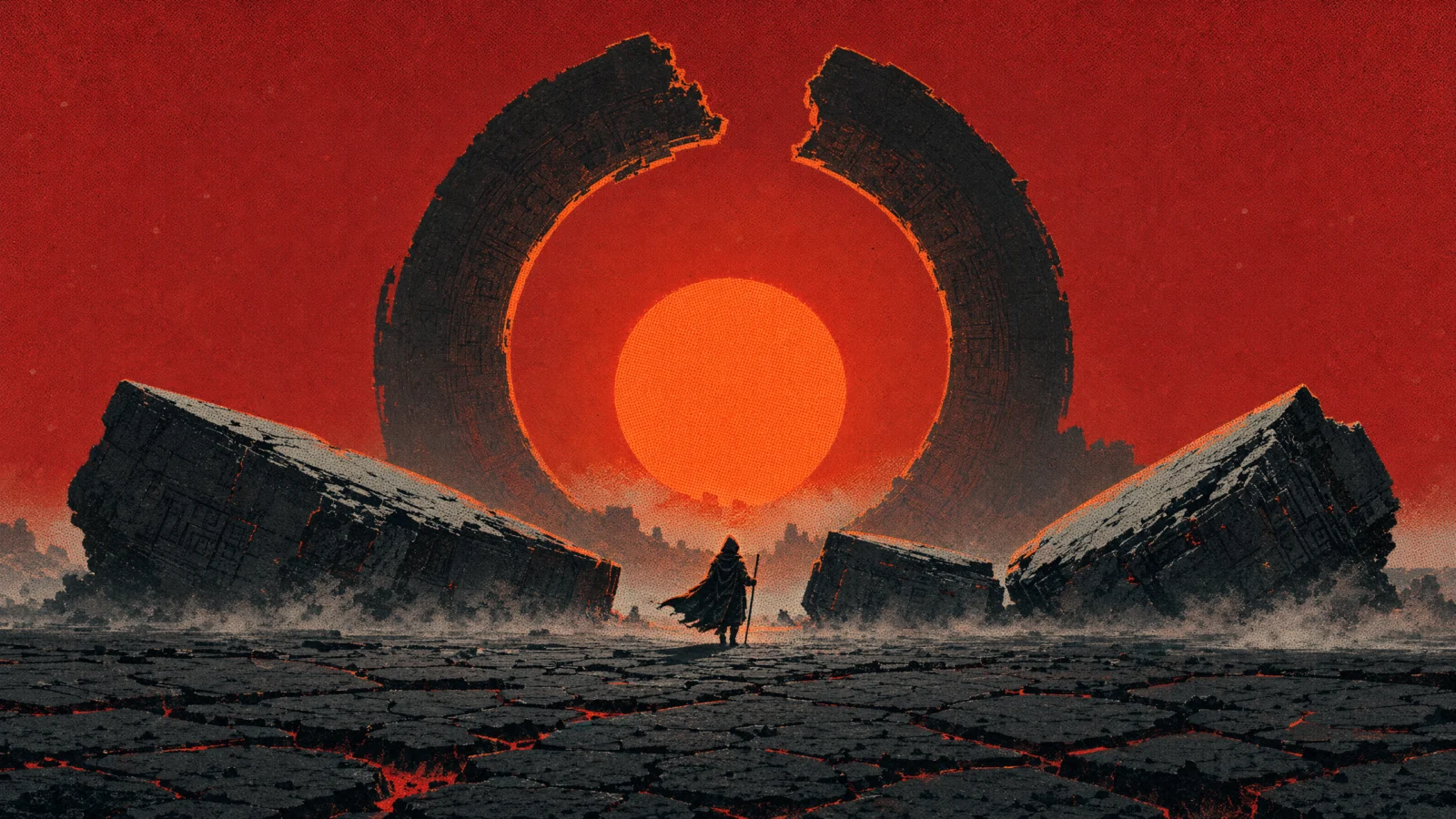
The silhouette chapter, and the Category 2 answer to The Crossing. Same silhouette-on-disc trick, but evolved: the sun now sits inside the broken structure, so the surviving arc frames the disc and the collapse becomes the story. This prompt teaches framing the light event with the subject. A circle around a circle is the strongest version, but any structure that wraps the light source (arch, gate, ribcage, window) inherits the effect.
The fallen segments do a second job: they carry the scale across the plain. One big object reads big once; a trail of its broken pieces reads big everywhere the eye lands.
What to steal from this one: wrap your structure around your light source, and scatter debris to spread the scale across the whole frame.
Swap ideas: a broken dam with the sun in the breach. A shattered dome, half standing, sun in the missing half. A colossal keyhole gate with the sun as the key.
Prompt 5: The Hanging City
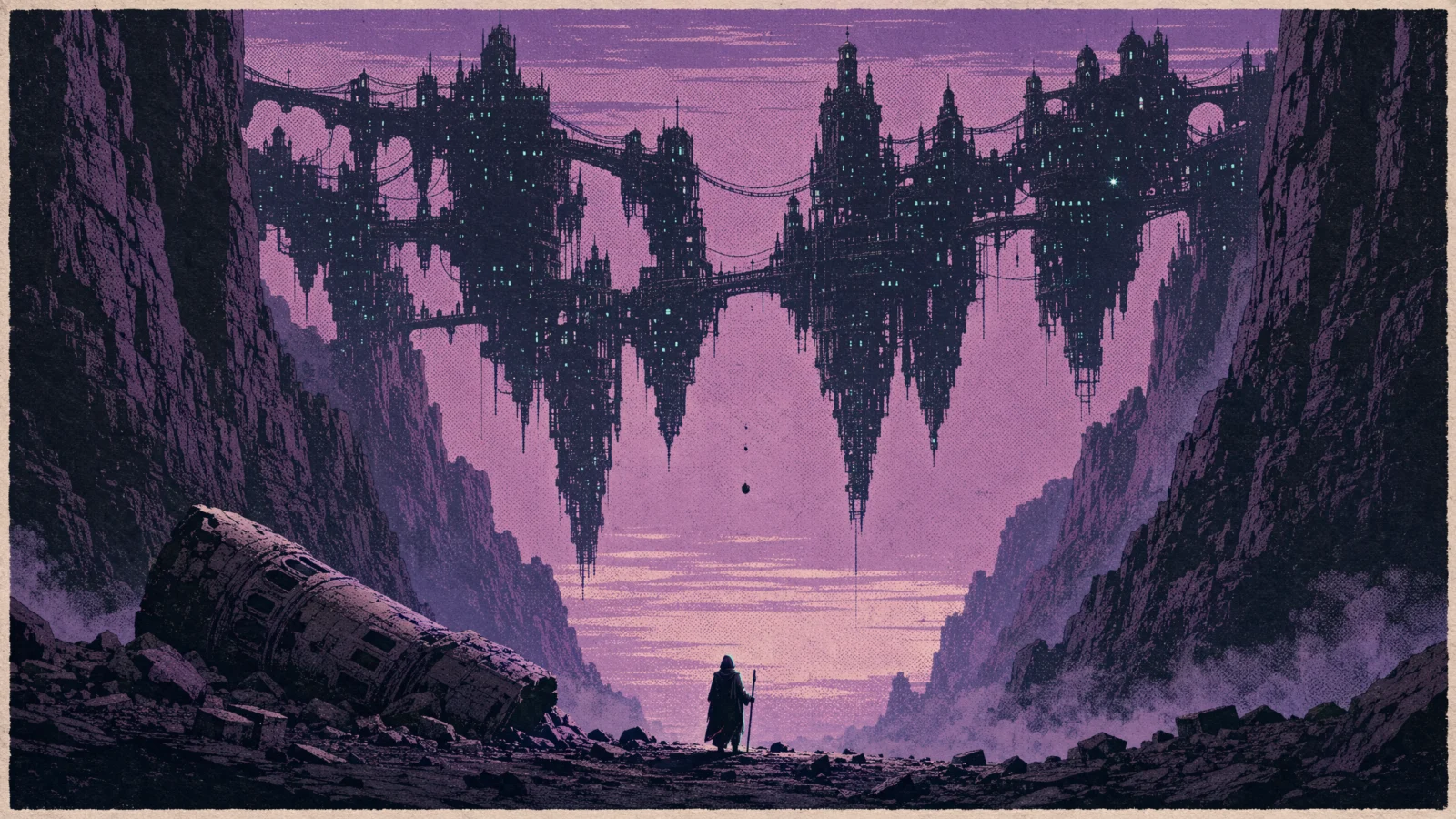
The wonder chapter, and the most complex structure in the vault so far. A ruined city suspended between canyon walls, towers hanging under the bridge spans like stalactites. Two lessons here.
First, describe impossible architecture by physical logic, not by style words. "Built across a web of massive stone bridges and cables, towers hanging beneath the spans" gives the model an engineering rule to follow. "Fantasy floating city" gives it nothing and you get generic art.
Second, the scattered teal window lights. Against the layered violet silhouette, a few dozen faint points of light are the entire narrative: someone lit those once. This is the mystery accent from The Arrival scaled up to a whole city, still costing only one palette slot.
What to steal from this one: invent structures with a physics sentence, then spend your accent colour on the smallest possible evidence of life.
Swap ideas: a city hanging from the underside of a floating landmass. A shipwreck fleet suspended in colossal chains between sea stacks. An orbital ring city seen from the ground at dusk, lights still on.
Prompt 6: The Waking Giant
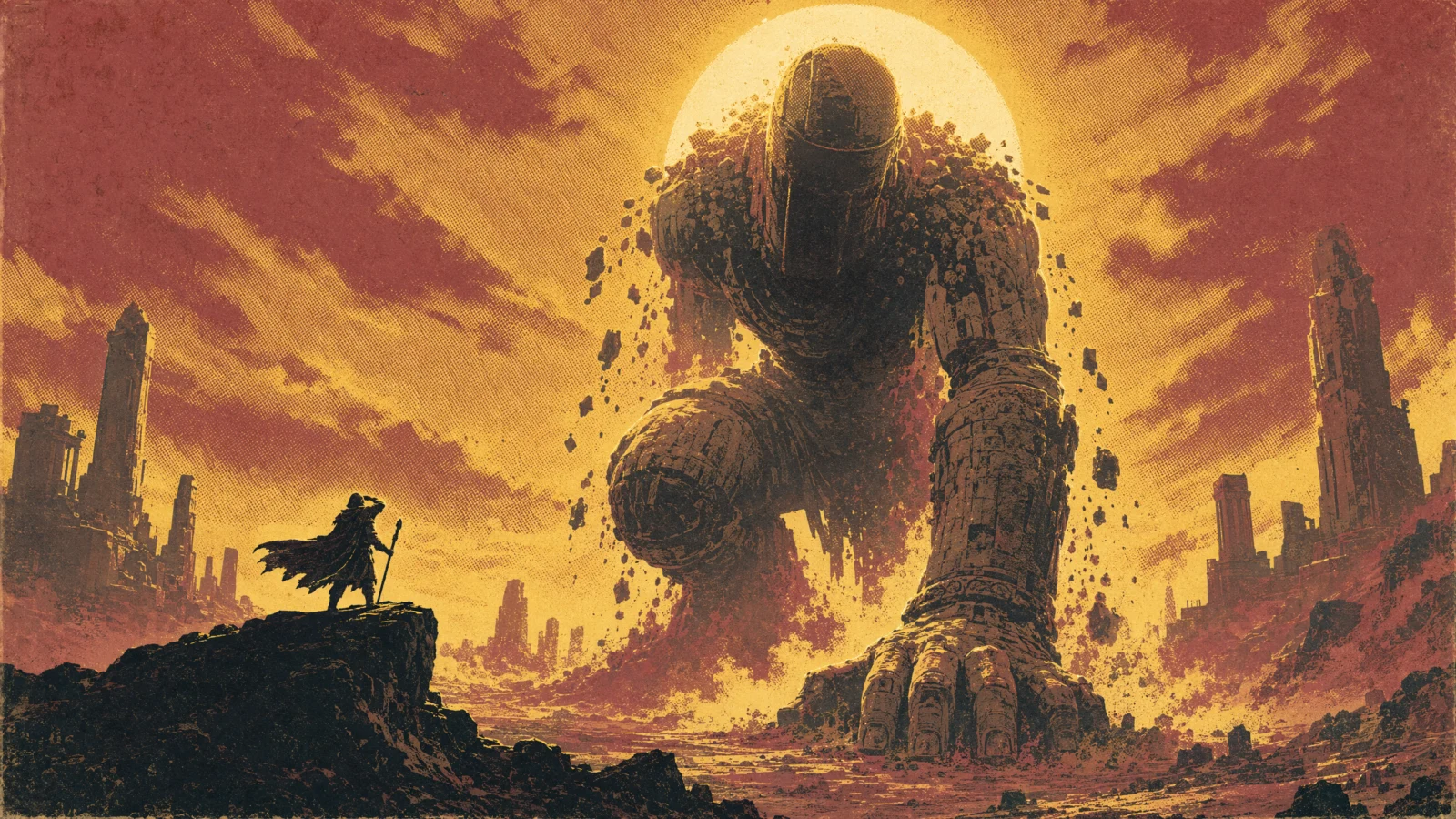
The money shot of the category. Everything moves: a colossal stone giant rises onto one knee, soil cascades off its shoulders, the dawn sun burns directly behind its head as a halo, and the traveller’s cloak snaps back with the shockwave. This is the frame that becomes the trailer moment when we animate this vault.
Two techniques carry it. The halo backlight: placing the sun directly behind the giant’s head keeps its face in shadow (mystery preserved, and the model never has to render a face it would ruin) while edging the whole figure in gold. And frozen cascade: debris caught mid-fall is the strongest motion seed in the entire vault, because falling material reads as this-exact-second, turning a still image into a paused film.
Note the extra DO NOT line: "the giant’s face detailed or human." Silhouette discipline applies to giants too. The moment the model draws a readable face, the mystery dies and the uncanny risk spikes.
What to steal from this one: halo backlight for any awakening or reveal, frozen falling debris for instant motion, and always DO NOT the faces you do not need.
Swap ideas: a colossal machine powering on instead of a stone giant, one teal eye igniting. A giant rising from the sea, water cascading instead of soil. A buried titan only lifting one hand, the rest still underground, sun behind the fingers.
Fixes If A Render Drifts
All Category 1 fixes still apply (glossy renders, extra colours, oversized figure, missing depth, faces appearing). Category 2 adds three of its own:
- Structure renders small or model-like: your SCALE ANCHOR is comparing to the whole instead of a sub-part. Rewrite it against the smallest named detail and add a frame overflow line ("the ceiling lost above the frame").
- Carved detail looks flat: your light is too frontal or too high. Move the sun low and to one side so it rakes across the surface. Raking light carves, overhead light flattens.
- Complex structure comes back as generic fantasy art: you described a style instead of a physics. Rewrite the structure as one engineering sentence: what holds what, what hangs from what, what broke.
Next Step
Category 3: Sky Objects is next. The giant is awake, and the traveller looks up: ringed planets, second moons, and things drifting through the clouds that are far too large to be birds.
Tools used in this lesson:
OpenArt powers everything we build with GPT Image 2. Code DigiAI gets you 15% off plus 100 free credits: https://openart.ai/?via=digiAI
Creative Fabrica Studio for design assets and print mockups, free trial plus bonus credits:
https://www.creativefabrica.com/studio/ref/24136043
insMind for quick edits and cutouts, free credits here: https://www.insmind.com/
Section 03
Category 3: Sky Objects
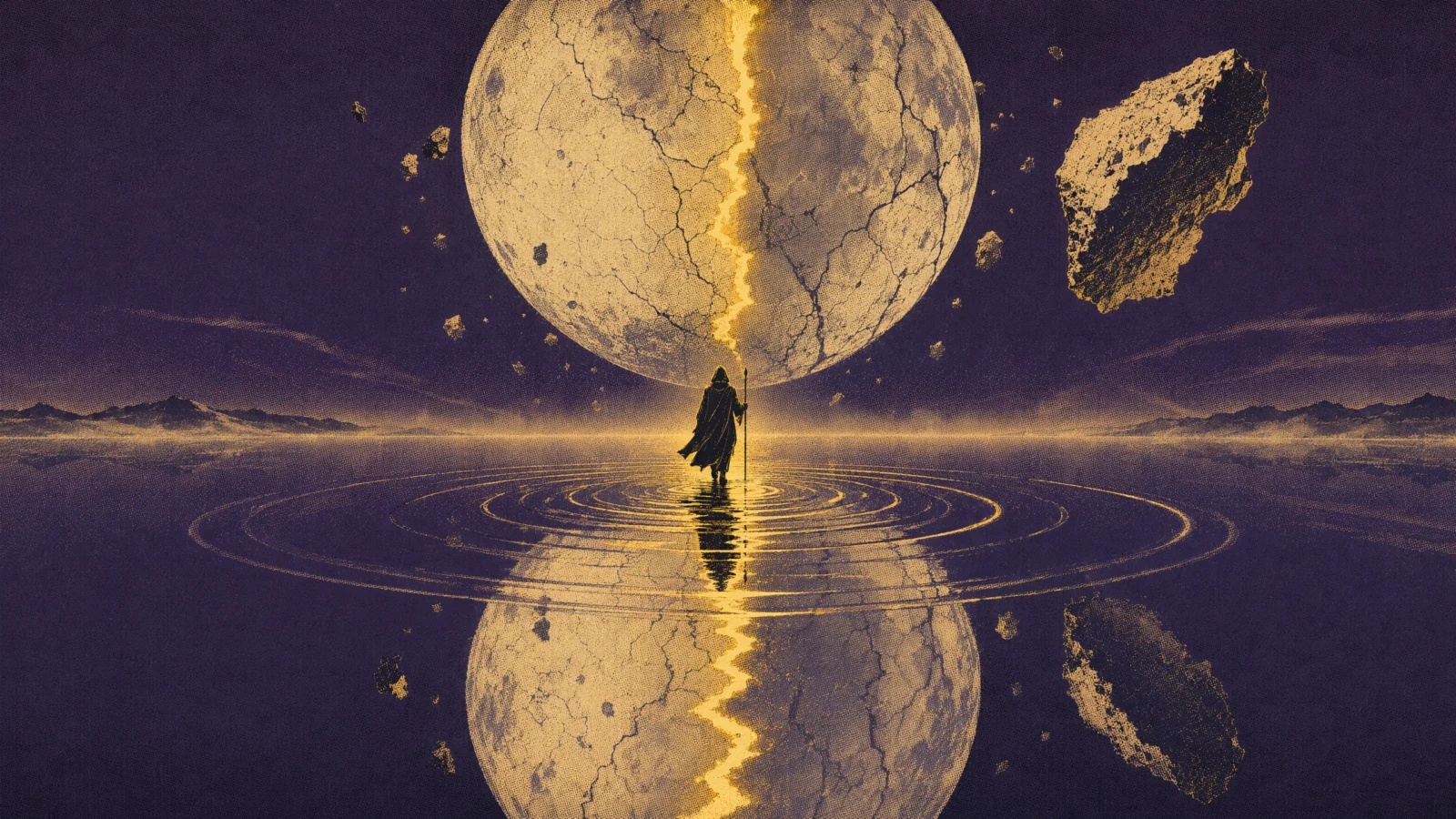
The traveller looks up.
Category 2 built the giants on the ground. Category 3 puts them in the sky: ringed planets in daylight, twin moons on black water, a leviathan crossing a cloud sea, and a dawn where the sky itself stands up. The ground stays deliberately simple in every frame, one plain, one lake, one beach, because in this category the sky is the subject and everything else is a stage for it.
All 6 prompts run on GPT Image 2 on OpenArt, 16:9, animation-ready. Same seven-block spine as Categories 1 and 2. If you are landing here first, read "How These Prompts Work" on the Pilgrim page before remixing.
What This Category Teaches
Category 3 is about one skill: making the sky carry the story.
AI models treat sky objects as decoration. Ask for a planet in the sky and you get a small tasteful circle in a corner. These six prompts beat that with three techniques, and each one is reusable far beyond this vault:
Sky objects get the same scale rules as ground objects. Every SCALE ANCHOR in this category compares the traveller to a sub-part of the sky object: a ring gap, a band ripple, the width of a burning trail. The sub-part comparison trick from Category 2 works exactly the same when the colossus is a planet. If it renders small anyway, add a frame-fraction line: "filling half the sky," "filling the upper two thirds of the frame."
The sky must touch the ground. This is the technique that separates these frames from wallpaper. In every prompt, the sky object physically affects the ground plane: the ring shadow lays a cool band across the plain, the moons lay light paths on the water, the falling star splits the desert into hot and cold halves, the ring rise paints stripes across the clay. A sky object that does nothing to the ground reads pasted on. A sky object whose light lands on the world reads real. Whenever you invent your own sky object, immediately ask: what does its light do to the ground?
Two temperatures beat one. Half the prompts in this category run a warm light against a cold light in the same frame: amber moon against white moon, ember trail against blue evening. One light temperature is a mood, two is a story. The limited palette makes this easy: spend two of your four colours on the two lights and let them fight.
The Swap Rules for This Category
Everything from Categories 1 and 2 still applies. Three additions for sky work:
- Swap the sky object, keep its ground effect. If you change the ringed planet to a shattered moon, rewrite what its light does to the plain. The object and its ground effect travel as a pair, always.
- Keep the ground simple. One terrain, one small landmark at most (a tree, a jetty, a ledge). A busy ground fights a big sky and both lose.
- Position the object off centre or breaking the frame. Dead-centre sky circles read like logos. Let the rings cut a diagonal, let the planet fill half the sky and bleed off the edge, let the trail run corner to corner.
Prompt 1: The Ringed Neighbour
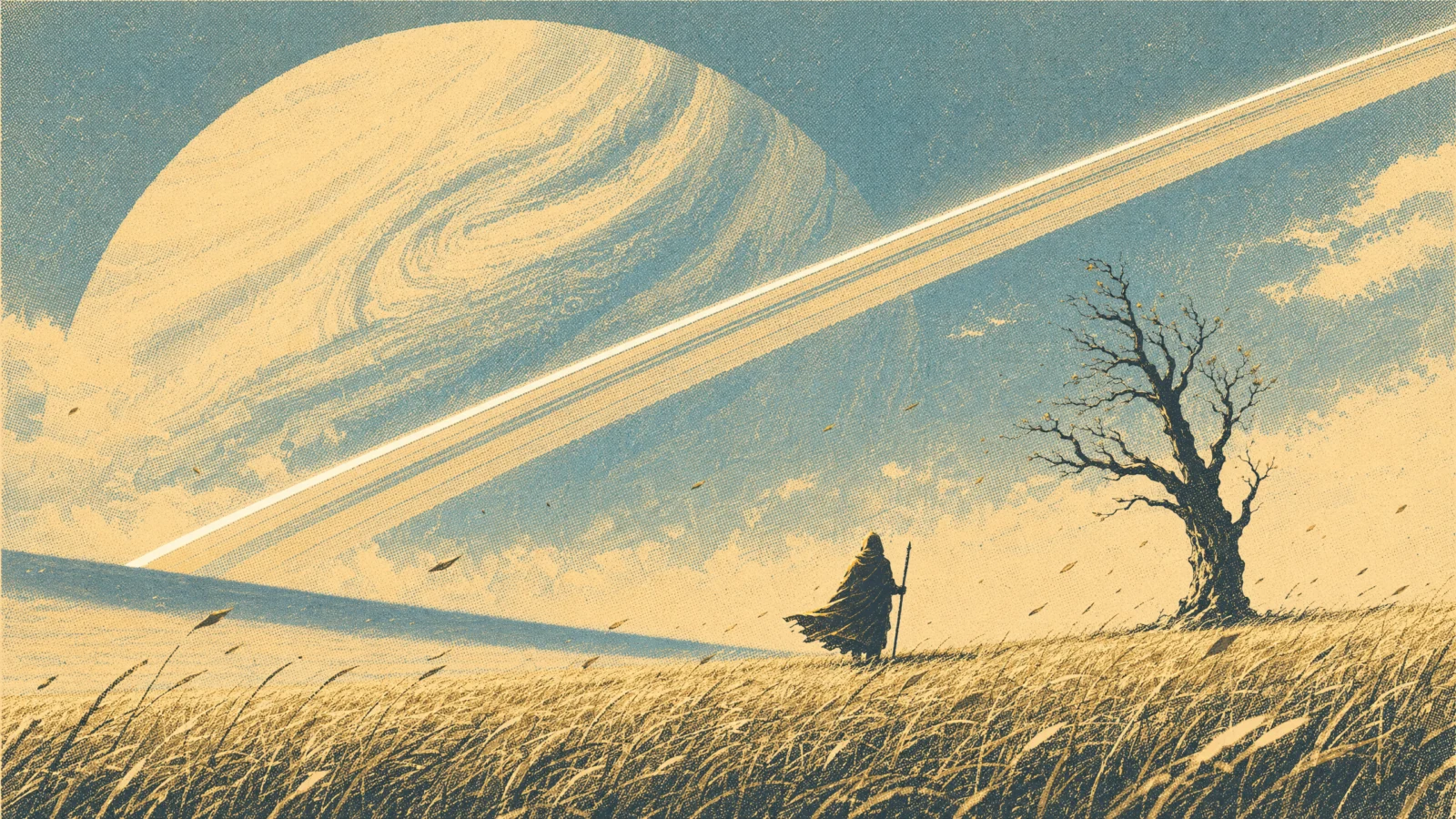
The daylight chapter, and the quietest frame in the whole vault so far. The trick worth studying is the daytime planet. Night skies with planets are everywhere; a colossal ringed planet visible through pale daylight, soft as a daytime moon, is the version nobody renders, and it instantly sells "another world" without a single dark pixel. The second detail doing quiet work: the ring shadow laying a faint cool band across the plain. That one line ties sky to ground and makes the planet physically present instead of painted on.
What to steal from this one: put your impossible sky object in full daylight. Soft, pale, half-transparent through atmosphere. It reads more alien than any night sky.
Swap ideas: a shattered moon in daylight, its fragments drifting in a slow arc. A second sun, small and cold, sharing the sky with the warm one. The same plain in snow, planet bands swapped to warm rust against a white world.
Prompt 2: The Two Moons
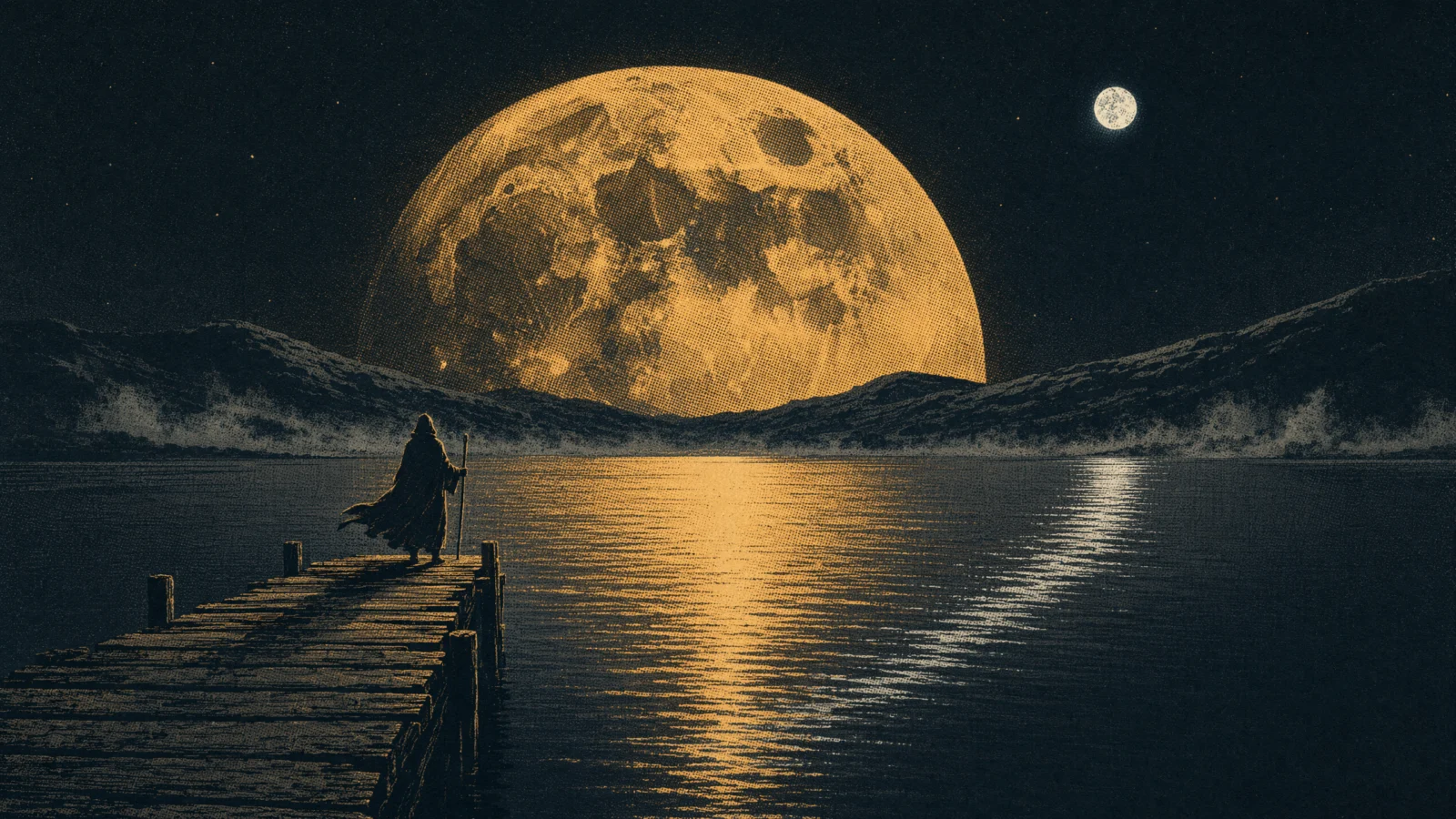
The stillness chapter, built entirely on the two-temperature technique. One huge amber moon low, one small white moon high, and the whole composition happens where their two reflected light paths cross on black water. Notice that the drama is not in the sky, it is on the lake: two lights, two temperatures, meeting on the water. When you have two light sources, always look for the surface where their effects can interact. That intersection is your image.
The jetty earns its place too. A narrow man-made line pointing into a vast natural scene gives the eye a runway and gives the traveller a stage. One small structure, placed at a frame edge, beats a whole village.
What to steal from this one: when you run two lights, stage their meeting point on a reflective surface. Water, wet sand, ice, glass. The crossing is the shot.
Swap ideas: three moons in a diagonal line, three crossing paths. The same lake frozen, light paths becoming glow trapped inside the ice. A hot spring version, steam rising through both light paths.
Prompt 3: The Leviathan
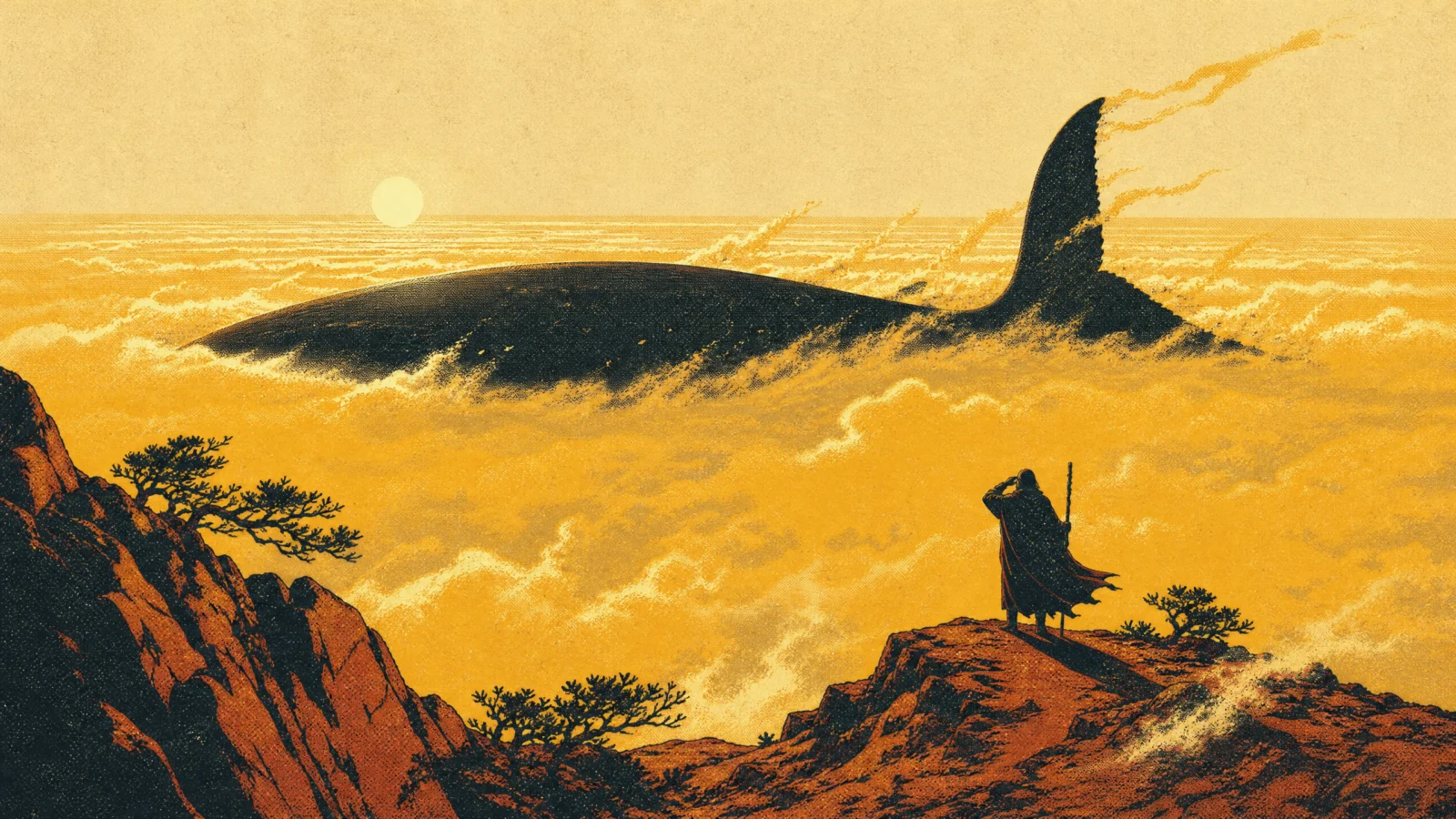
The wonder chapter, and the first living colossus in the sky. The core technique is the hidden mass: only the creature’s back and tail fin break the cloud surface, everything else stays below. This does three jobs at once. The cloud sea becomes an ocean (instant scale metaphor the viewer already understands), the hidden body makes the creature feel bigger than anything you could draw, and the model never has to render anatomy it would ruin. What you hide is doing more work than what you show.
Note the DO NOT line: "the creature’s face or eye visible." Same silhouette discipline as the giants and the traveller. A visible eye turns a leviathan into a cartoon whale in one stroke.
What to steal from this one: when rendering huge creatures, submerge most of them in something. Clouds, water, sand, fog. The surface break is the shot, the hidden mass is the scale.
Swap ideas: a pod of three, one huge and two small, breaking the clouds in a line. A colossal serpent through desert dunes instead of clouds, sand rolling off its back. A derelict airship half sunk in the same cloud sea, dead engines trailing vapour.
Prompt 4: The Falling Star
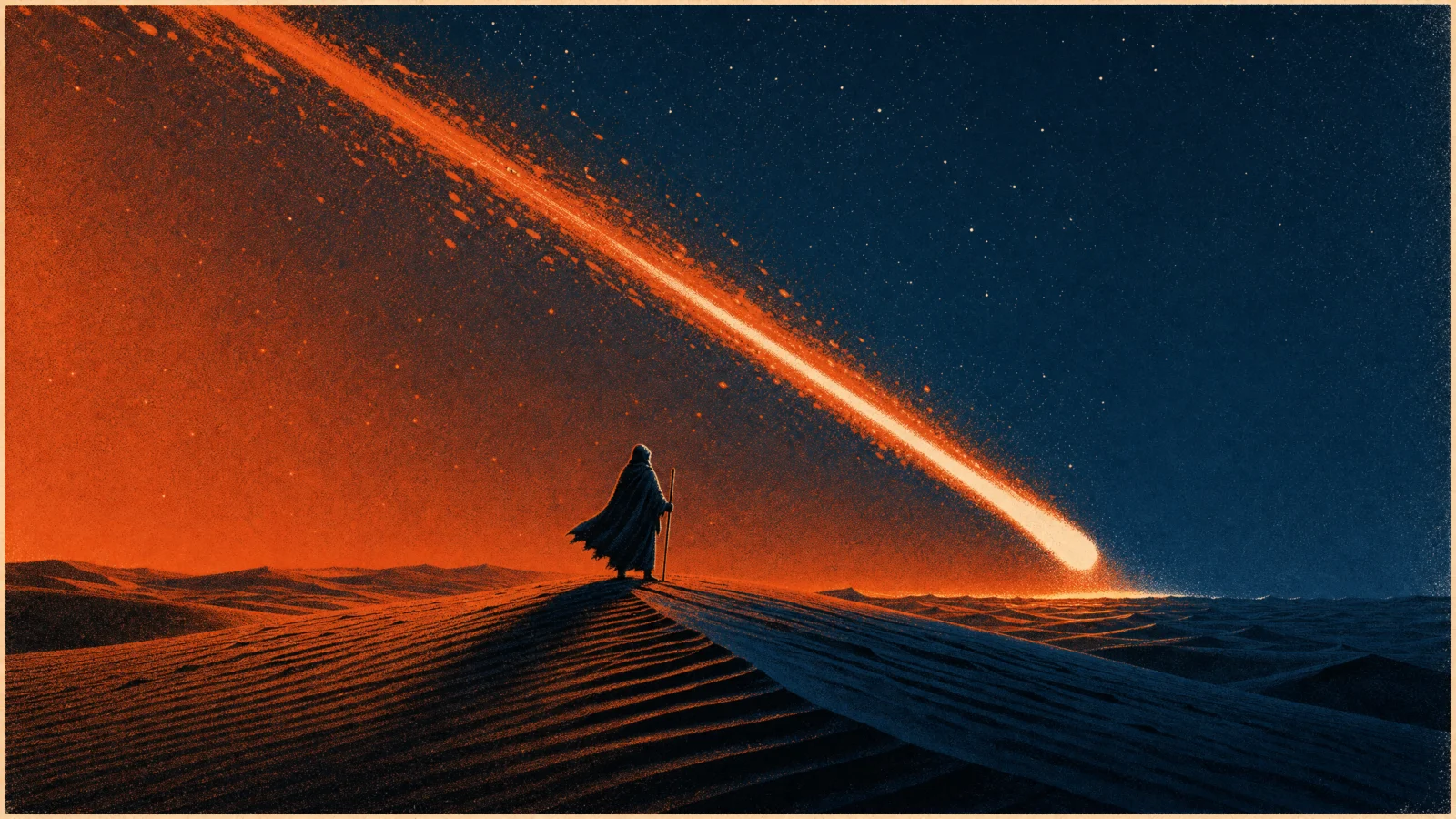
The event chapter, and the most technically ambitious light setup in the category. A single burning object splits the sky corner to corner, and the frame divides into a hot half and a cold half, with the split running across the traveller. This is the two-temperature technique pushed to its limit: instead of two lights meeting on a surface, one event cuts the entire world into two colour zones. The detail that sells it is the traveller’s shadow cast in two directions at once. One line, and the physics of the whole frame clicks.
The DO NOT carries a story rule: "explosion on the ground." The object must stay falling, frozen mid-event. The moment it lands, the image becomes an aftermath, and aftermath is a different (weaker) emotion than incoming.
What to steal from this one: let one event split your frame into two colour temperatures, and always freeze the event before its climax. Mid-fall beats impact. Incoming beats arrived.
Swap ideas: a slow ascending object instead, a launch trail climbing out of the frame. Dozens of small falling lines behind one huge one, a meteor storm with a leader. The trail reflected in a salt flat’s wet mirror, doubling the diagonal.
Prompt 5: The Eye of the Storm Planet
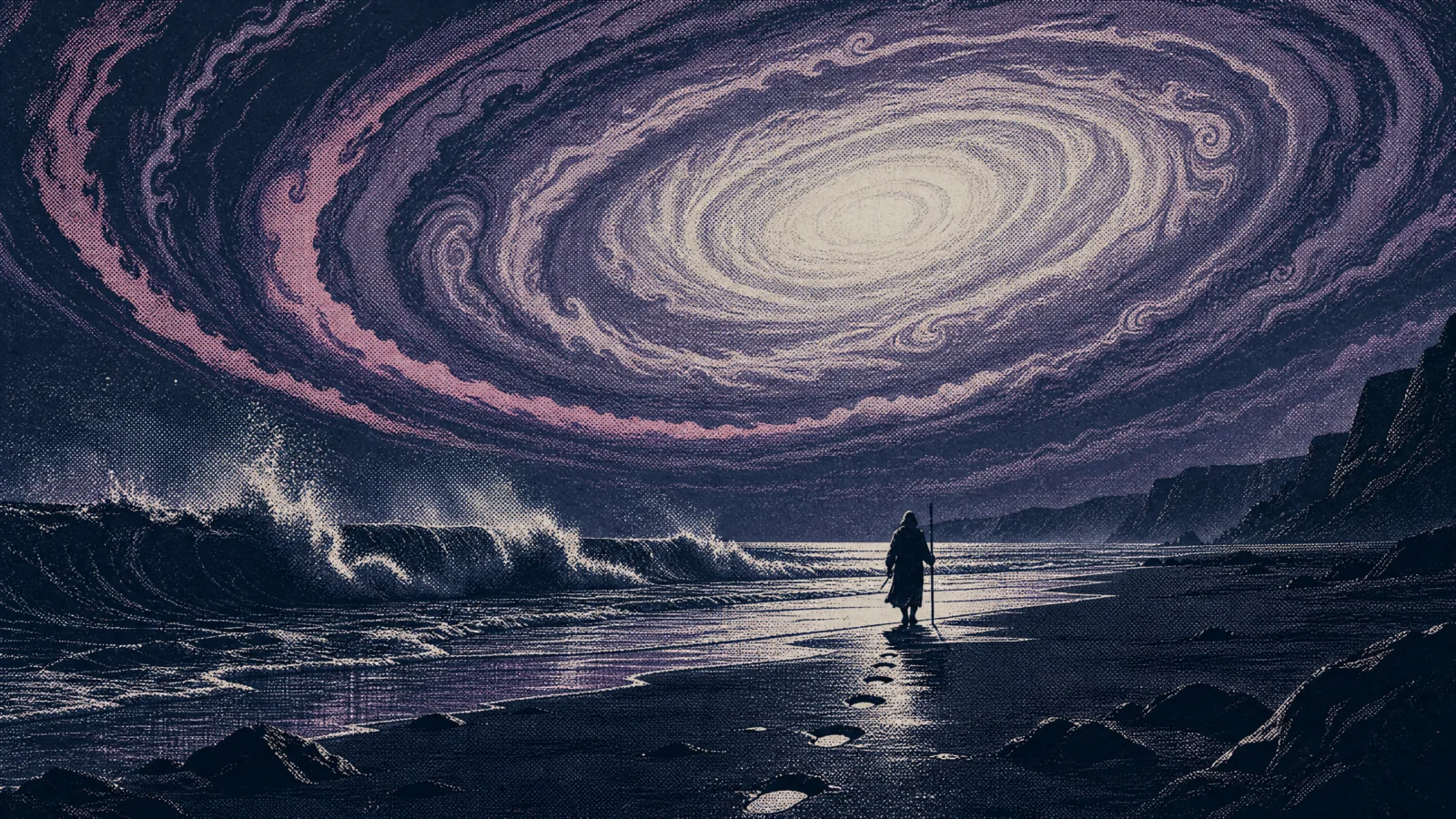
The pressure chapter. A gas giant fills two thirds of the frame, and its great pale storm oval sits just off centre like an eye looking down. The technique here is giving the sky a gaze. Nothing in the prompt says "watching," yet the frame feels observed, because an oval in banded surroundings reads as an eye to every human brain. You can weaponise this shape psychology anywhere: a round window in a dark tower, a break in the clouds, one glowing port on a hull.
The second layer is the silver sheen on the wet sand, with every footprint holding a small pool of light. The sky-touches-ground rule at its most intimate: a planet a million miles wide, present inside a bootprint.
What to steal from this one: shapes carry psychology. Ovals watch, diagonals move, verticals judge. And always land your sky light in one tiny human-scale detail, that contrast is the emotion.
Swap ideas: the same beach with the storm eye half set behind the sea, rising or sinking. A frozen shore, the eye light caught in ice sheets instead of wet sand. Two storm eyes, one bright one dark, for a completely different psychological read.
Prompt 6: The Ring Rise
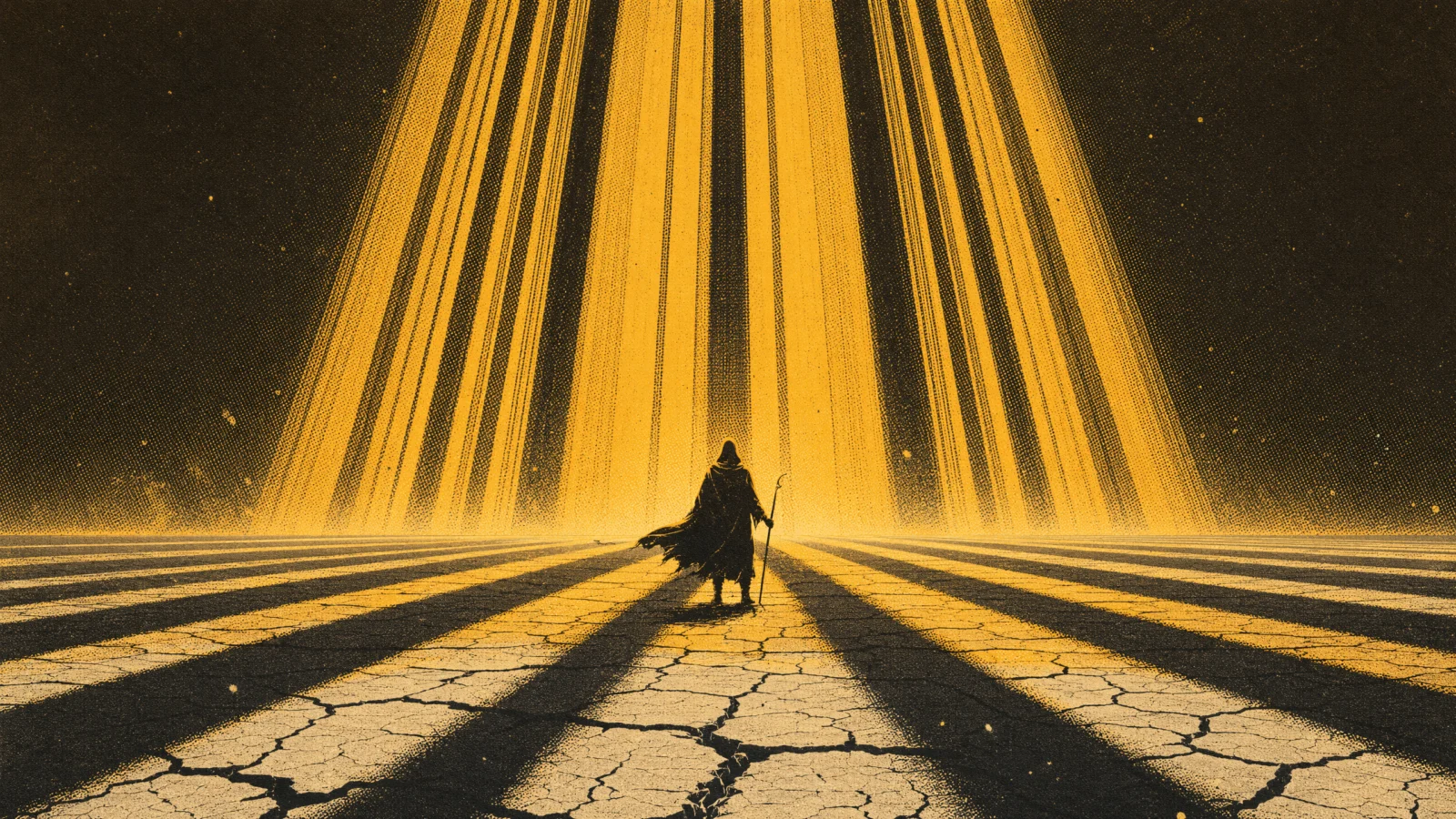
The money shot of the category, and the strangest frame in the vault so far: the planet stays hidden below the horizon and only its rings rise, edge-on, a single immense blade of light climbing out of the top of the frame. This is the partial arrival, the same power that drove The Waking Giant and The Falling Star: the event caught before its climax. A full planet on the horizon is a view. Rings with no planet yet is a promise, and promise out-pulls spectacle every time.
The light does the compositional work: dawn pours through the ring gaps and lays hard parallel stripes of gold and shadow across the entire plain and across the traveller. The whole world becomes banded. One light event restructures every surface in the frame, which is the sky-touches-ground rule at maximum volume.
What to steal from this one: hide the main object and show only its leading edge. And when your light source has structure (rings, blinds, lattice, branches), let its pattern print itself across the whole scene.
Swap ideas: the rings rising over a city ruin skyline instead of a bare plain, stripes falling across broken towers. A night version, the rings lit cold silver by an unseen moon. The traveller’s long shadow as the only dark stripe pointing toward the rings.
Fixes If A Render Drifts
All Category 1 and 2 fixes still apply. Category 3 adds four sky-specific ones:
- Sky object renders as a small decorative circle: add a frame-fraction line to SCENE ("filling half the sky," "filling the upper two thirds of the frame") and keep the sub-part SCALE ANCHOR. Both together, not either alone.
- Sky object looks pasted onto the sky: its ground effect is missing or too weak. Strengthen the line describing what its light does to the terrain. Sky touches ground, always.
- Two-temperature split muddies into one warm wash: name the boundary harder. "A clean vertical boundary where the warm light ends and the blue shade begins." Give the model the dividing line as geometry.
- Gas giant bands render as ordinary clouds: anchor once with "horizontal parallel storm bands like Jupiter seen close" and keep the band colours in your palette slots.
Next Step
Category 4: The Threshold is next. The sky has announced itself, and now the world answers: gates, stairs, arches, and doorways into light. The traveller stops watching and starts entering.
Tools used in this lesson:
Section 04
Category 4: The Inhabitants

The world stops being empty.
For three categories the traveller walked alone. Category 4 opens the world: caravans on beetle mounts, a market inside a ribcage, strangers meeting on a causeway, herders on stilts, a sprint ahead of a storm, and a river of funeral lights. Six frames, six completely different kinds of life, and the traveller appears in only two of them, never centre stage.
This is also the category where the vault learns its most important compositional lesson: how to build frames around many figures without breaking the silhouette style, and how to make each frame carry a different kind of motion so the video episodes stop repeating themselves.
All 6 prompts run on GPT Image 2 on OpenArt, 16:9, animation-ready. Same seven-block spine, one change: FIGURE becomes FIGURES, and that plural changes everything about how the block is written. Read on.
What This Category Teaches
Three skills, all new to the vault:
Hero actions, not head counts. When a frame holds fifteen silhouettes, you do not describe fifteen people. You name three to five specific actions and let the rest be rhythm: a vendor stirring a pot, two figures haggling over a scale, a child chasing another between poles. Named actions render as story; head counts render as blobs. Every crowd prompt in this category runs on this rule, and it is the single most transferable technique on the page. Any time you build any crowd in any style, name the hero actions and count nothing.
Vary the stride phase. When multiple figures or animals do the same thing (a caravan walking, a pack sprinting), the amateur result is copy-paste clones in identical poses. The fix is one line: "each at a different phase of the step cycle." Six beetles mid-stride at six different points of the step reads as a living procession. The same technique staggers any repeated element: lanterns swaying at different angles, boats at different points of the current.
One register per frame. The six prompts run six emotional registers: procession, crowd warmth, intimate trust, gentle work, full-speed danger, and mass ritual. That range is deliberate and it is the fix for the sameness problem every long image series eventually hits. When you build your own series, assign each frame a register before writing a word. If two frames share a register, one of them changes.
The Swap Rules for This Category
Everything from Categories 1 to 3 still applies. Three additions for populated frames:
- Swap the species and the trade, keep the action structure. The beetle caravan can become a sail-sledge convoy, the lantern herd can become a fish shoal in shallow water. What must survive is the action skeleton: something guided, something carried, something stray being brought back.
- Keep every figure a silhouette, and keep creature eyes off. The no-face rule now covers animals. An eye on a creature does what a face does on a person: kills the mystery and invites the model to ruin it. Every creature prompt carries "no eyes" in DO NOT.
- Give every frame ONE brightest point. A vial, a brazier, a boat flame, a light blade under a storm. In crowded frames the single brightest point is what stops the composition dissolving into noise. Place it where you want the eye to land first.
Prompt 1: The Caravan
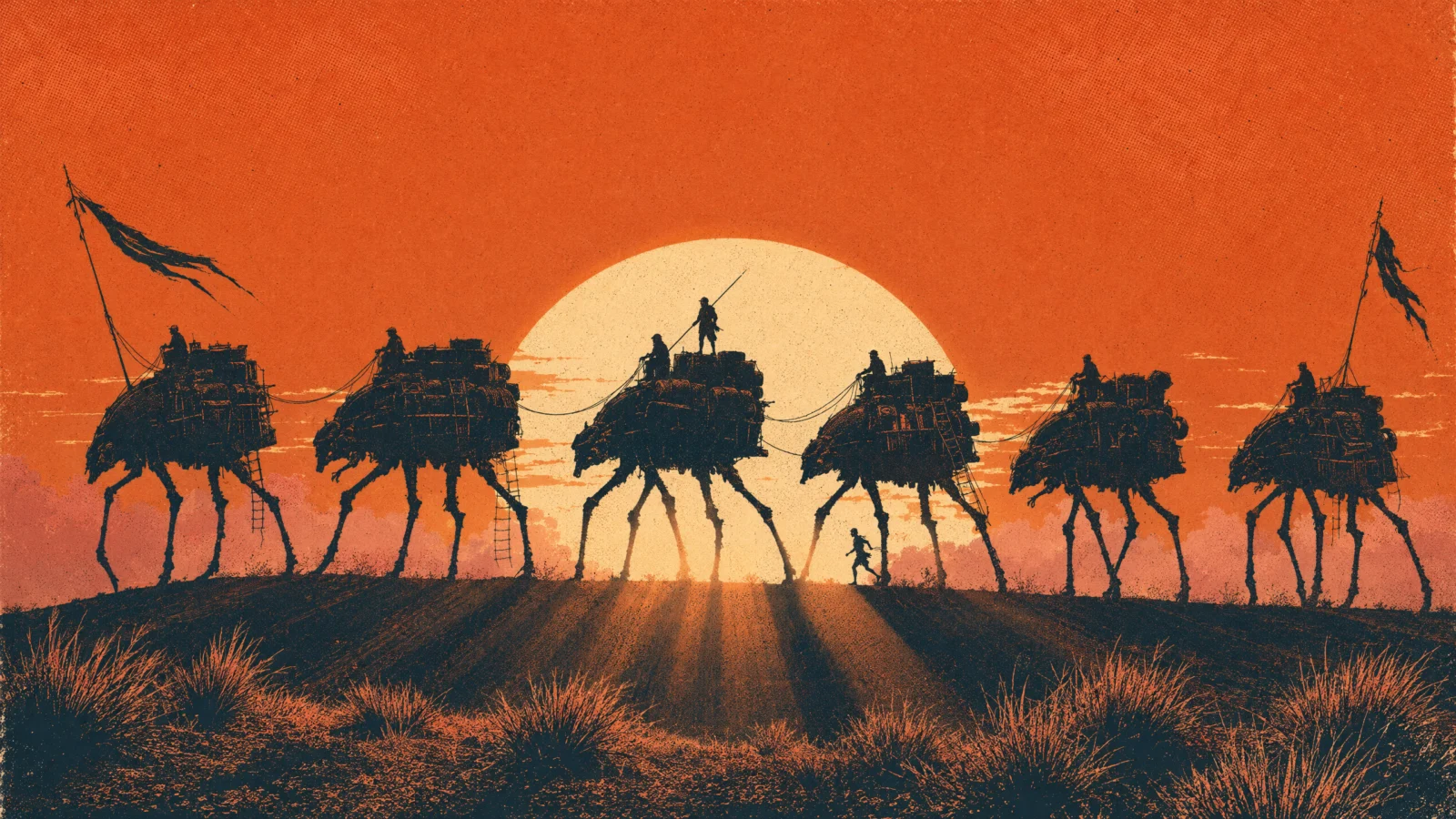
The procession chapter. Six house-sized beetle mounts in single file on a sunset ridge, and every technique in the frame is about rhythm. The animals repeat, but each is at a different stride phase, each carries different cargo, and the riders break the pattern further: one standing with a pole, one leaning off a rope ladder, one runner on foot. Repetition with variation is what makes a procession read as alive.
The sun placement is the second lesson: the disc sits behind the middle of the caravan so hot light pours between the animals’ legs in spokes. Backlight through a walking line turns negative space into the show.
What to steal from this one: the stride-phase line for any repeated figures, and backlighting through gaps, legs, spokes, and rigging. The space between subjects is a light instrument.
Swap ideas: a sail-sledge convoy crossing a salt flat, sails at different trim angles. A river barge train pulled by two swimming giants. A night caravan version, one lantern per mount, six warm points in the dark.
Prompt 2: The Waystation
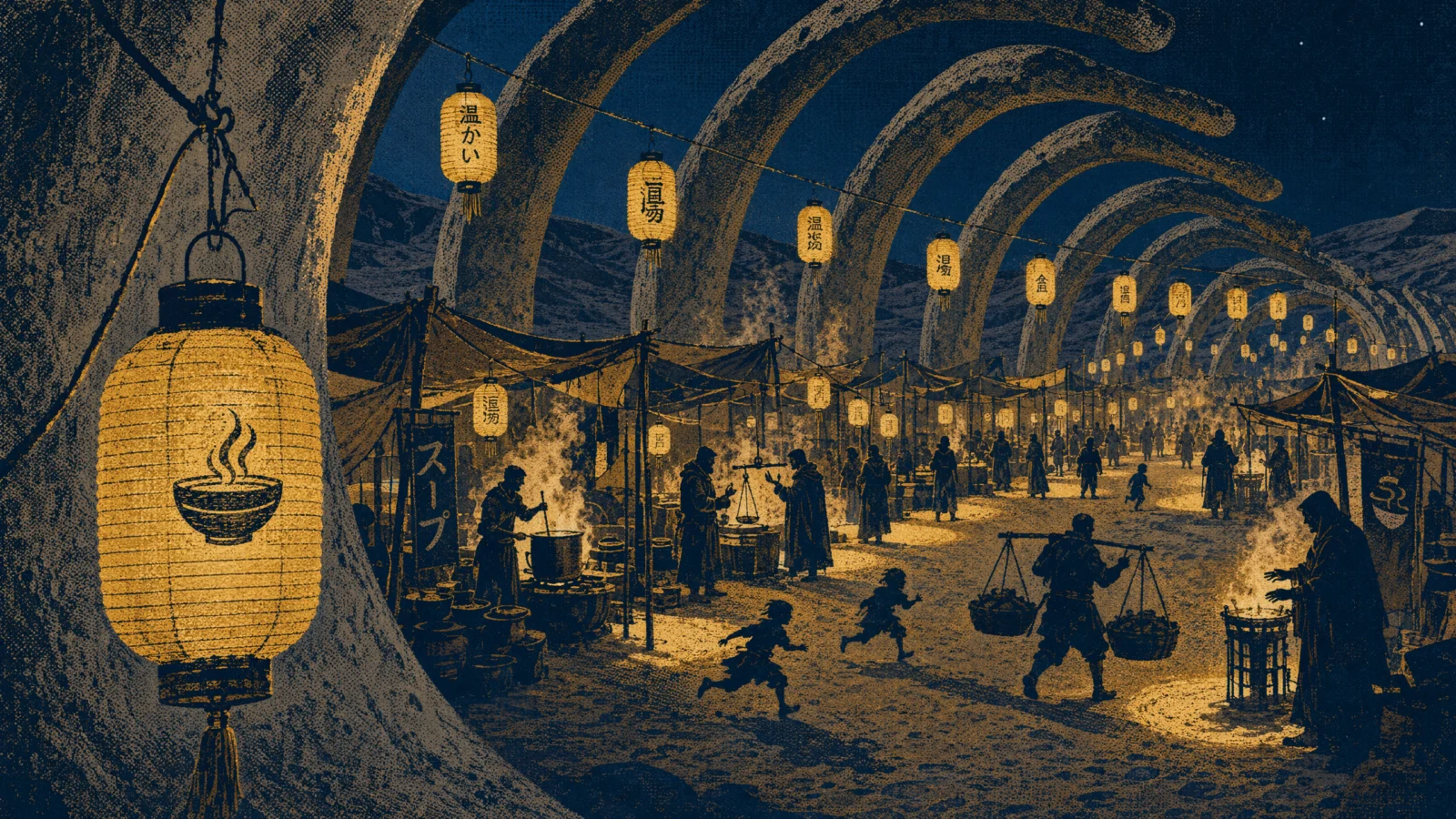
The warmth chapter, and the busiest frame in the entire vault. A night market inside the ribcage of a colossal skeleton, lanterns strung between the ribs. This is the hero-action rule at full power: fifteen to twenty silhouettes, but the prompt names only five actions (the vendor stirring, the hagglers at the scale, the running child, the porter with the bowed carry-pole, the figure at the brazier). Those five carry the whole market; the rest are rhythm.
The lighting teaches pools, not wash. Each lantern throws its own warm island onto the sand, and the market becomes a chain of glowing pools inside cold blue night. Multiple small pools always beat one even wash for warmth, depth, and story: every pool is a place someone chose to stand.
What to steal from this one: five named actions per crowd, maximum. And build night warmth as a chain of small light pools, never a single flood.
Swap ideas: the same market inside a beached ship hull, lanterns on the ribs of the frame timbers. A cliff-face market on hanging platforms, pools of light stacked vertically. A dawn version, the lanterns dying pale as cold daylight takes over, two light temperatures fighting.
Prompt 3: The Exchange
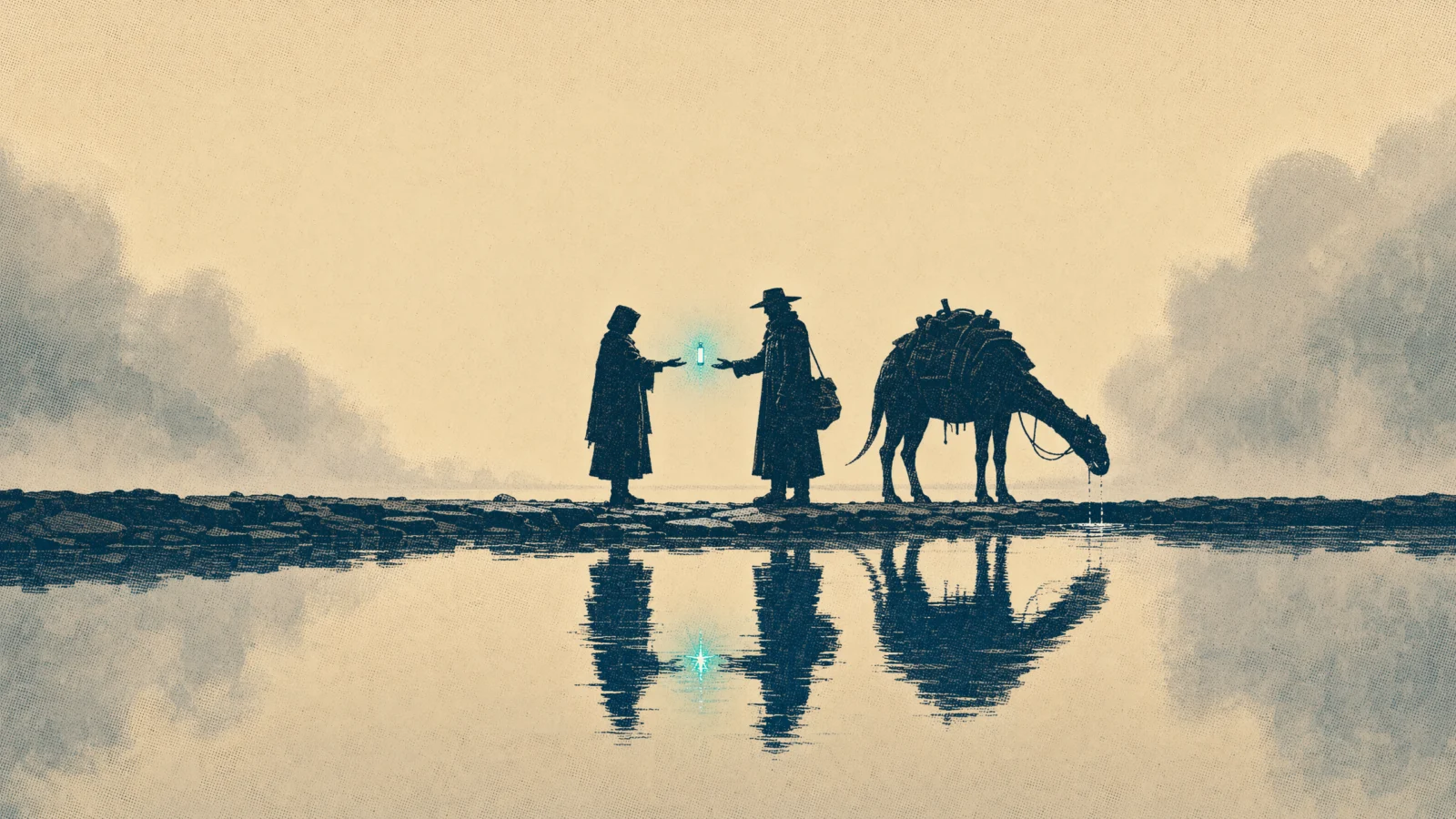
The intimacy chapter, and the smallest brightest point in the vault: a glowing vial passing between two hands. Two travellers meet at the centre of a causeway across mirror water, fog closing both ends. The composition is pure theatre staging: a stage (the causeway), a spotlight (the vial), two actors in profile, and a curtain (the fog). When you want story, stage your figures side-on; profiles read intention (reaching, offering, receiving) far better than front or back views.
The vial teaches the smallest light rule: the tinier the brightest point, the harder it pulls the eye and the more it means. A bonfire is illumination; a vial is a decision. Its double reflection in the still water buys a second composition for free.
What to steal from this one: stage two-figure stories in profile, make your brightest point as small as the story allows, and always check whether still water can double it.
Swap ideas: the exchange refused, the stranger’s hands raised in polite decline, same staging, opposite story. A map passed instead of a vial, unrolled between four hands. The meeting on a bridge of ice, the vial’s glow lighting the ice from within.
Prompt 4: The Lantern Herd
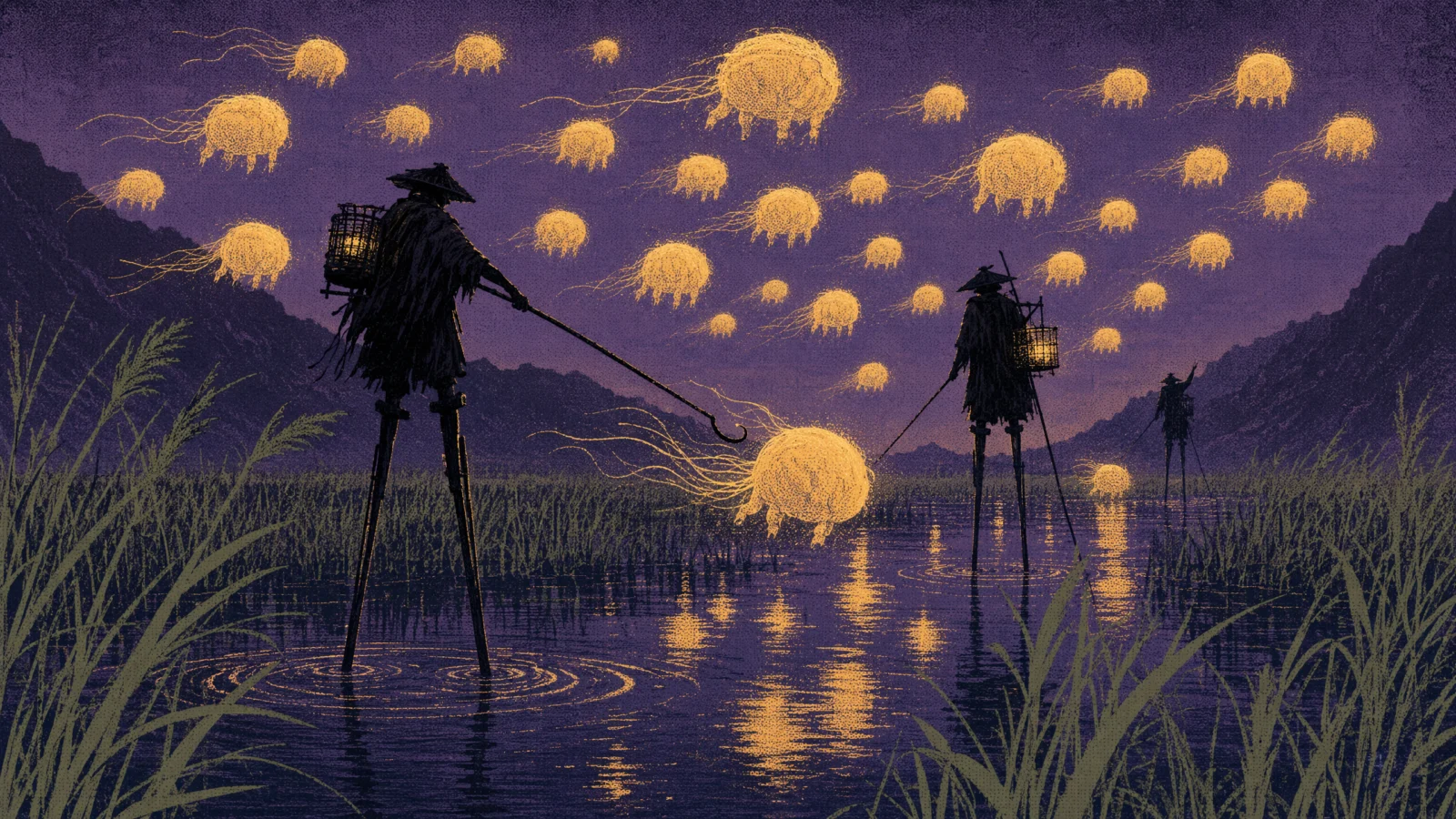
The gentle chapter. Thirty glowing creatures drift over a dusk marsh while three herders on stilts guide them home. Two inventions carry the frame. First, the light source is alive: the herd itself lights the scene, thirty warm glows over black water, so subject and lighting are the same thing and can never disconnect. Second, the stilts: raising the herders three times human height makes their silhouettes strange and puts them inside the herd’s airspace instead of below it.
Note what the herders are doing: not standing, working. One guides a stray back with a pole, one carries a cage lantern, one signals far off. Work is the most underrated silhouette subject there is; a body doing a job reads as story even at fifty pixels tall.
What to steal from this one: make your subject the light source when you can, and give background figures jobs, not poses.
Swap ideas: a shoal of glowing fish in shallow tide flats, waders with nets instead of stilts. The herd penned at night, one gate silhouette and thirty glows crowding it. A storm coming, herders hurrying the glows toward shelter, same gentleness under pressure.
Prompt 5: The Race Before the Storm
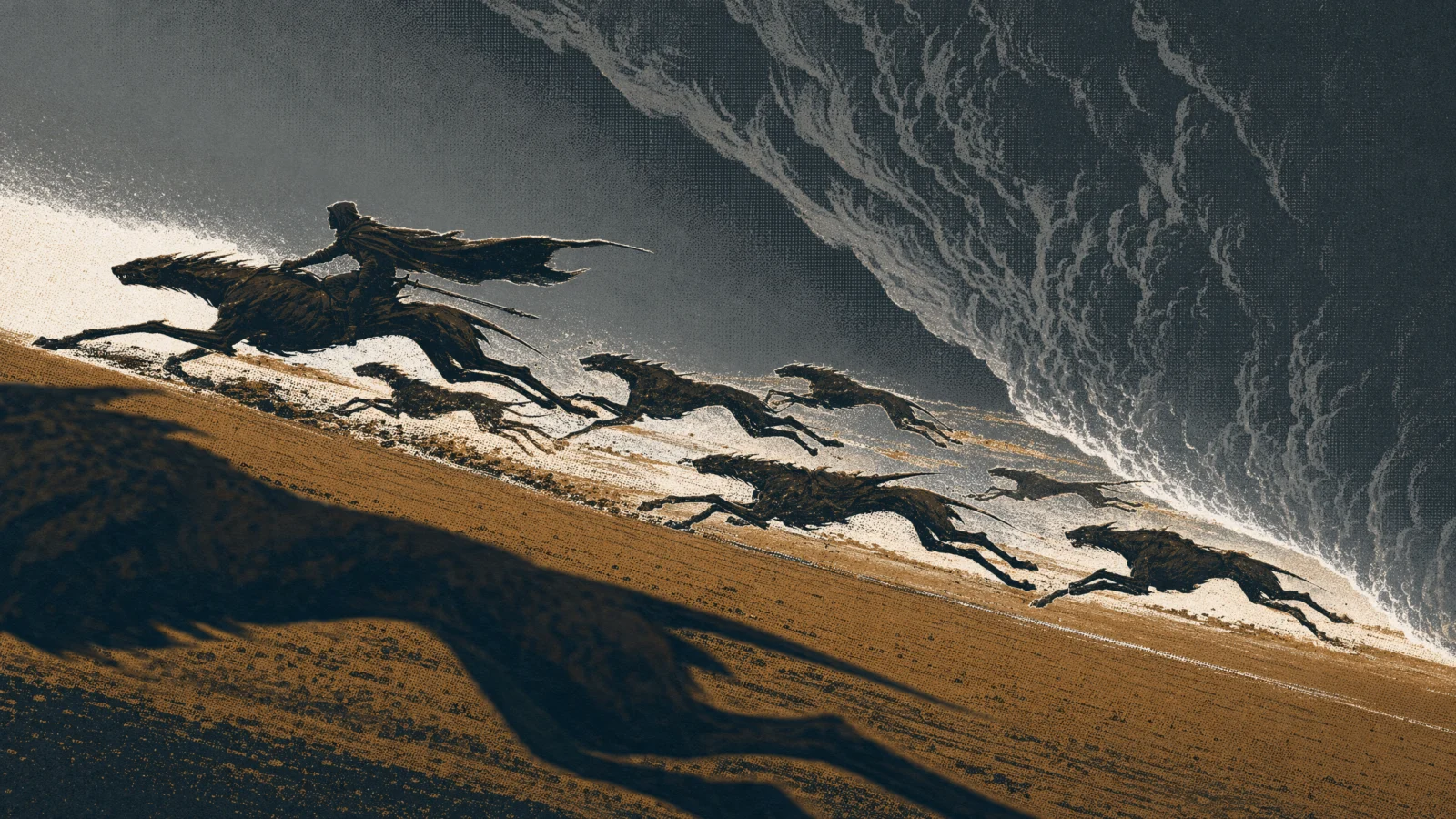
The speed chapter, the vault’s first sprint, and the money shot of the category. Nine creatures at full gallop down a dune slope, the traveller riding low on the lead animal, a storm wall eating the sky behind them. Everything learned so far fires at once: stride-phase variation across nine animals, a single light blade escaping under the storm as the one brightest element, and the two-temperature fight between cold silver rim light and warm sand.
The technical lesson is frozen speed. The DO NOT bans motion blur, because in flat print style, speed is drawn with shape, not smear: legs at full stretch, sand thrown in ribbons, a cloak cracked flat and horizontal. Blur is how photographs show speed; extension is how prints do. The cloak alone is a speedometer, the harder it is snapped flat, the faster the frame reads.
What to steal from this one: draw speed with stretched shapes and thrown debris, never blur. And when you need instant danger, put the threat in the frame but behind the subjects, always chasing, never arrived.
Swap ideas: the same pack racing a flash flood down a canyon, water wall instead of storm wall. A night race, the pack rimmed by the glow of what chases them. The herd from Prompt 4 stampeding, gentleness inverted into panic, herders clinging to their stilts.
Prompt 6: The River of Lights
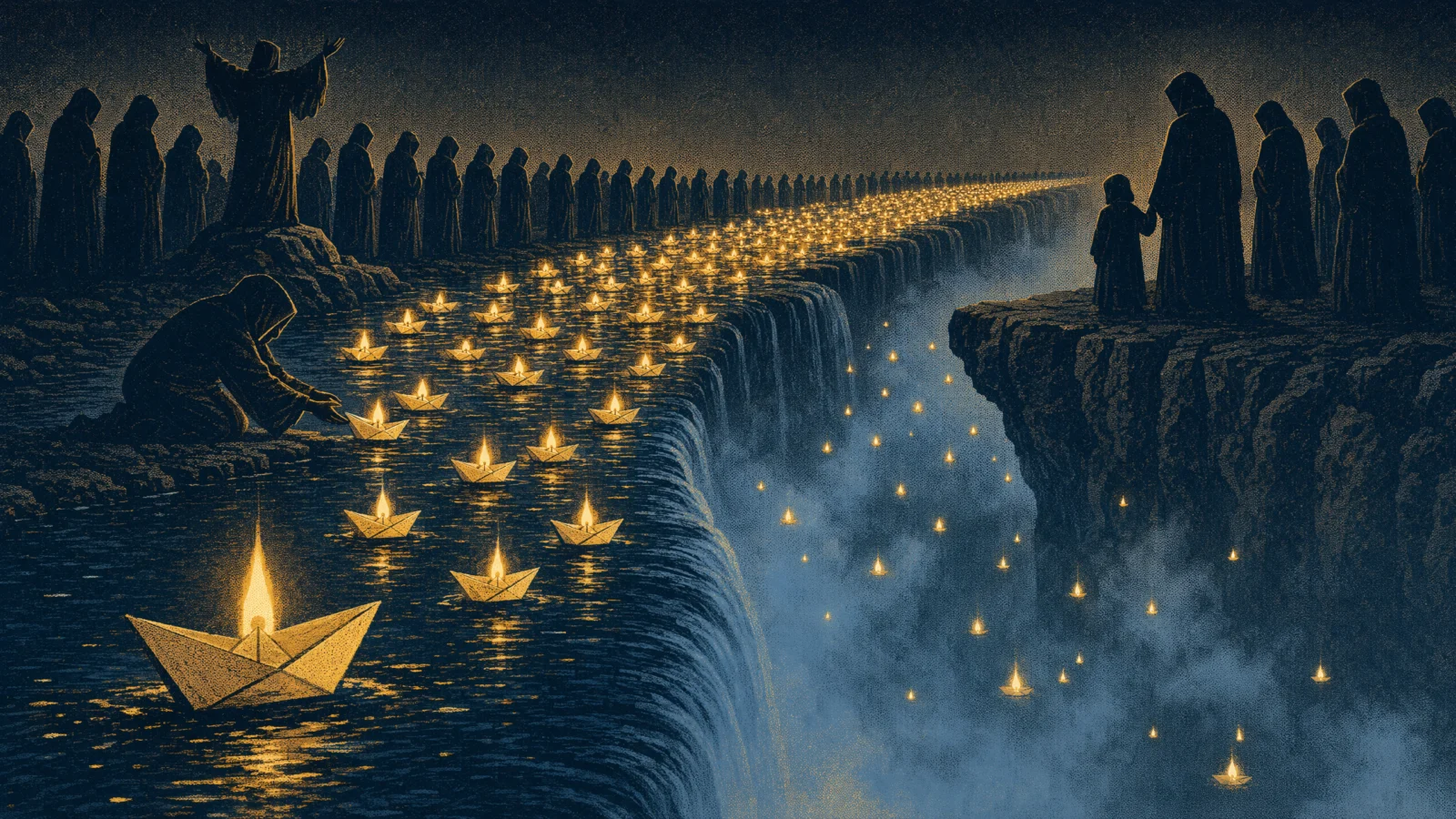
The ritual chapter and the emotional close. Forty mourners line a river at night while hundreds of small flame-boats stream past them, over a cliff lip, and out into the mist, where they drift down instead of falling. One impossible grace note, held to the last moment of the frame.
Two structures to study. First, stillness against current: the crowd stands motionless while the river of lights moves through them. Still figures beside moving light is one of the strongest emotional contrasts available, and it works because the motion carries what the figures cannot. Second, the hero actions are emotional this time: a kneeling figure releasing a boat, a child holding a sleeve, an elder with raised arms. Same rule as the market, completely different register. The technique is register-neutral; it carries soup and grief with equal strength.
What to steal from this one: run moving light past still figures whenever the emotion is bigger than the people. And save your one impossible detail for the edge of the frame, the boats drift instead of falling, and that single soft physics break is what makes the image belong to this world.
Swap ideas: a festival version, the same river of lights but the crowd dancing, grief swapped for joy with the identical structure. Lights released into the sky instead of water, the ribbon rising not falling. A single mourner and a single boat, the whole ritual reduced to one exchange with the current.
Fixes If A Render Drifts
All fixes from Categories 1 to 3 still apply. Category 4 adds the crowd set:
- Figures merge into blobs: too many bodies for the model to separate. Cut the count in the prompt (fifteen becomes eight to ten) but keep every named hero action. The actions carry the frame, the count never did.
- Every figure in the same pose: the stride-phase line is missing. Add "each at a different phase of the step" or stagger the named actions harder.
- Creatures render with eyes or faces: tighten the DO NOT and add "smooth featureless head" to the creature description. Same discipline as human faces, zero exceptions.
- Creatures render as man-made objects (lanterns with frames, machines): add "soft-bodied living creatures, organic, not man-made" to SCENE.
- Speed frame comes back blurred: motion blur crept in despite the DO NOT. Add "every silhouette razor sharp, speed shown by stretched pose and thrown sand only" to FIGURES.
- The brightest point is too big or migrates: name its size against a body part ("small enough to disappear inside a closed fist") and state it is the single brightest element in the frame.
Next Step
Category 5: Close Quarters is next, and the camera finally comes down. Hands, tools, firelight, a map unrolled, a creature’s breath in cold air. After four categories of vast, the vault goes intimate, and the frames start moving like scenes instead of paintings.
Tools used in this lesson:
Section 05
Category 5: Close Quarters
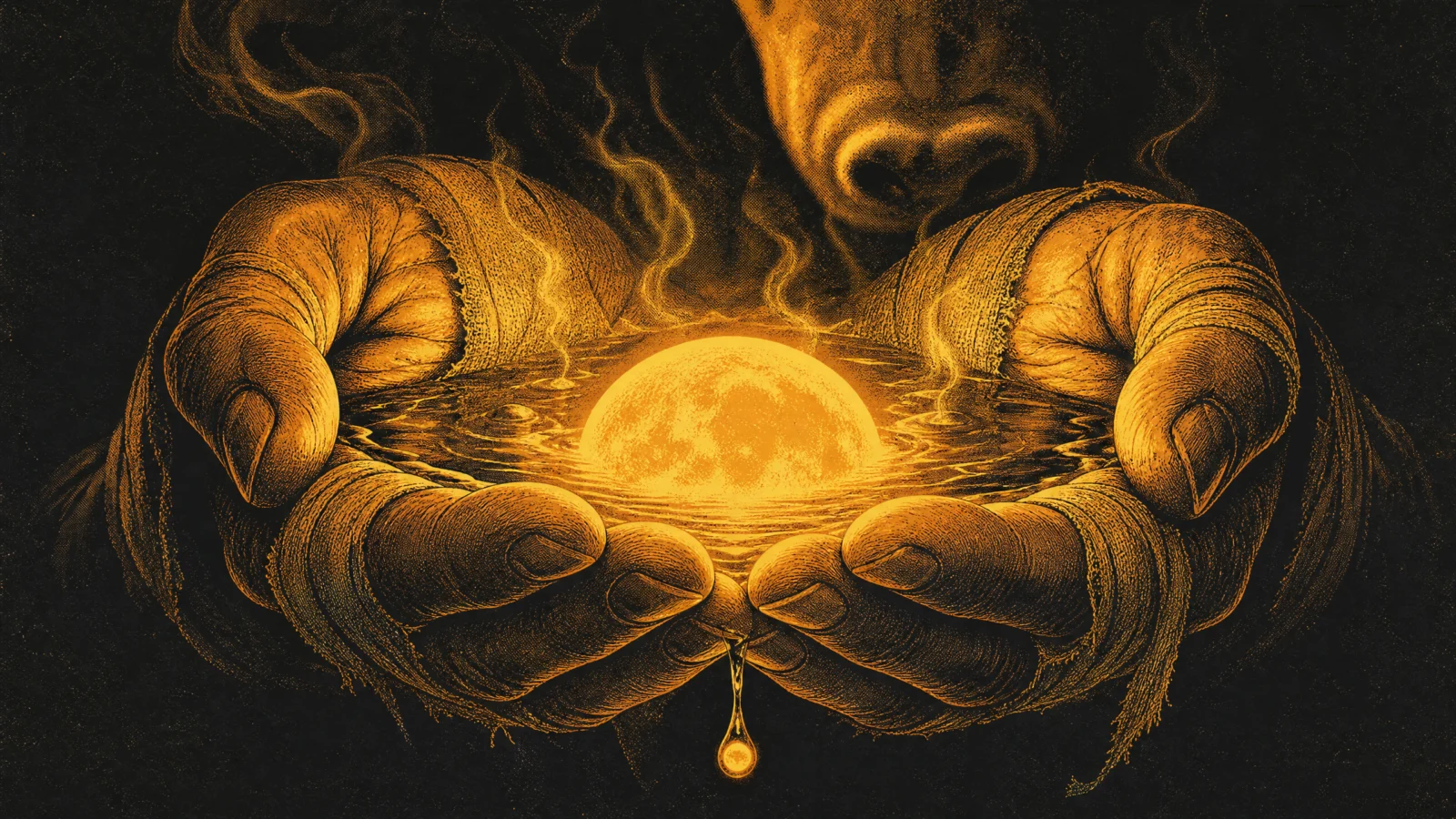
The camera comes down.
Four categories of vast: plains, colossi, planets, crowds. Category 5 closes the distance to arm’s length. Hands, tools, breath, firelight, and one long companionship told entirely without faces. There is not a single wide shot in this set, and the vault is stronger for it.
The rule that holds this category together: the world stays huge, but only through edges, reflections, and light. The giant sun arrives inside a falling water stream. The storm exists as grit racing past a shelter’s opening. A mountain pass is present only as dusk light skimming a stone rim. Close-up never means small; it means the big world compressed into something you can hold.
All 6 prompts run on GPT Image 2 on OpenArt, 16:9, animation-ready. Same seven-block spine. Still no faces, ever, and in this category that rule does its finest work: hands, boots, and a creature’s muzzle carry more emotion than any face render could survive.
What This Category Teaches
Three skills, and they transfer to any close-up work you ever do:
Hands are the new faces. Five of these six frames lead with hands, and each hand is directed like an actor: tendons taut with the control of a pour, fingers spread from a letting-go, one palm open and waiting, not reaching. A hand’s pose is its expression. When you write hand prompts, direct the tension and the intent, never just the position. "Fingers relaxed, not reaching, waiting" is a full sentence of character. "A hand near the creature" is nothing.
Compress the world into the frame. Every prompt smuggles the vast world into its close shot through one channel: backlight (the sun inside the water stream), light through holes (the map glowing teal from beneath), a frame edge (storm grit past the shelter), or a distant glow behind the subject (the pre-dawn sun behind two breaths). When you build your own close-ups, pick the channel first. A close-up with no world behind it is a product shot; a close-up with the world pressing in at the edges is cinema.
The story object. Each frame is built around one object that carries the narrative: a flask, a map, a needle and thread, a compass, a burning letter. The object is doing what the emotional premise promises. This is the same "one impossible element" discipline from the surrealism work, pointed at story instead of surrealism: one object, one action, one meaning per frame.
And running underneath all six: the companion arc. The creature from Category 1’s ridge line is now travelling with the traveller. It appears in four frames, never as a full body, a muzzle waiting above a bowl, breath meeting a palm, a muzzle at a toll bowl’s rim, a sleeping flank beyond a fire. Payoff without exposure. If you are building your own series, this is how you develop a character you can never fully show.
The Swap Rules for This Category
Everything from Categories 1 to 4 still applies. Three additions for close work:
- Swap the object, keep its action and meaning. The flask pour can become bread broken in half, the map can become a knot diary of cord and beads. What must survive: one object, one action, the meaning the action carries.
- Direct hands like actors. Every swapped hand gets an intent word: controlled, hesitant, open, spent, steady. And keep poses simple, hands are the highest mangle-risk subject in AI imaging. Finger wraps and gloves are your friends; they simplify what the model must draw.
- Choose your world-channel before writing. Backlight, edge, hole, reflection, or distant glow. One per frame. State it inside LIGHT EVENT or DEPTH so it cannot be dropped.
Prompt 1: The Last Water
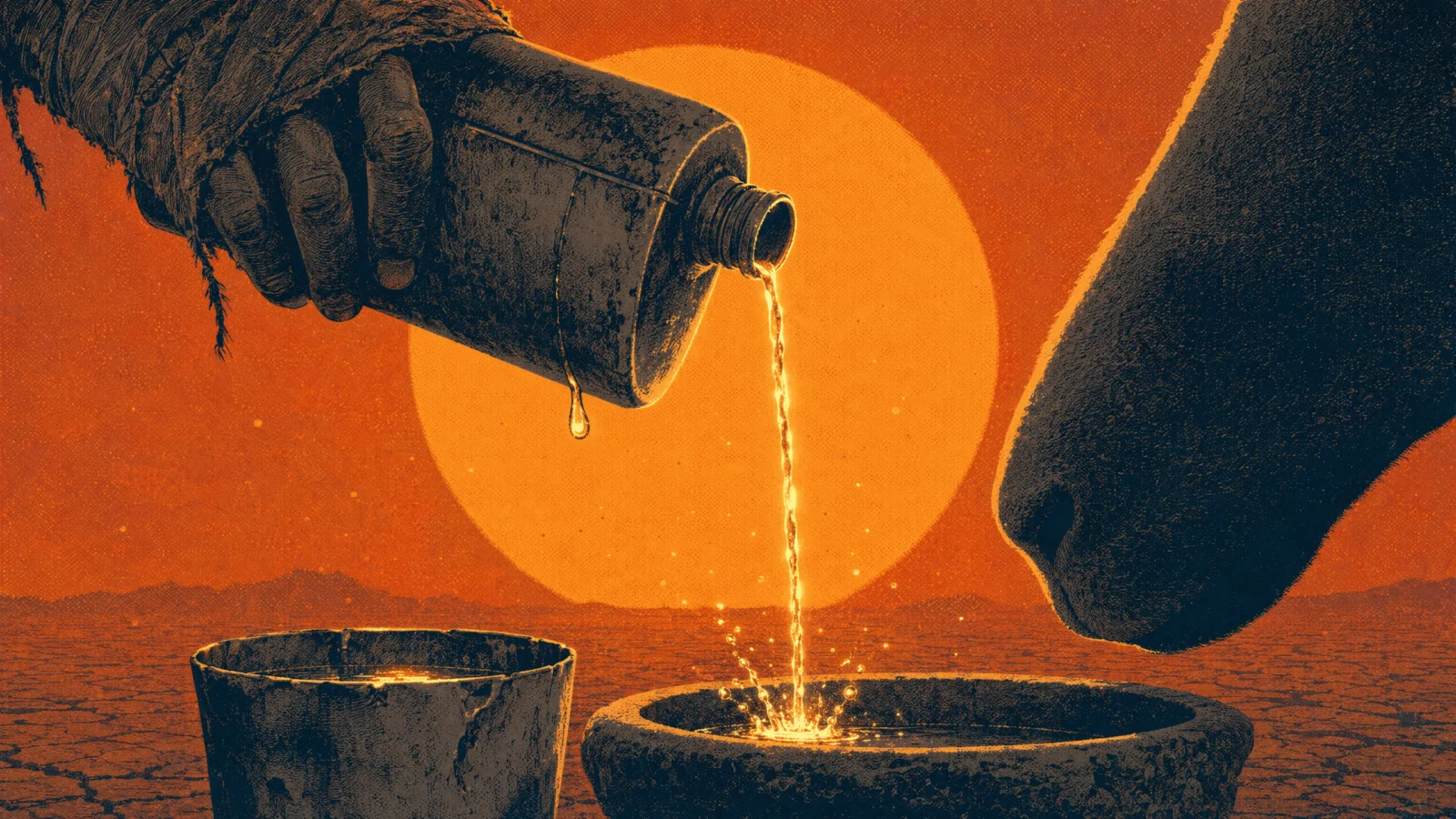
The opening chapter, and the whole companionship in one pour. A flask tips at burning dawn, the falling stream catches the giant sun and runs like molten thread, and the pour is angled toward the creature’s bowl while the traveller’s own cup sits half-filled. That angle is the entire story. No face, no words, one decision made visible.
Two techniques to study. First, the sun inside the stream: the vault’s giant sun spans the whole background but is carried down the frame inside one thread of backlit water. This is the world-compression rule at its purest, and it is additive, if the effect lands fully you get magic, and if it half-lands the frame still works, because the pour and the angle carry the meaning on their own. Second, the condensation drop sliding down the flask’s flank, "like the flask itself giving up its last." One tiny detail agreeing with the big theme. That agreement between small physics and large meaning is what makes a frame feel authored instead of generated.
What to steal from this one: tell relationships through resource decisions, who gets the water, the warmth, the last of anything. And when your frame has a theme, find one small physical detail that repeats it.
Swap ideas: the last bread broken in half at dusk, the larger half set down on the creature’s side. A fire’s last fuel, one stick added to the animal’s side of the windbreak. The same pour in reverse, the creature nudging its full bowl toward an exhausted, collapsed glove.
Prompt 2: The Map of Burns
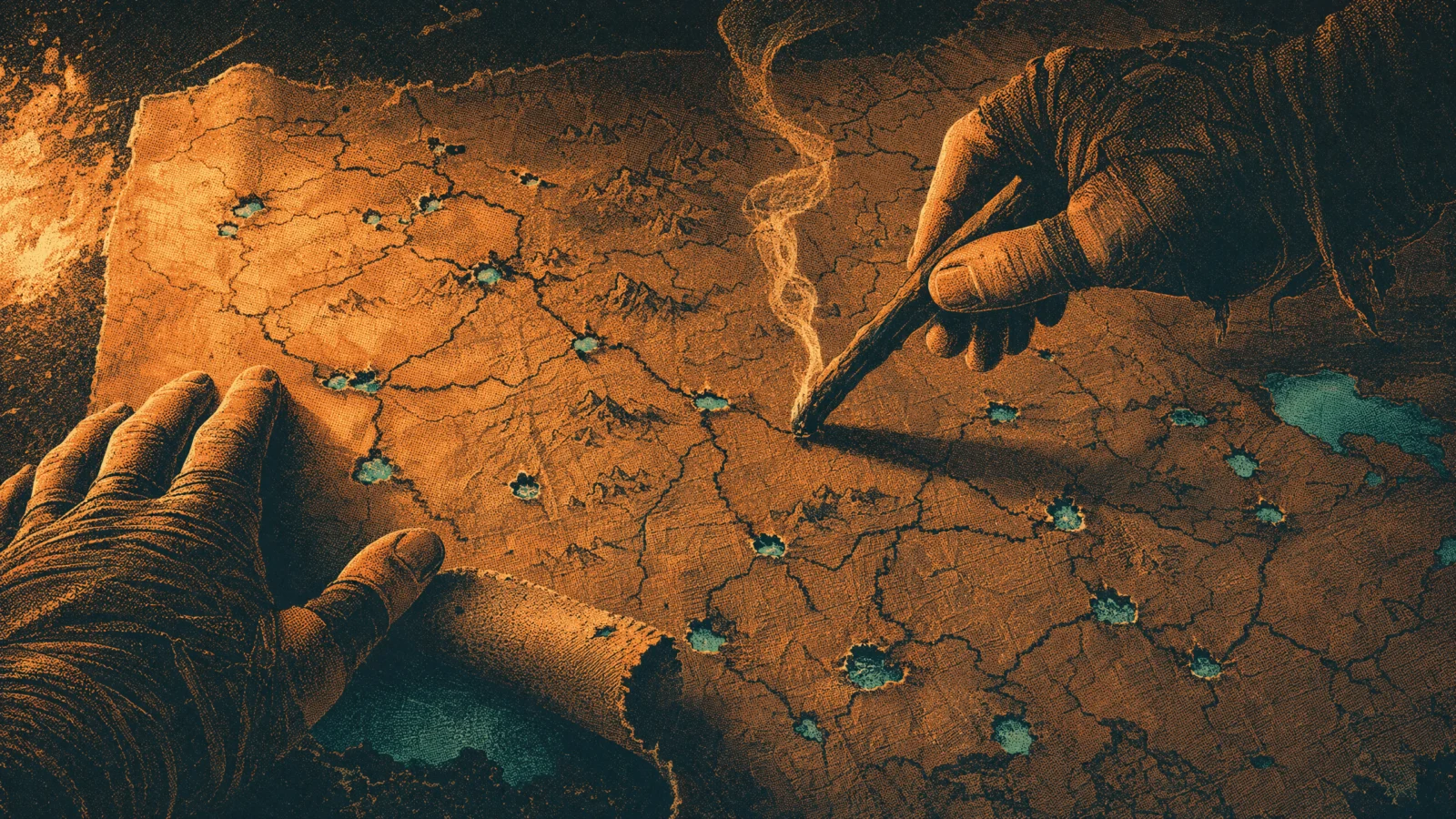
The invention chapter. A map made of its own damage: routes seared into cloth as scorched lines, destinations burned through as holes, and through those holes a faint teal glow from beneath, as if the map is lying on something lit. A map that records where you have been by what it cost, that is a world-building idea disguised as an object, and it is the kind of object invention this category runs on.
The light setup is the two-source fight: warm firelight raking across the cloth from the left, cold teal rising through the holes from below. Warm above, cold below, fighting across one surface. Also note the raking angle doing the same job it did on the Sleeper’s carved face in Category 2: side light makes every burn line cast its own thread of shadow, so the map’s texture becomes terrain.
What to steal from this one: invent objects whose damage IS their information, worn steps, patched sails, notched staffs. And light textured surfaces from the side, always.
Swap ideas: a knot diary, a cord of beads and knots read between two hands by firelight. A star chart scratched into a metal plate, dawn light raking the scratches. The same map years later, so burned through it is more hole than cloth, held up against the light.
Prompt 3: The Shared Breath
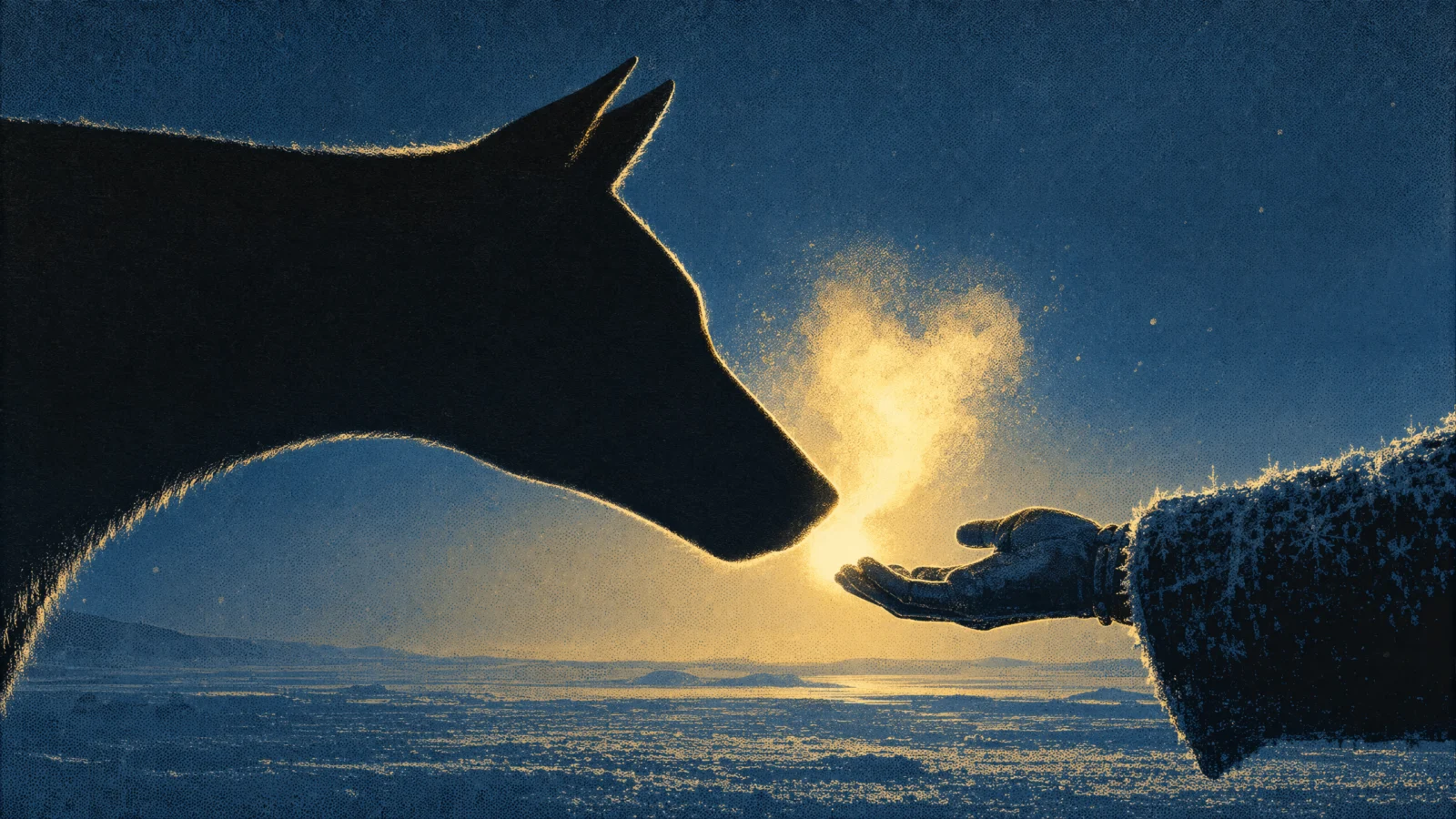
The trust chapter, and the most delicate frame in the vault. Freezing pre-dawn, the creature’s huge head lowered level with one open palm, and between muzzle and hand their two breaths meeting, merging into a single vapour cloud backlit by the tiny rising sun. The brightest object in the frame is made of two beings breathing. That is the smallest-light rule from the causeway vial pushed to its logical end: the light is not carried or lit, it is exhaled.
Study the hand direction: "fingers relaxed, not reaching, waiting." Reaching would make it a command; waiting makes it an offer. One word of intent changes the entire meaning of the frame. And the gap, the palm and muzzle stay "a hand’s width apart", protected by the DO NOT. Touch would close the story; the almost-touch keeps the trust still happening.
What to steal from this one: build your brightest point from something the subjects produce, breath, sparks from a grindstone, dust from clapped hands. And protect your almost-moments in the DO NOT; the frame before contact always outpulls the contact.
Swap ideas: the same meeting in a sandstorm, two shapes sharing the lee of a rock, breath replaced by shared shadow. First meeting version, the creature’s neck only half lowered, the gap twice as wide, trust still being decided. Years-later version, the muzzle resting its weight fully in the palm, the only frame where touch is earned.
Prompt 4: The Repair
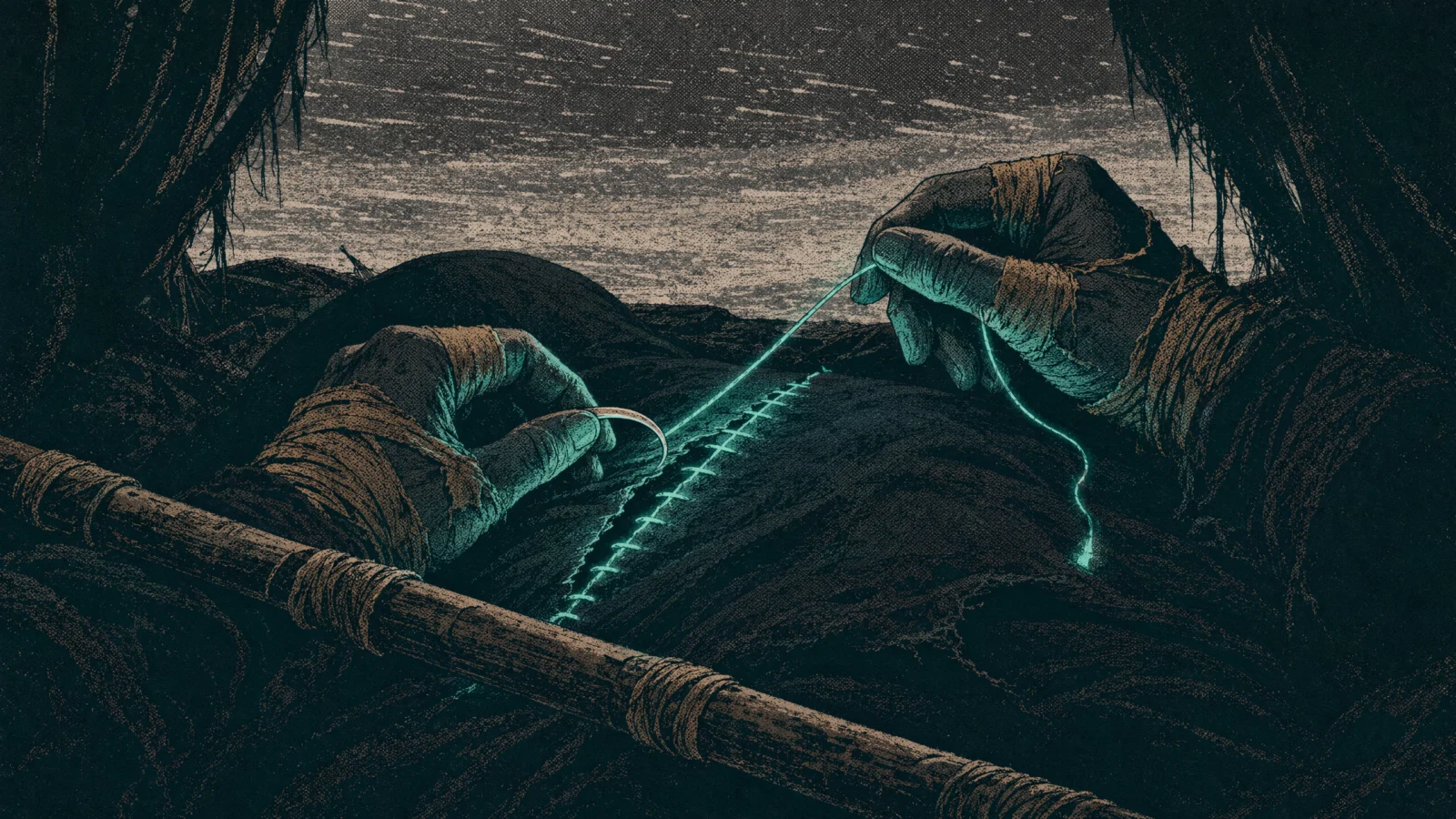
The devotion chapter. Inside a lean-to during a sandstorm, two hands stitch a tear in the hooded cloak with glowing teal thread, the same teal as the causeway vial, now revealed as something spendable, thread, light, and currency in one. The storm exists only as grit racing past the shelter’s open edge: the world-channel rule with the world reduced to a single moving border at the top of frame.
The light invention: the thread is the only light source, and it lights the work from between the hands. Underlight from the task itself, the labour literally illuminating the labourer. And the closed half of the seam already glows faintly, a scar of light, so the frame shows past, present, and future of the repair in one line: done, doing, still to do.
What to steal from this one: let the task light the worker. Welding, stirring embers, threading light. And show progress inside the frame, half-done states tell time better than any clock.
Swap ideas: re-wrapping the staff’s grip with glowing cord, old wrap unwinding on one side, new on the other. Mending the creature’s harness while it sleeps, one strap across a dark flank. Boot repair at a fire, sole sewn with the last of the teal thread, the spool visibly nearly empty.
Prompt 5: The Toll
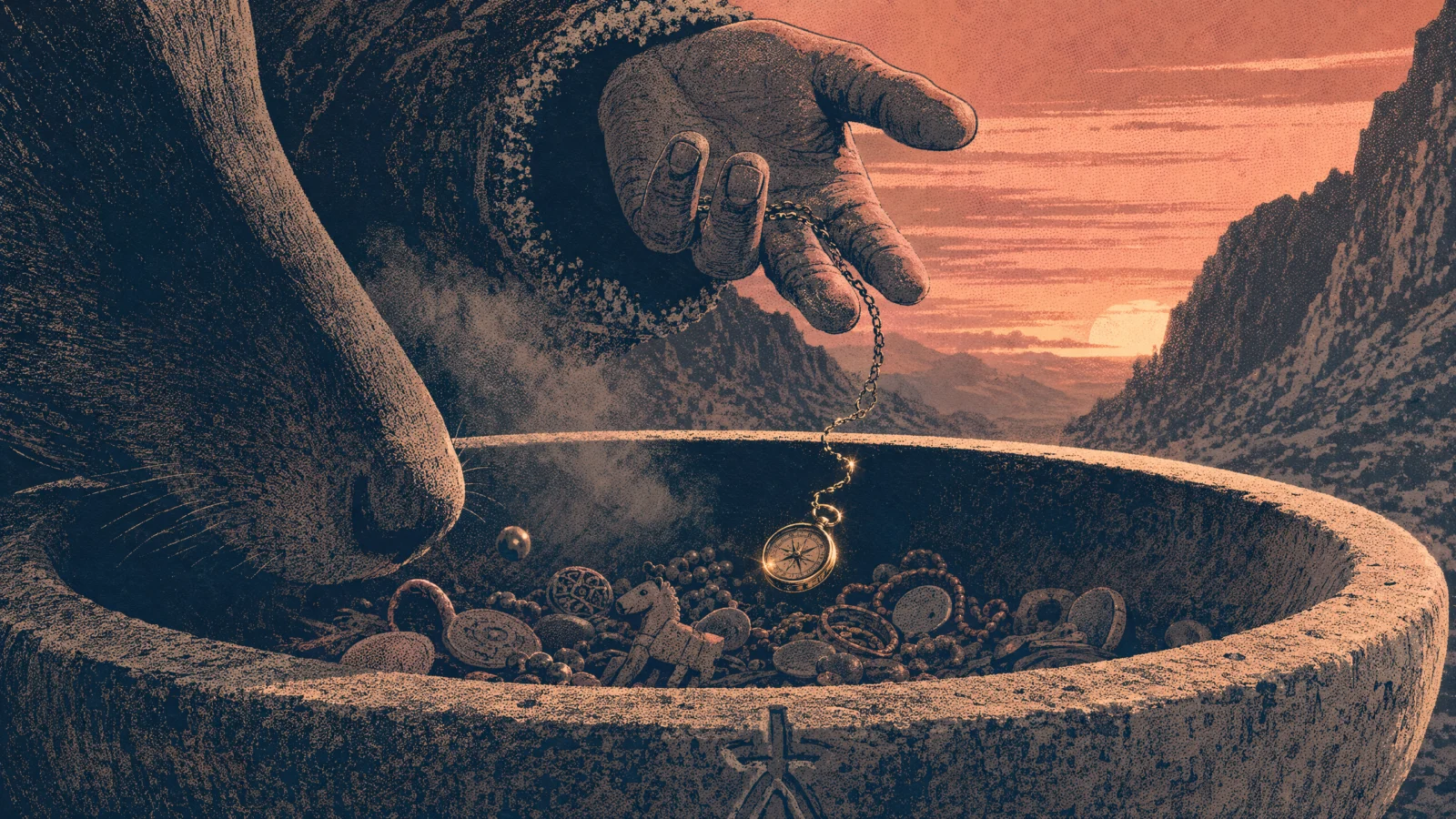
The cost chapter. A stone altar bowl at a mountain pass, worn smooth by centuries of hands, holding the small treasures of every traveller who paid to cross: buttons, beads, a child’s carved toy, a ring. And one open hand releasing a brass compass, caught a finger’s width above the pile, chain still uncoiling. The compass is the traveller’s ability to find the way, and the bowl takes it. Choose an object whose loss means something and the toll writes itself.
The bowl is also a masterclass in implied crowd: a century of travellers present in one basin of small goodbyes, forty mourners’ worth of story with zero figures rendered. And the creature’s muzzle at the far rim, sniffing the offerings, its breath stirring a single bead, the companion arc touching the frame with one moving bead’s worth of presence.
What to steal from this one: collections imply everyone who contributed to them. Shelves of shoes, walls of marks, bowls of tolls. And when you pay a price in an image, make it specific, "a compass" costs more than "a treasure."
Swap ideas: the return crossing years later, the same bowl, the hand hovering, hesitating, above the old compass still lying where it fell. A toll of light, travellers each leaving one glowing thread tied to a post, the traveller adding teal. The creature paying too, nudging one of its own shed spines onto the pile.
Prompt 6: The Ember Letter
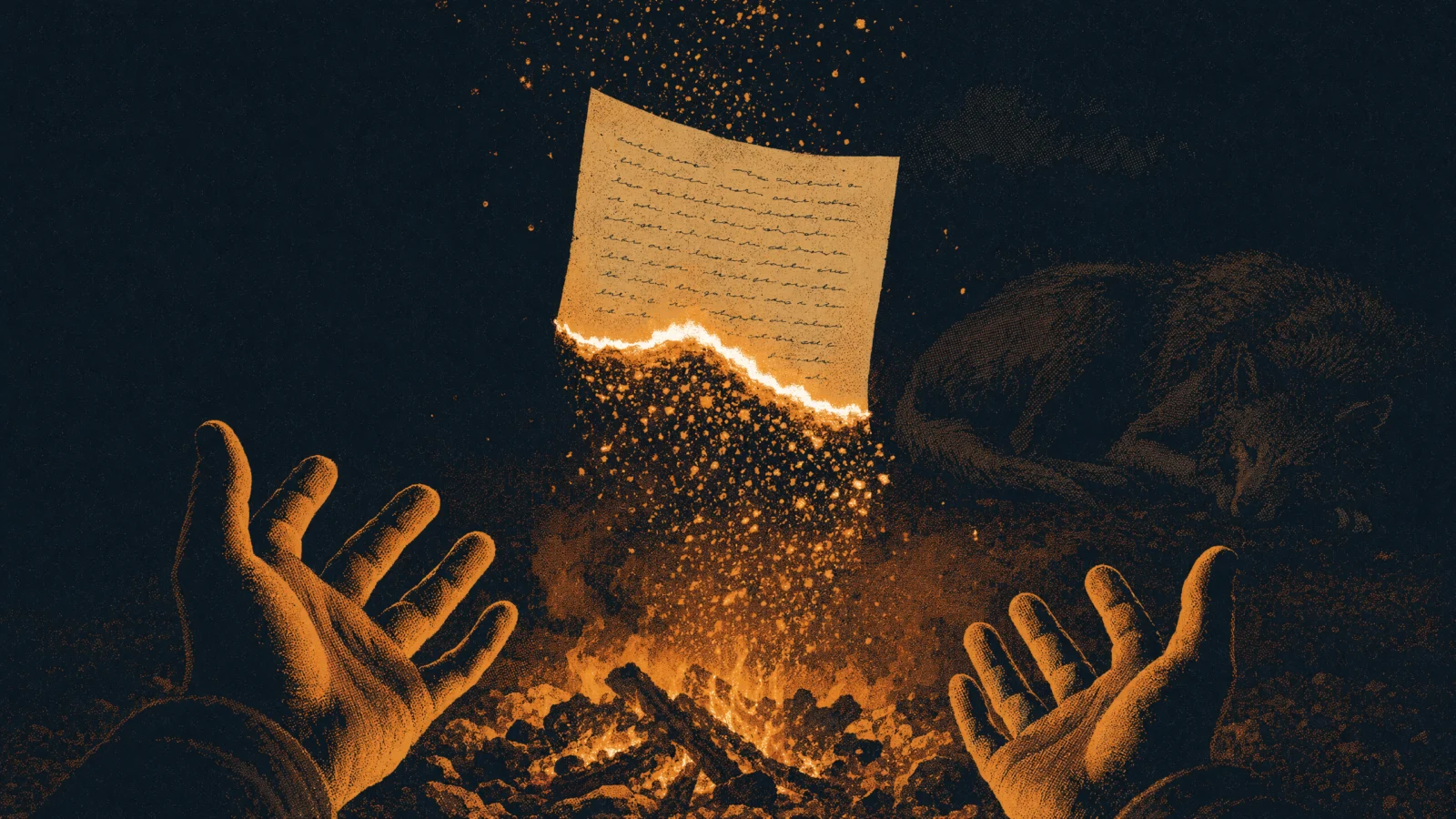
The release chapter and the close of the category. Above a dying campfire, one sheet of burning paper floats on the heat, eaten from below by a crawling fire line, and the burned portion does not fall as ash, it breaks upward into a rising column of embers. The hands that released it are still open at the frame corners. Behind the fire, the creature sleeps, one flank rising and falling.
Two lessons close the category. First, the moving boundary: the fire line crawling across the page is a live edge between what the letter still says and what it has already become, the same before-and-after power as the repair seam, now in motion. Second, the inversion of ash: burned things fall, so embers that rise read instantly as the message being sent rather than destroyed. Find the physics your viewer expects, and reverse only that. One reversal per frame, the same one-impossible-element discipline the whole vault runs on.
The DO NOT protects both tricks: no readable words (the letter stays everyone’s letter) and no grey ash (the transformation stays an ascent).
What to steal from this one: put a moving boundary inside your frame, fire lines, dye spreading in water, frost climbing glass. And earn your impossible moment by keeping every other physic honest.
Swap ideas: a message sent into water instead, ink lifting off a submerged page and drifting downstream as a glowing thread. A carving shaved into a stick, each shaving curling into the fire, the message sent one cut at a time. The reply, an ember column descending out of the night sky into the cold fire pit at dawn.
Fixes If A Render Drifts
All fixes from Categories 1 to 4 still apply. Category 5 adds the close-up set:
- Hands mangle: the number one risk in this category. Simplify the pose first, one clear action per hand, and keep the wraps and gloves, they reduce what the model must draw. If a two-hand frame keeps breaking, cut to one hand and let the second action go.
- Readable text appears (map, letter): harden with "abstract marks only, no alphabet, no language, no letters." Real words break immersion and break the no-text rule of the whole vault.
- The two breath plumes render separate: name the merge as geometry: "the two plumes joined into one single cloud at the exact centre between muzzle and palm."
- Object clutter creeps in (toll bowl becomes a junk pile): cut the inventory to "a sparse scatter of small offerings, most of the basin in shadow." Sparse reads as sacred, full reads as flea market.
- The world-channel disappears (no storm at the shelter edge, no sun behind the stream): the frame will feel like a studio product shot. Restate the channel inside LIGHT EVENT and DEPTH both, the double anchor keeps it alive.
- Underlight goes soft or vanishes (thread, fire, stream): state the source is "the only light source in the frame" and name what it underlights: "throwing soft underlight up the fingers."
Next Step
Category 6: Light Events is the finale. The sky takes over completely: eclipse, dust storm front, double sunset, aurora. The camera goes wide one last time, and after the intimacy of Close Quarters, the vault’s biggest spectacle lands with everything it has earned.
Tools used in this lesson:
Section 06
Category 6: Light Events
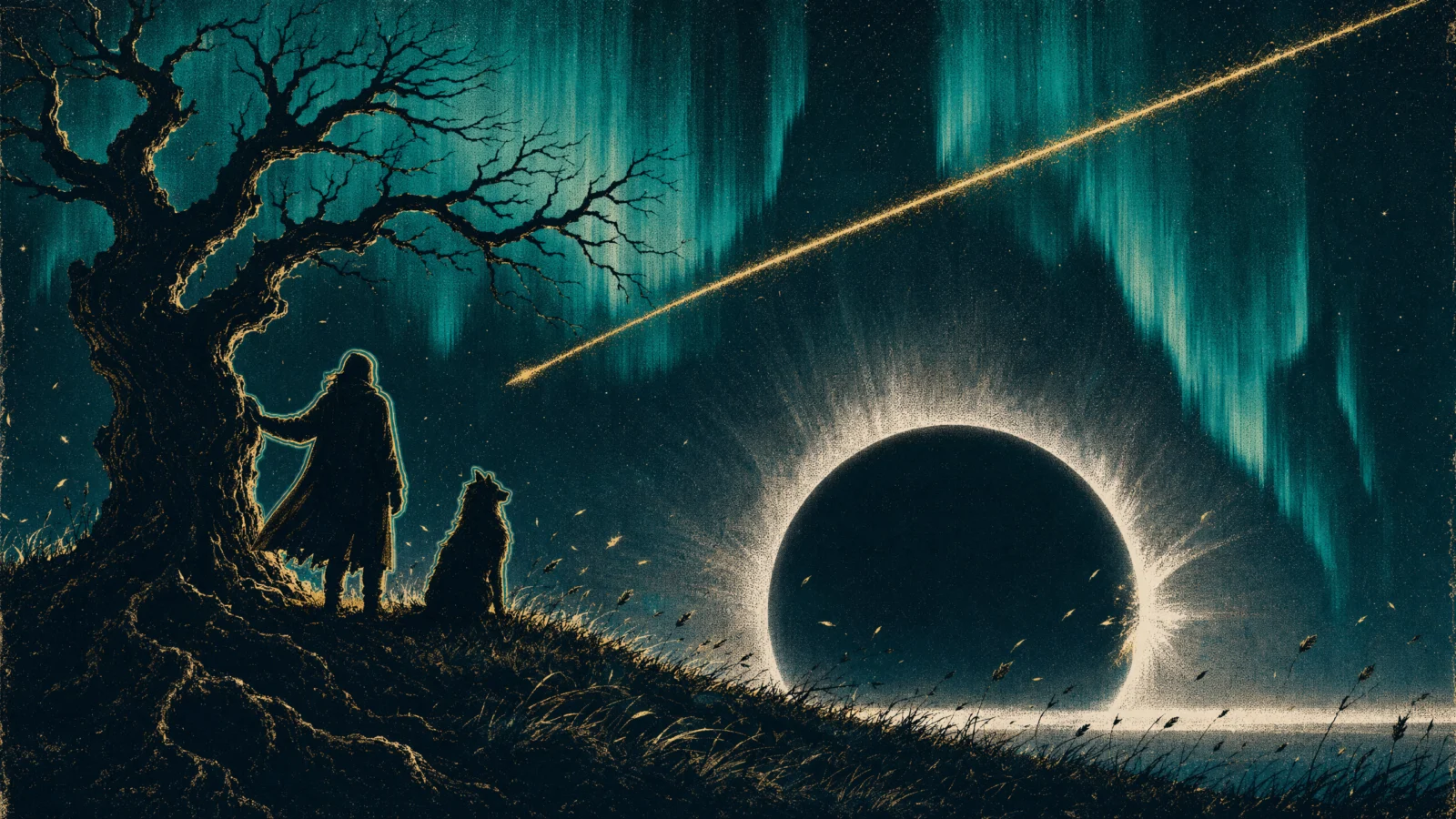
The sky spends everything it has.
This is the finale. Six light events, one ending: an eclipse that brings a road of pilgrims to their knees, an aurora over a frozen mirror, a green flash that lives for one second, a meteor storm watched from shelter, a sun pillar lighting the last climb, and finally the same salt flat where the journey began, at sunset, with two walkers on the path instead of one.
Category 6 goes wide again after the intimacy of Close Quarters, and that contrast is deliberate: spectacle lands hardest right after stillness. But this category is not just bigger skies. Every frame here pays off something planted earlier in the vault, and the last prompt closes the circle on the very first one. If Categories 1 to 5 taught you techniques, Category 6 teaches you how to end a series.
All 6 prompts run on GPT Image 2 on OpenArt, 16:9, animation-ready. Same seven-block spine, one last time.
What This Category Teaches
Three closing skills:
The light event as story beat. Until now, light events were staging: they lit the world and touched the ground. In this category each one carries a narrative meaning: the eclipse is awe, the green flash is a moment almost missed, the sun pillar is the world keeping a candle lit. When you build your own finale frames, choose the light for what it means, not just how it looks. The sky is a character in this category, and it gets the character arc.
Payoff planting. The dented cup from The Last Water stands in the final frame’s foreground. The creature that followed at thirty paces in Category 1 now leads the climb in Prompt 5. The staff carried as a weapon-like brace for five categories rides across relaxed shoulders in Prompt 2. None of these are new inventions; they are old details returning with new meaning. This is the cheapest, most powerful trick in series work: plant small, pay off late. If you build your own vault-length series, keep a list of your planted objects from day one.
The full-circle frame. Prompt 6 recreates Prompt 1 of the whole vault, same salt flat, same sun, same light path, with three changes: the walkers face away instead of forward, there are two of them, and one object is left behind. A finale that mirrors the opening with meaningful differences reads as an ending in a way no new location ever can. Same frame, changed traveller. That is what an ending is.
The Swap Rules for This Category
Everything from Categories 1 to 5 still applies. Three additions for finale work:
- Swap the light event, keep its meaning. The eclipse can become a total planet transit, the aurora can become a slow lightning storm trapped in high cloud. What must survive is the emotional role each event plays in the sequence: awe, wonder, grace, peace, guidance, home.
- If you build your own series close, mirror your own opening. Pull up your first frame, keep its composition, and change exactly the things your story changed. Two or three differences maximum, each one earned.
- Companions appear in every finale frame. Whatever your series’ relationship is, person and creature, two travellers, a figure and a machine, the finale is where they are never apart. Separation is a middle-of-story tool. Endings are togetherness or its absence, chosen deliberately.
Prompt 1: The Eclipse
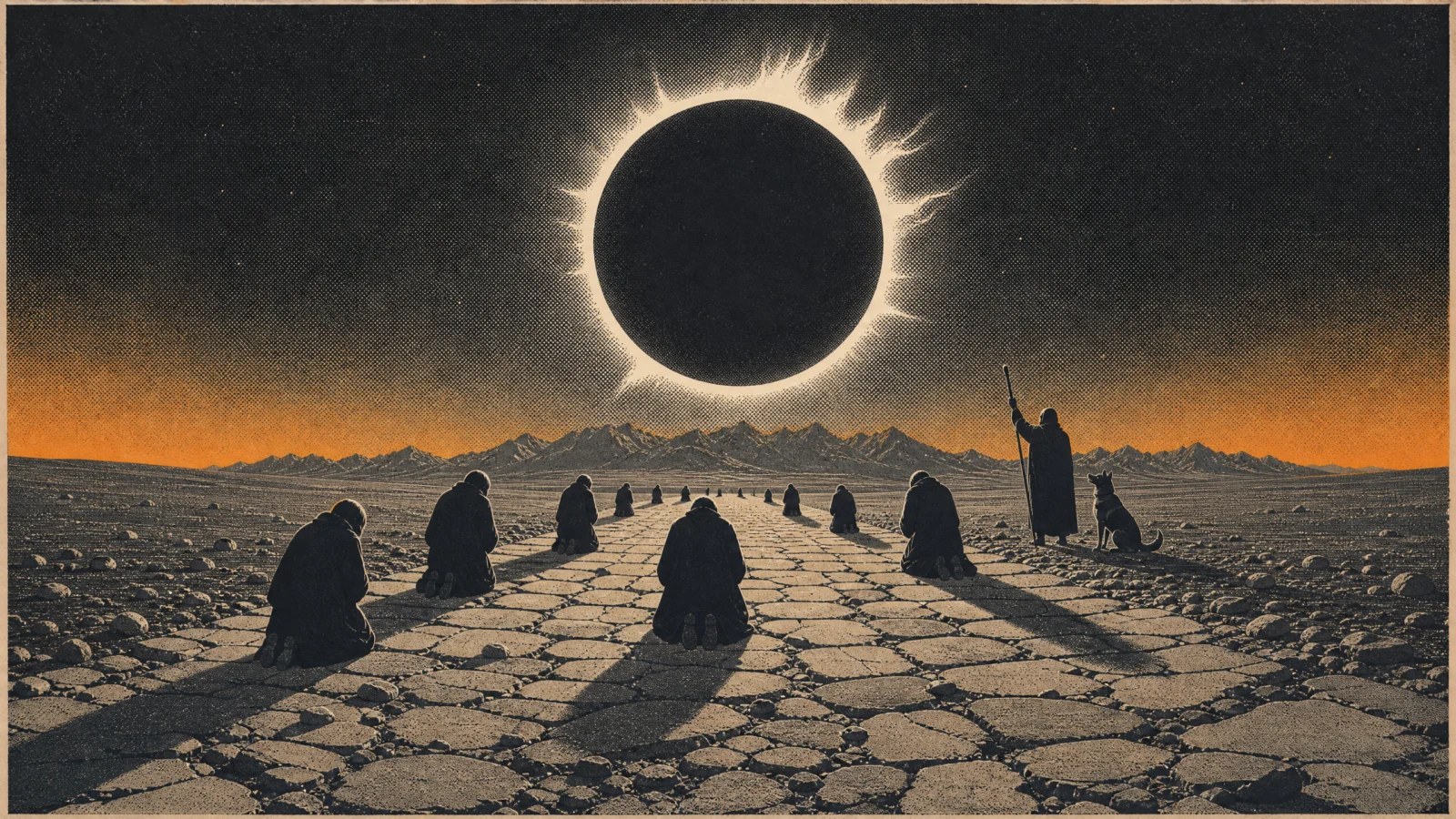
The awe chapter. Midday goes silver-dark, a pilgrim road stops, and a dozen silhouettes kneel toward a black sun ringed in white fire. The compositional lesson is the one who stands: eleven kneeling figures make the twelfth, standing with staff raised in greeting, the instant subject of the frame. Crowd conformity plus one exception equals a story with zero words. The creature sits beside the standing figure, the pair marked out by posture alone.
The eclipse also brings the vault’s strangest light recipe: a black disc as the frame’s centre, a corona as the only true light, and an amber glow on the horizon in a full circle, sunset in every direction at once. That last detail is real eclipse physics, and it is exactly the kind of detail that makes an impossible-feeling frame land as true.
What to steal from this one: break one figure out of a crowd’s shared behaviour and the frame is theirs. And when you render rare phenomena, find the one real physical detail nobody expects, it buys truth for the whole image.
Swap ideas: the moment after, the black disc sliding off the sun’s face, first light returning across the kneelers. A city crowd version, rooftops full of watchers instead of a pilgrim road. A double eclipse, two moons crossing the sun in sequence, two coronas.
Prompt 2: The Curtain
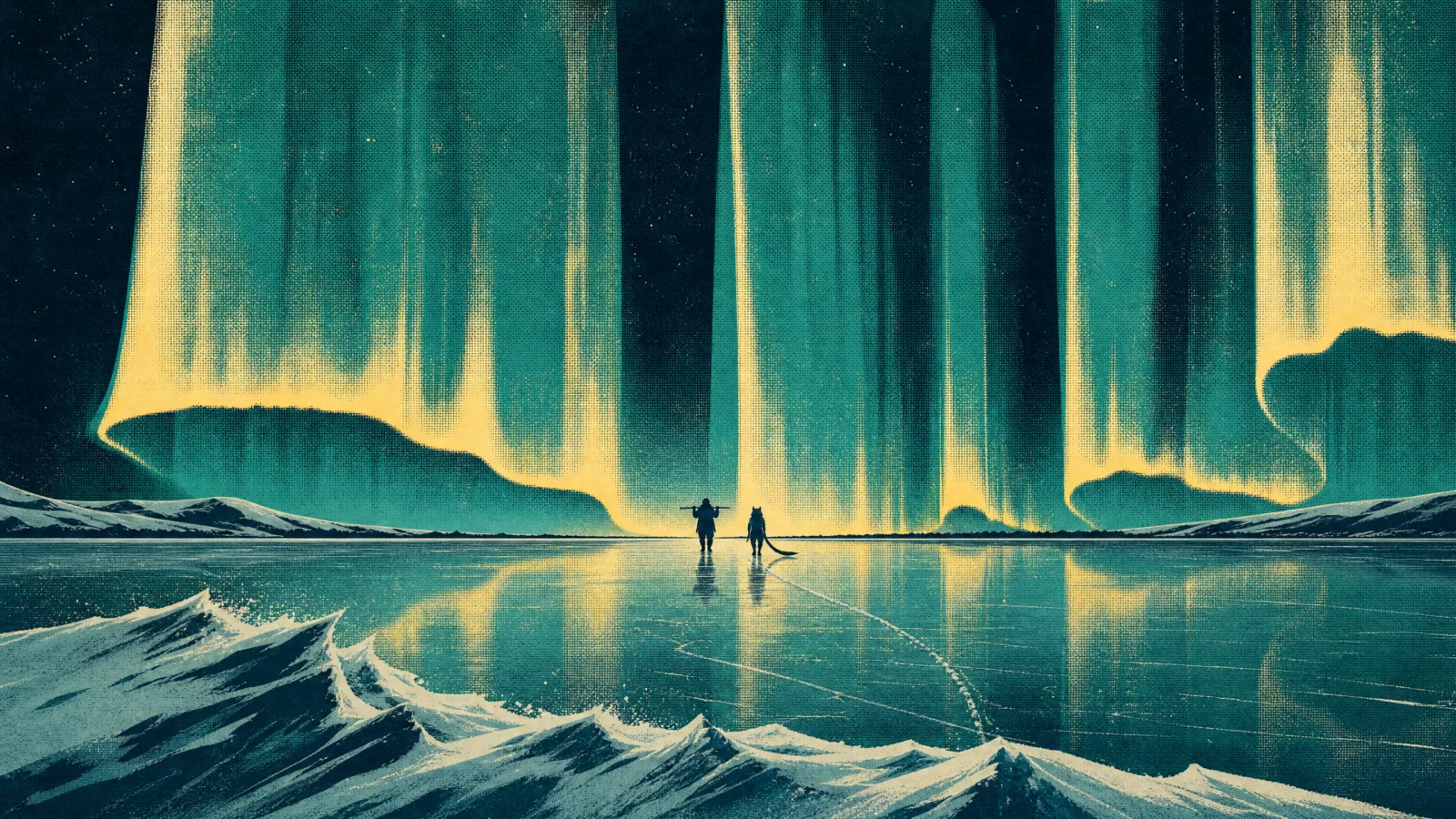
The wonder chapter, and the vault’s most symmetrical frame. Aurora curtains fill the sky, a frozen lake mirrors them, and the world becomes sky above and sky below with one dark line of snow between. The traveller and creature walk that line, side by side, exactly on the seam.
Two details carry the emotional weight. The staff is carried across the shoulders with both arms hooked over it, the walk of someone no longer bracing against the world. Five categories of the staff as support, and one carry position rewrites the character. Props are postures; how a figure holds a thing tells you who they have become. And the reflection breathes "a half-beat behind the sky", a mirror with lag reads as alive, where a perfect mirror reads as glass.
What to steal from this one: change what a recurring prop means by changing how it is held. And give reflections a slight delay or imperfection whenever you want the world to feel like it is participating instead of just rendering.
Swap ideas: the same lake with the aurora’s colours in the ice only, the sky itself dark, light living below. A heat mirage version at noon, curtains of shimmer instead of light. The pair stopped, sitting on the ice, the swept tail line ending in a curl around them.
Prompt 3: The Green Flash
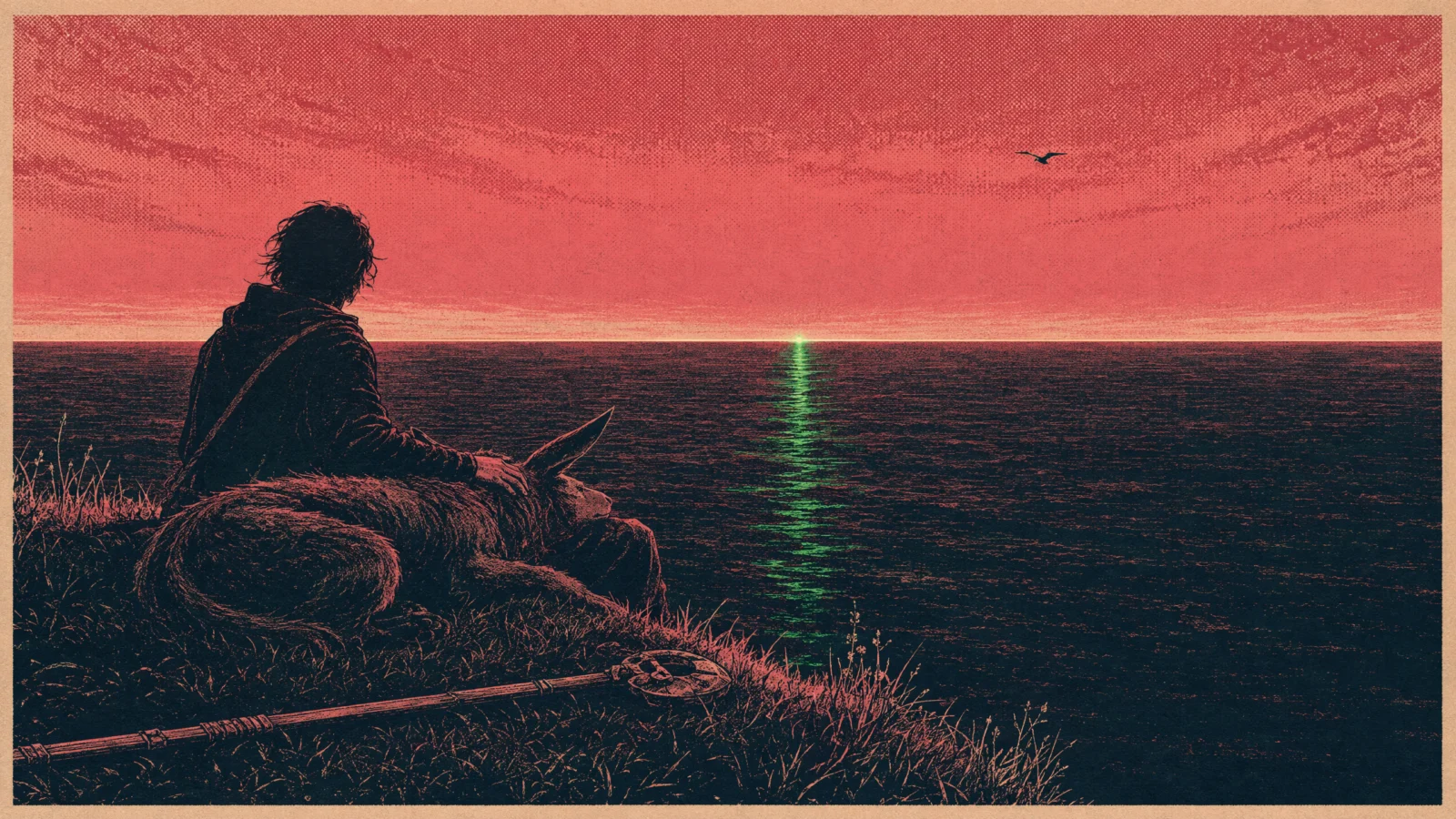
The grace chapter, and the smallest light in the entire vault: one emerald spark at the exact point where the sun vanishes, gone in a second, and the frame knows it. After five categories of colossal light events, the finale’s centrepiece moment is the tiniest one, and it out-hits all of them. Scarcity is intensity. One second of green is worth more than a sky of gold because the frame tells you it will not last.
The watchers hold the emotional register: the traveller sits on the cliff edge, legs hanging, staff laid flat in the grass, off duty for the first time in the vault, and the creature’s head rests across the traveller’s lap. The hand flat on its neck is the touch that Prompt 3 of Close Quarters deliberately withheld. Planted there, paid off here. The vault’s rules about earning contact were building to this frame.
What to steal from this one: make your rarest element your smallest, and let the frame acknowledge its own briefness. And if you withheld a touch, a meeting, or an arrival earlier in a series, its payoff frame should be quiet, not loud.
Swap ideas: a blue flash at moonset over a desert, colder and stranger. The flash missed, the traveller mid-blink turned toward the creature, the green burning behind them unseen, a completely different meaning from one head turn. A city crowd on a harbour wall, dozens of silhouettes, and only one child-sized figure pointing at the right second.
Prompt 4: The Fire Rain
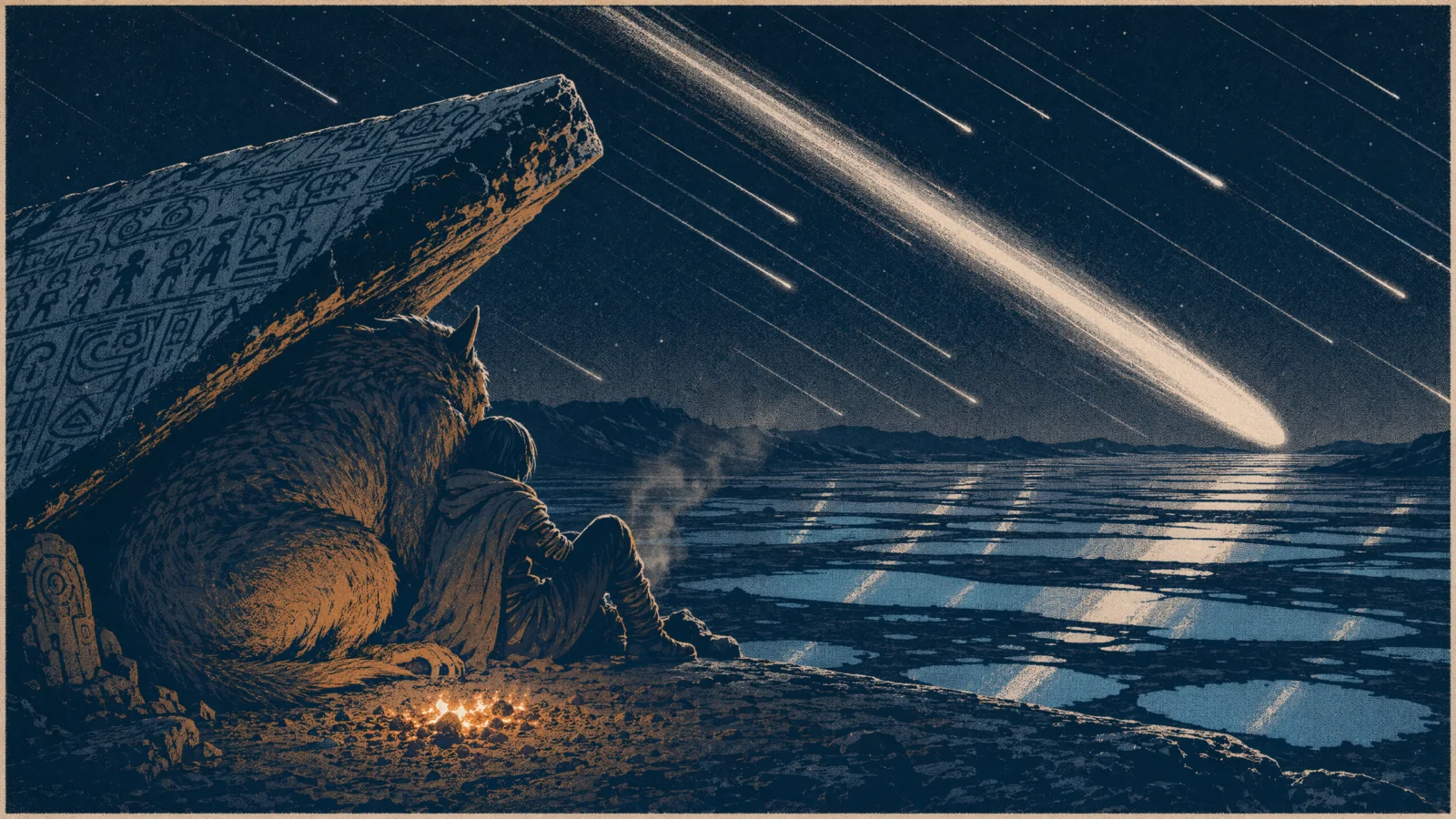
The peace chapter, built on the vault’s boldest contrast: the sky’s most violent event watched from its safest place. A meteor storm fills the night in matched diagonals, and the traveller sits back against the creature’s flank under a leaning carved slab, warmed by a tiny ember bed. The creature curled "like a wall" completes the companion arc’s protective turn, and the frame’s whole meaning lives in the two lights: cold meteor silver striping the world, one small amber glow holding the shelter. The vault’s giant sky and the vault’s smallest fire, and the watchers held between them.
The craft lesson is danger at a distance: the meteors reflect in rain pools, fall in matched diagonals, and the DO NOT bans any ground impact. The storm stays sky, the shelter stays safe, and the frame reads as peace instead of peril. Where the threat lands decides what the image feels, place it carefully.
What to steal from this one: two lights, one vast and cold, one small and warm, and put your subject between them. And decide whether danger touches the ground in your frame; that single choice sets the entire emotional register.
Swap ideas: the same storm watched from inside the ribcage waystation, lanterns and meteors sharing the sky, the market silent and looking up. A lightning sea version, the pair sheltered on a headland while silent storms stack offshore. Dawn after, the basin steaming, one new small crater glowing far off, the only impact, and it already cooling.
Prompt 5: The Sun Pillar
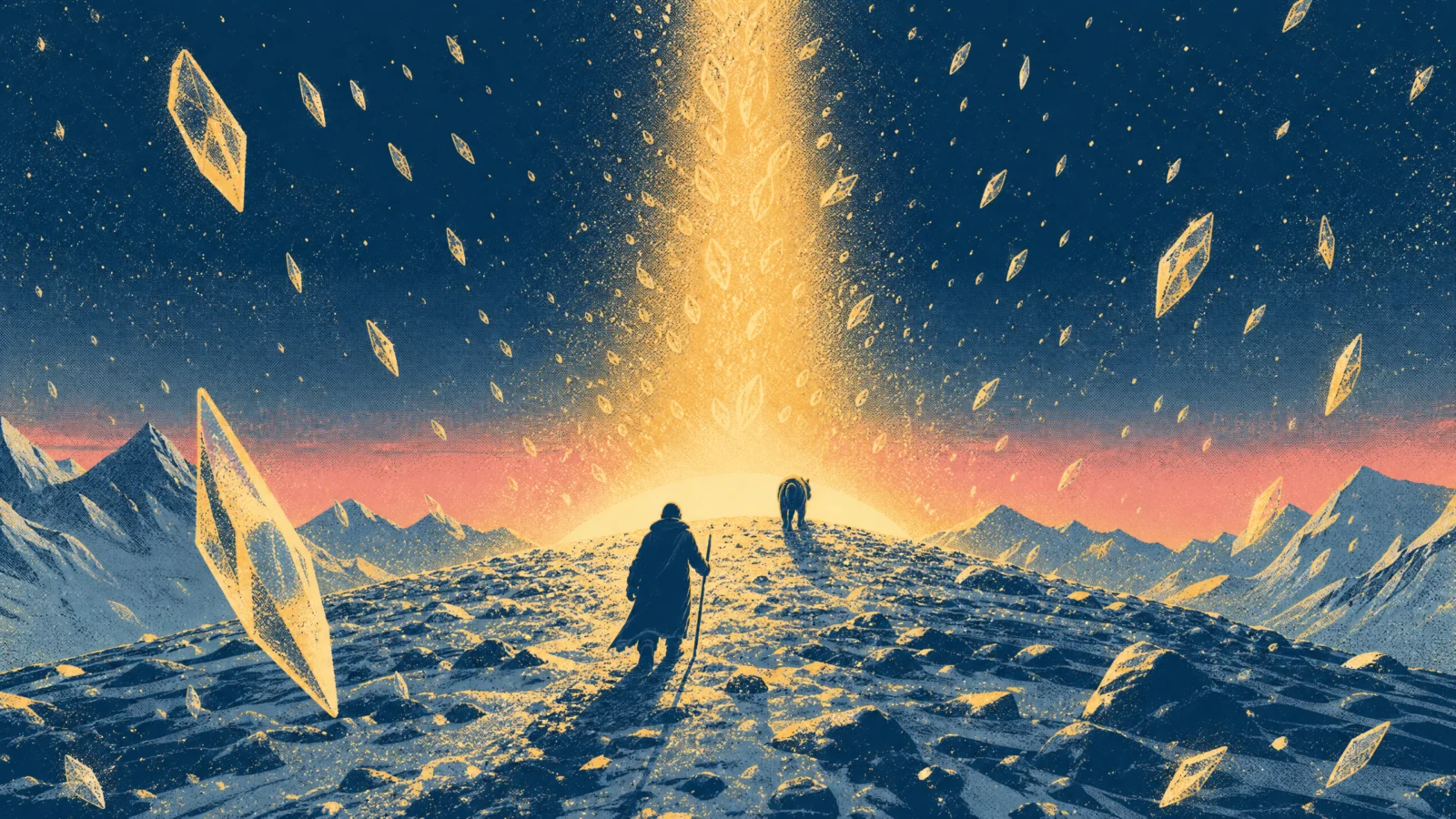
The guidance chapter, and the last climb. A vertical column of gold light stands from the sun’s disc straight out of the frame, built from millions of drifting ice crystals catching fire, and the pair climbs the pass toward it. This is the vault’s final scale statement, and it runs on the crystal physics: the pillar is not a beam, it is countless small drifting things each flaring as they cross the light. Light made of particles always outperforms light made of glow, because the model renders the particles and the particles carry the depth.
The story detail that closes the companion arc: the creature leads. One stride ahead, for the first time in six categories. The follower from Category 1’s ridge, thirty paces behind in the dark, now walks first into the light. One position swap, the entire relationship’s journey. And the staff is a walking stick again, planted mid-step, tools return to being tools when the story lets them.
What to steal from this one: build big light from small particles, always. And when a series ends, look for the one positional reversal, who leads, who follows, who carries, that shows the arc without a word.
Swap ideas: a moon pillar at midnight, silver column, the pair descending instead of climbing. Twin pillars from a double sun, a fork in the light, the frame holding the choice. The pillar seen from inside, crystals flaring past the camera, the two silhouettes ahead in the gold.
Prompt 6: The Long Sun Sets
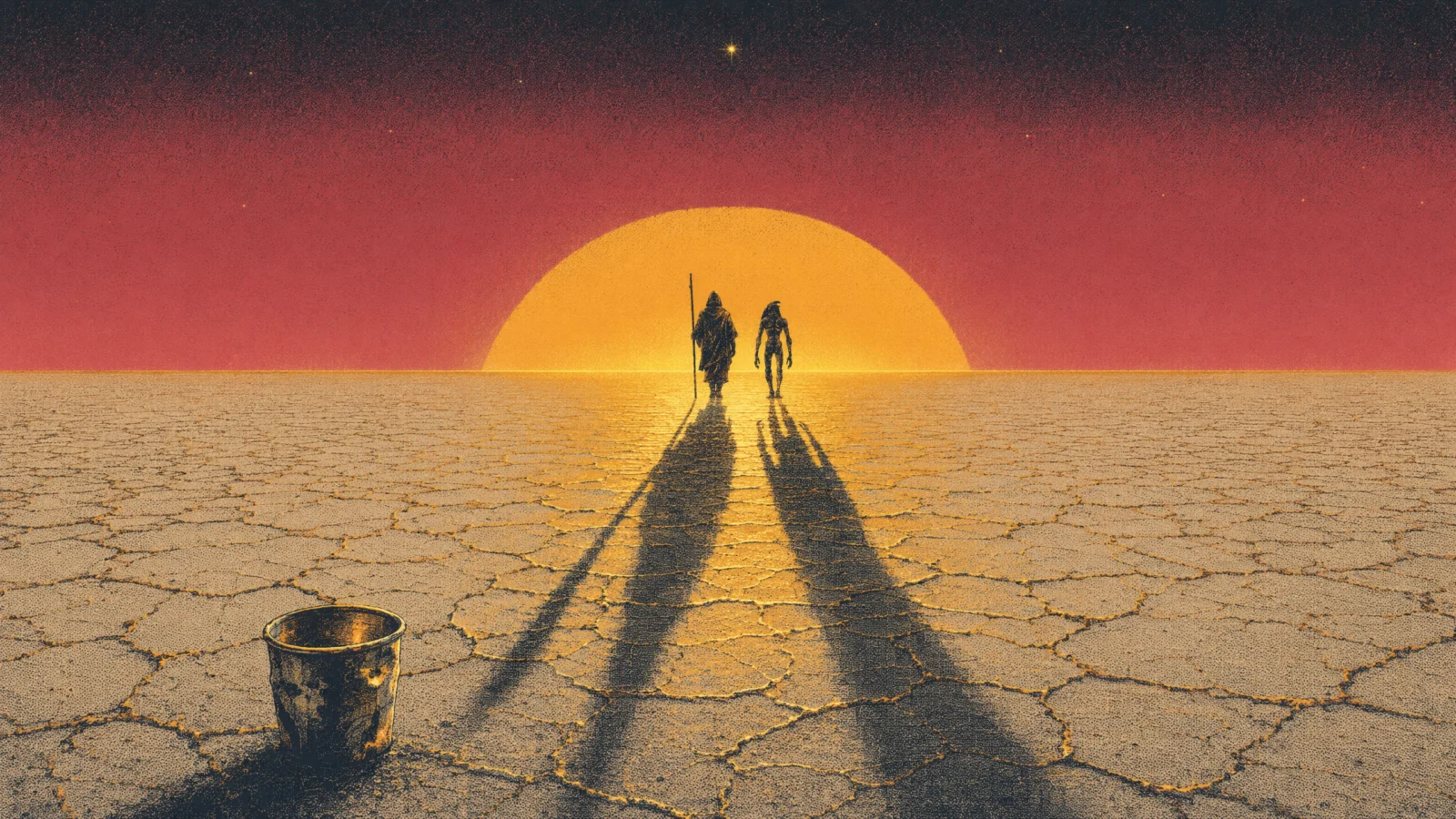
The final frame of the vault, and the full circle. The same endless salt flat from The Long Walk. The same giant sun, now half sunk and finally setting. The same bright path across the cracked ground, and on it, two walkers instead of one, side by side, unhurried, their long shadows stretching back toward camera. And in the near foreground, planted upright in the salt, the dented cup from The Last Water, left behind, holding one last glint of gold.
Everything the finale chapter of any series needs is in the mechanics of this frame. The mirror: same location, same composition as the vault’s opening image. The differences: direction reversed (walking away into the light, not toward an indifferent horizon), the number changed (two, not one), and one object surrendered. The cup is the receipt of the whole story, the vessel of the first shared water, no longer needed because the sharing became permanent. The shadows do the last piece of work: "longer than they will ever be again," reaching back down the path toward the viewer, toward everywhere the journey has been. And one early star at the top of the frame, because every ending is also a night beginning.
The DO NOT holds the tone: the walkers never stop and never look back. An ending walked through, not posed for.
What to steal from this one: everything above is the template. Mirror your opening, change two or three earned things, leave one object behind, and keep your figures moving. That is how a series ends.
Swap ideas: the dawn-after version, the salt flat at first light, the cup still standing, the walkers gone, only two sets of tracks running toward the horizon. Your own series’ version, your first frame, mirrored, with your two or three earned changes. The one-year-later frame, the cup half buried in salt, a new lone traveller’s boot entering the frame beside it, the journey beginning again for someone else.
Fixes If A Render Drifts
All fixes from Categories 1 to 5 still apply. The finale adds four:
- The eclipse renders as a normal sun: harden the disc: "the sun’s face is pure black, a hole in the sky, only its rim burning." The black disc is the frame; protect it first.
- The aurora mirror fails on the ice: fall back gracefully to "the aurora’s glow washing across the ice in soft bands" and let the perfect reflection go. The walkers on the seam still carry the frame.
- The green flash floods the sky: pin it to its point: "the green exists only at the one point where the sun vanished, nowhere else in the frame." One spark, or the meaning dies.
- The foreground cup vanishes in Prompt 6: small foreground objects are the first thing GPT2 drops. Promote it: move the cup to the front of SCENE and add "the dented metal cup is the nearest and sharpest object in the frame." It is the emotional payload; do not publish the frame without it.
The Vault, Complete
Thirty six frames, one journey. The Pilgrim taught scale and the silhouette. The Colossus taught monumental structure. Sky Objects taught the sky touching the ground. The Inhabitants filled the world and taught crowds, speed, and ritual. Close Quarters brought the camera to arm’s length and taught hands, objects, and trust. Light Events ended it: awe, wonder, grace, peace, guidance, and home.
Every technique stacks. Every frame is 16:9 and carries its MOTION SEED, which means this vault is also a thirty-six-shot storyboard waiting for its video episodes. The Long Sun will rise again.
Next Step
Start at Category 1 and build the journey in order, or jump to the category your current project needs. And keep your remixes on the spine: four colours, print finish untouched, one light event, silhouettes only, no faces ever. The system is the style.
Tools used in this lesson: