
Section 01
Episode 1: The Waking Giant
Retro Print Cinema, The Living Print Style
A vintage screen-print poster that comes alive. A colossal stone giant tears itself out of the earth, boulders cascade off its shoulders, the dawn sun flares as its head crowns it, and through all of it the image never stops being a print: flat colours, halftone grain, paper texture, alive and moving.
This is the style we are building this whole vault on, and it has a name: the Living Print. Vintage screen-print poster art brought to life, flat colour separation, halftone grain, and paper texture preserved in motion, with full cinematic camera and physics. Not anime. Not photorealism. A poster in motion. Nobody else on YouTube is animating in this style, which is exactly why we are.
This page teaches the full prompt line by line: what every block does, why it is there, and what breaks if you change it. By the end you will not just have this clip, you will be able to put any print-style image you own into motion.
What You Need
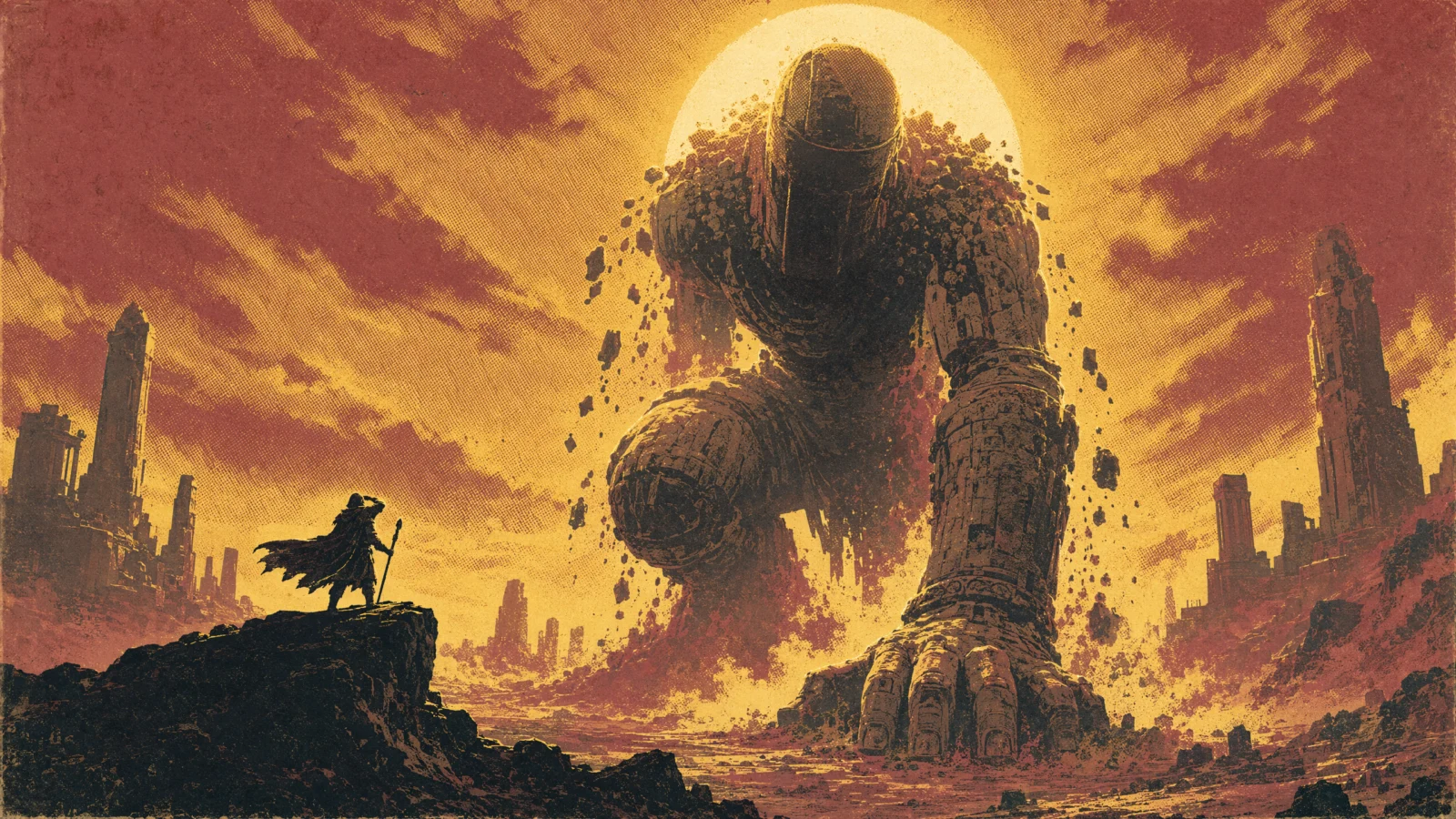
One reference image: the Waking Giant frame from Vol.17 Category 2 (or any print-style image with one big clear event in it). Upload it to Seedance 2.0 on OpenArt as your only image. Set duration to 15 seconds, 16:9.
One important thing before we start: we are NOT using this image as a first frame. We are using it as a composition and style reference, and that single choice is the biggest lesson on this page. Read on.
The Full Prompt
Block By Block: What Every Line Is Doing
Block 1: The Reference And Style Lock
This is the most important decision in the whole prompt, so let us slow down on it.
Why composition reference and not first frame. We tested both, and the difference is night and day. When you give Seedance an image as the first frame, it locks your exact pixels as the starting point. That sounds good, but it makes the model treat everything in your image as fixed paint. The sky sits dead. The background never participates. You get your image with one thing wiggling in it. When you give the same image as a composition and style reference, the model rebuilds the scene in your style and then owns every element in it, which means the sun can flare, light can sweep the valley, dust can roll, the whole world can react.
The trade you are making: with composition reference, the clip will not match your still image pixel for pixel. The giant will be slightly different, the layout will drift a little. For this vault that is exactly right, we want the world of the print, in motion, not a slideshow of the exact print.
Try it yourself: run this same prompt once with "as the first frame" instead. Watch how the sky freezes and the energy dies. That one comparison will teach you more about Seedance reference behaviour than any tutorial.
The style sentence. "Flat colour separation, halftone dot grain, limited four-colour palette, matte paper texture in every frame." Every phrase here is a wall against Seedance’s default behaviour. Seedance wants to render realistically, that is its training. Left alone, it will smooth your flat colours into gradients, dissolve your grain, and add photoreal lighting by around second three. Naming each print property individually, and saying "in every frame," is what holds the style for the full 15 seconds. If you shorten this to just "keep the art style," the clip starts as a print and ends as a 3D render.
The sky line. "The sky stays exactly as the reference: a clear glowing dawn sky with fine dust haze, no cloud layer." This line exists because of a failure we hit in testing. Our reference image has a nearly clean sky, but an earlier version of this prompt told the clouds to race. Seedance had no clouds to move, so it invented some, and it dumped them in the last seconds of the clip when the main motion was winding down. The lesson: describe the sky your image actually has. If your reference has clouds, tell them what to do. If it does not, say so explicitly, or the model will donate its own.
Block 2: The Shot Declaration
Three jobs in one line. "One single continuous shot, no cuts" sets the format: this is a single take, and without this declaration Seedance may cut to a new angle mid-clip. "For 15 seconds" matches your generation setting, always state the duration inside the prompt too. And "fast, powerful motion throughout" sets the tempo floor for the entire clip.
That tempo phrase earns its place. Our first test of this episode came back beautiful and slow, everything drifted like it was underwater. Print-style images seem to pull Seedance toward gentle motion, maybe because most illustrated content it has seen moves softly. So the speed has to be demanded three times in this prompt: here in the declaration, in the event verbs inside WHAT HAPPENS, and in the DO NOT list where slow motion is explicitly banned. Remove any one of the three and the tempo sags.
If you want a calm clip instead: change this line to "SLOW, MAJESTIC MOTION THROUGHOUT," swap the event verbs down a register, and remove the slow-motion ban from DO NOT. The structure stays, the tempo dial moves.
Block 3: WHAT HAPPENS, The Three-Phase Arc
This is the biggest structural upgrade over our earlier vaults, so understand why it exists.
A 15 second clip with one instruction, "the giant rises," gives Seedance about four seconds of content and eleven seconds to improvise. Improvisation is where clips die: the model pads, loops, or invents (that is exactly where our phantom clouds came from). The fix is claiming every second with a written arc. Three phases: the strain (tension before the event), the rise (the event at full power), the settle (the aftermath, energy leaving the frame).
Notice this is build and release plus a landing. The strain makes the rise hit harder, because power reads strongest right after resistance. And the settle gives the final seconds a scripted job, the dust ring thinning, the last boulders falling, so the clip ends on purpose instead of running out of fuel.
Notice the phases are not timestamped. No "0 to 5s" markers anywhere. Timestamps tell Seedance to cut, and this is a continuous shot. Writing "first phase, second phase, final phase" as flowing prose gives the model the sequence without inviting an edit. This matters: if you replace the phase words with timestamps, you will get three separate shots.
The event verbs in caps. TEARS, RACING, CASCADE, SURGES, HIT, CRACKING. Every phase leads with a violent verb, and the caps genuinely bias the model toward stronger motion on those words. Compare "the shoulder comes free of the ground" against "the shoulder TEARS free of the valley floor." Same event, completely different energy in the render.
The traveller line. "The traveller on the outcrop HIT by the shockwave, cloak CRACKING backward." One human-scale reaction inside a giant-scale event. This is what sells the size: the giant looks big because something small gets pushed by it. When you build your own version, always keep one small witness in the frame and let the event touch them.
Swap lesson: this three-phase skeleton carries any transformation. A tower collapsing: the groan, the fall, the dust plume drifting. A ship surfacing: the swell, the breach, the water sheeting off. Keep strain, release, settle, and change the nouns.
Block 4: WHO REACTS, The Environment Layer
This block is the difference between an animated sticker and a living scene. In our first test, the giant moved and the world watched politely. Dead backgrounds are the number one tell of low-effort AI video. So WHO REACTS is now a full environment layer, and there is a rule hiding in its first sentence: "the environment answers with what it owns."
What it owns. That phrase is the whole discipline. Look at what reacts: the sun flares (the sun is in the image), light sweeps the valley (the sun is being blocked and revealed), dust rolls in a ring (the giant is throwing that dust), the haze shifts (the haze is in the image). Every reaction comes from something already present in the reference. Nothing is imported. The moment you ask the environment to react with things it does not have, clouds in a clean sky, birds that were never there, the model invents, and inventions arrive late, cheap, and off-style.
So when you adapt this block, do an inventory first: what does my image actually contain? Sky, light source, ground material, loose particles, vegetation, water? Those are your reaction instruments. Write reactions only for those.
The traveller’s second beat. "Leans hard into the wind, then slowly straightens as it passes." The witness gets an arc too, matching the three phases. Small figures with their own timeline read as characters; small figures with one frozen pose read as decals.
Block 5: CAMERA
Three techniques stacked here, all reusable.
The compound move. Push-in while tilting up, two motions at once. A single move reads mechanical, a compound move reads like a camera operator making a choice. And this specific compound is doing story work: pushing in while tilting up makes the giant grow past the frame edges, so the camera itself performs the scale.
The one shudder. "Camera shuddering once on the shoulder tear." Camera shake is a spice, not a sauce. One shudder synced to the biggest impact makes that moment physical. Constant shake for 15 seconds makes the whole clip feel broken. If your clip has one hit, give the camera one flinch, on the hit, never elsewhere.
The ease-out. "Easing to a slow drift as the giant holds its full height." The camera tempo follows the event tempo: fast through the strain and rise, calm in the settle. If the camera kept charging while the scene settled, the ending would feel wrong and you would not know why. Camera energy and event energy must land together.
Block 6: SFX And BGM
The audio is written as the same three-phase arc as the visuals: tearing and impacts (strain and rise), then "fading to ringing quiet" (settle). The BGM matches, build, swell at the exact story peak ("at the crowning"), resolve to a drone. Anchoring the musical peak to a named visual moment is the trick worth stealing, Seedance genuinely tries to line them up. Keep audio direction as neutral cinema language like this, name textures and arcs, and it renders reliably.
Block 7: The Quality Line
Short and adapted for this style. Note what is missing: no "4K Ultra HD cinematic texture" from our usual closing line. Heavy realism-quality language pulls against the print style, we are deliberately not asking for cinematic realism. "Sharp print texture" asks for quality in the terms of this aesthetic instead. When your style is stylized, your quality line has to speak the same language.
Block 8: The DO NOT List
Every item here is a scar from a real failed take. Read it as four defence groups:
Style defence (photorealism, 3D render, smooth gradients, realistic lighting, losing grain, losing palette): the wall against Seedance’s realism pull, guarding the same properties the style lock names up top. Style is protected twice, positively at the start, negatively at the end, because it is the thing this entire vault lives or dies on.
Tempo defence (slow motion, sluggish movement): the third leg of the speed instruction.
Sky defence (added clouds, new sky elements, clouds forming, static sky during the rise): the phantom cloud fix. Note it blocks both failure directions at once, nothing new appears, AND the sky is not frozen. The sky must react using what it owns, which the WHO REACTS block already handles.
Format defence (cuts, shot changes, face detail, on-screen text): continuous shot protection, the no-faces rule from Vol.17 carried into motion, and the standard text block.
Keep your DO NOT lists like this one: targeted at failures you have actually seen, not a generic wall of every possible problem. A short sharp list holds; a fifty-item list dilutes.
The Method In One Box
Every episode in this vault, and any Living Print clip you build yourself, follows this skeleton:
- Reference as composition and style, never first frame. Let the model own the scene so the world can react.
- Lock the print style by naming its parts, and describe the sky your image actually has.
- Declare one continuous shot, the duration, and the tempo.
- Write WHAT HAPPENS as three phases: strain, release, settle. Claim all 15 seconds. No timestamps.
- Write WHO REACTS as an environment layer that only uses what the image owns.
- Compound camera move, one synced shudder maximum, ease out with the event.
- Audio follows the same arc, musical peak anchored to a named moment.
- DO NOT list guards style, tempo, sky, and format.
Variations To Try
The calm version. Same giant, opposite register: "SLOW, MAJESTIC MOTION," the rise taking the full clip, soft verbs, no shudder. Compare it against the fast version and you will feel exactly what the tempo instructions do.
A different event, same skeleton. Take Vol.17’s Storm Wall image: phase one the storm face curling tighter, phase two the last light beam dying as the wall arrives, phase three the traveller vanishing into the grey. Strain, release, settle.
Your own print. Any flat-colour, grainy image works, from Vol.17 or your own work. Inventory what the image owns, write the three phases, keep the style lock word for word.
Common Issues And Fixes
The style drifts realistic partway through. The style lock got diluted. Check that every print property is still named individually in Block 1 and that the full style defence group is in DO NOT. If it still drifts, add "risograph print aesthetic" to the style sentence as a named anchor.
Everything moves too slowly. One of the three tempo legs is missing. Check the declaration line, the event verbs, and the slow-motion ban. All three, always.
New clouds or objects appear late in the clip. Your sky or scene description does not match your reference, or a reaction asks for something the image does not own. Fix the description, audit WHO REACTS, and make sure the ending phase gives those final seconds a job.
The clip cuts to a different angle. The continuous-shot declaration is missing or you used timestamps in WHAT HAPPENS. Phases in prose, never numbered seconds.
The giant’s face renders detailed. Strengthen to "the giant’s head stays a rough featureless stone mass" in WHAT HAPPENS and keep the face ban in DO NOT.
The clip matches my image too loosely. That is the composition-reference trade working as designed. If a specific element must survive exactly, name it in the prompt body ("the traveller stands on the rock outcrop at lower left"). If you need pixel-exact, you are back to first-frame and you give up the living sky, choose per clip.
Next Step
Episode 2: The Lantern Herd. Thirty floating lights over a night marsh, a storm gust that scatters them like blown embers, and three herders on stilts fighting to gather them back, the vault’s coordination test, and the episode where you learn to direct chaos without the clip falling apart.
Section 02
Episode 2: The Lantern Herd
Retro Print Cinema, The Living Print Style
Thirty floating lights, a storm gust, and a marsh that mirrors everything. The herd drifts in calm rotation, then a hard wind tears across the marsh and scatters the glows like blown embers, the herders fight to hold them, and the water beneath doubles every single event. This is the vault’s coordination test: dozens of independent elements reacting at once, in three phases, without the print style breaking.
Episode 1 taught the template. This page teaches two new things on top of it: how to choose which image to animate (including the honest story of why this episode almost used a different frame), and how to direct chaos, many elements moving together without the clip falling apart.
The Lesson Before The Prompt: Why This Image
This episode was originally planned around a different Vol.17 frame, the sprinting pack racing the storm. We built the prompt, tested it, and the animation came back fast and beautiful, and fake. The reason is worth a whole section, because it will save you credits forever.
A video model animates the physics your image gives it. In the sprint frame, several galloping animals were mid-stride with no clear ground contact, which is fine in a still, frozen motion reads as speed. But Seedance took the floating poses literally and kept them floating. No prompt fixes that, because ground contact is a property of the input image, not the animation. The clip moved perfectly and believed nothing.
So the swap logic: pick the image where the "flaw" is the physics. The lantern herd is supposed to float. The exact property that broke the race is the feature here. And the marsh gives every other element honest contact: stilts planted in water with ripple rings, and every glow doubled as a reflection. Contact through reflection is even stronger than contact through ground, the water confirms where everything is.
The rule to keep: before animating any image, audit its contact points. Does everything that should touch the ground touch it? Are mid-air elements supposed to be mid-air? If a still uses frozen motion for drama (thrown sand, leaping figures, falling debris), expect the video model to inherit those exact positions. Choose frames where the physics you see is the physics you want.
What You Need
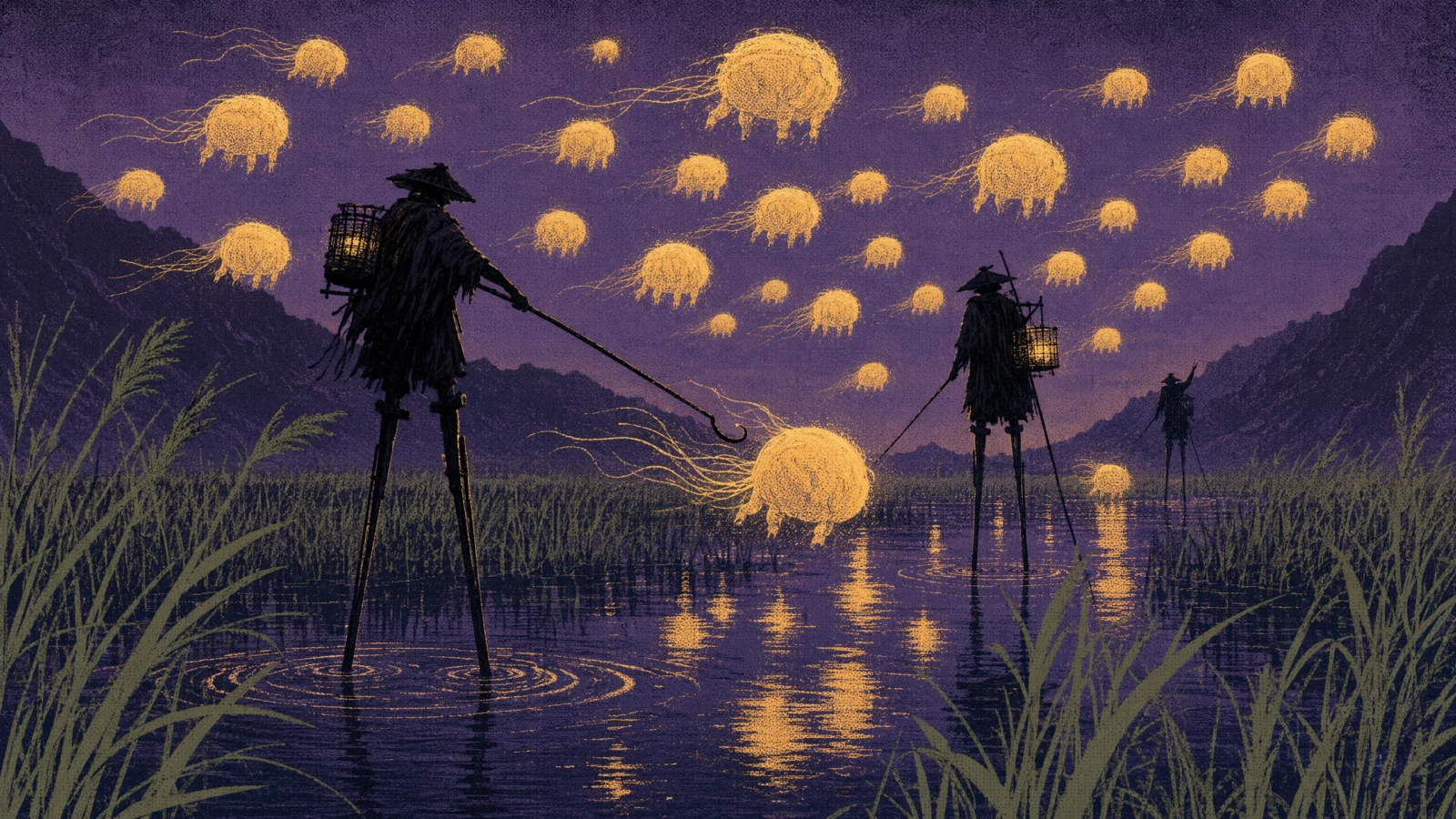
The Lantern Herd frame from Vol.17 Category 4 (or any print-style image with floating elements and a reflective surface). Upload to Seedance 2.0 on OpenArt, one image, 15 seconds, 16:9. Composition and style reference, never first frame, same as Episode 1, the world has to own its water and reeds to make them react.
The Full Prompt
Block By Block: What Is New In This One
The style lock, shot declaration, quality line, and DO NOT structure carry over from Episode 1, read that page first if you have not. Here we go deep on what this episode adds.
The Shot Declaration: A Tempo Shape, Not A Tempo Level
Episode 1 set one tempo for the whole clip: "fast, powerful motion throughout." This declaration does something more advanced: it names a tempo curve. Calm, chaos, calm. The reason it lives up here and not just inside the phases: the declaration is the first thing the model reads, and setting the shape early means every block after it is interpreted inside that arc.
What changes if you flatten it: write "fast motion throughout" on this clip and the calm phases die, the drift becomes jittery, the regather never settles, and the gust loses its impact because nothing contrasts it. The gust only hits because the drift was slow. Contrast is the tempo trick, and it is declared in one line.
WHAT HAPPENS: Directing A Crowd Of Motion
The three-phase arc returns (drift, gust, regather is just strain, release, settle wearing marsh clothes), but the new problem is population. Thirty glows, three herders, reeds, water. You cannot direct thirty things individually, and you must not direct them as one blob. The block solves it with group verbs plus named exceptions:
The herd gets group verbs: FLOATS in rotation, SCATTERING downwind, CURVE back in. One instruction moves thirty bodies. The herders get individual actions: LUNGING with poles, stilts DRIVING deep, SWEEP in wide arcs. Three named actors carry the story inside the crowd. This is the same hero-action rule from the Vol.17 crowd frames, now in motion: masses move by group instruction, meaning moves through named figures.
The direction discipline. Look at phase two: reeds SLAMMING flat "in one direction," the herd scattering "downwind," tendrils streaming. Everything in the gust obeys one wind. In testing, this is the single most fragile thing about chaos scenes, if elements scatter randomly, the clip reads broken instead of stormy. Chaos on screen is not randomness, it is one force applied to many things. When you write your own chaos phase, name the force, name its direction, and make every moving element obey it.
The simile trick. "Scattering downwind like blown embers." One simile gives Seedance a complete motion behaviour, embers drift, swirl, and sink in a recognisable way, that would take three sentences to describe mechanically. Use one simile per phase maximum, and pick ones with famous physics: blown embers, falling leaves, startled birds, spilled marbles.
The regather geometry. "CURVE back in from the edges of the frame, drawing together into one drifting cluster." The path is named, curved, from the edges, into a cluster, because without a path, scattered elements teleport home. Endings that reassemble need travel written into them.
WHO REACTS: The Mirror Is A Second Cast
Episode 1 taught "the environment answers with what it owns." This episode’s inventory has a superstar item: the water. And the block treats the reflections as their own actors, they race, they rejoin, they reassemble. This matters because reflections are the contact system of the whole clip (the reason this image was chosen), so they cannot be implied, they have to be directed. "The water reflects the creatures" is passive and will be dropped by second five. "Every glow’s reflection races and rejoins beneath it" is an instruction the model keeps.
The water also gets a full arc of its own: SHATTERS into ripples, then SMOOTHS to a mirror. Surface states are phase markers, when the audience sees the mirror return, they feel the story resolve without knowing why.
Steal this whole pattern any time your scene has water, glass, ice, or wet ground: give the reflective surface its own arc, and give the reflections verbs.
CAMERA: The Camera Joins The Weather
Same principle as Episode 1 (camera energy matches event energy) but pushed one level: the camera now follows the tempo curve through all three states. Drift, push, track, ease, rise. The push forward at the gust is the key beat, the camera physically joins the wind, entering the herd as it scatters, which puts the viewer inside the chaos instead of watching it.
The final move, "easing back and rising slightly," is composition work: it frames the reformed cluster and its full reflection for the closing frame. The last shot of the clip is the image’s thesis, floating lights doubled in a mirror, so the camera is explicitly told to end there. Always give your camera a named final frame; clips that know their last image end clean.
The DO NOT: Population Control
Two new defence items worth understanding. "Creatures popping in or out, glows changing count drastically": crowd clips tempt the model to spawn and delete bodies during chaos, this pins the population. And "static water, frozen reeds": the inverse guard, the environment must not sit out the storm. Between the two, the scene can neither overreact by inventing nor underreact by freezing. That pairing, no inventing plus no freezing, is the standard sky-and-surface defence for every episode in this vault.
The Method Update
Everything from Episode 1’s method box holds. This episode adds four:
- Audit contact points before choosing an image. Floating that should be grounded cannot be fixed by prompting. Pick frames whose physics is the physics you want.
- Declare a tempo shape, not just a tempo level, when your clip has more than one energy state.
- Direct crowds with group verbs, carry meaning with named actors, and bind all chaos to one directional force.
- Give reflective surfaces their own arc and reflections their own verbs.
Variations To Try
The night herd. Same prompt, sky changed to full night in the style block, the glows becoming the only light. The water flicker line gets stronger, every reflection becomes a lantern.
The stampede inversion. Phase two swaps the wind for a predator shadow crossing the moon: the herd scatters upward instead of downwind. One force, one direction, straight up, everything else identical.
Your own crowd. Any Vol.17 frame with multiple figures works on this skeleton, the market, the mourners, the caravan. Group verbs for the mass, named actions for three heroes, one force per chaos phase.
Common Issues And Fixes
Reflections vanish during the gust. The model dropped its second cast under load. Add "every creature keeps its reflection at all times" to WHO REACTS. If it persists, reduce the herd size in phase one, fewer bodies, more reflection budget.
Elements scatter in random directions. The one-force rule broke. Name the wind direction explicitly ("left to right") in every phase-two line: reeds, herd, tendrils, cloaks, all of it.
Herders’ stilts merge or tangle. Same failure family as the gallop legs. Cut to two herders and give each one a distinct action, one lunging, one sweeping.
Glows teleport back in the regather. The travel got skipped. Add "each glow travels a visible curved path back to the cluster."
The calm phases jitter. Tempo leaked from the declaration. Confirm "slow motion during the gust" (not everywhere) is the only tempo ban in DO NOT, and that phase one and three use drift verbs, not event verbs.
Water freezes after the gust. The settle got read as a stop. Change "settling to a mirror" to "settling to a mirror with the last slow ripples still crossing it", stillness-alive, the frame keeps breathing.
Next Step
Episode 3: The Broken Ring. The sun trapped inside a shattered colossal ring, ash storming through the gap, and the vault’s first light-transformation clip, where the event is not a thing moving, but the light itself changing state.
Section 03
Episode 3: The Broken Ring
Retro Print Cinema, The Living Print Style
Nothing in this clip moves. Everything in this clip changes. The sun seated inside the broken ring builds from a smolder to a full white blaze and dies to a red ember, and the whole world answers the light: shadows swing and stretch, ash ignites into sparks and rains back dark, heat shimmer thickens and thins, and a tiny traveller walks through the middle of it all.
Episodes 1 and 2 animated things, a rising giant, a scattered herd. This episode animates light itself. The event is not an object crossing the frame; it is the frame changing state. This is a register most AI video creators never touch, because it needs a different way of writing prompts, and that different way is the whole lesson of this page.
The Lesson Before The Prompt: Light Is An Actor
Here is the mental shift this episode runs on. In a normal prompt, light is scenery: you set it once in a style line ("golden hour, rim lighting") and it holds still while things move through it. In a light-transformation clip, the light is the character, and it needs everything a character needs: an arc, verbs, and consequences.
The arc: smolder, blaze, ember. The verbs: PULSING, SURGES, BURSTING, SINKS, RETRACTING. And the consequences are the real secret, light on its own is invisible in a flat print style. You cannot show "brighter" directly in flat colour. You show it through what the light does to physical things: shadows stretching, ash igniting, edges rimming with fire, plates flickering. Every physical element in the frame becomes a light meter.
That is why this image was chosen. The Broken Ring frame is full of light meters: fallen fragments that cast shadows, drifting ash that can catch fire, heat shimmer, a cracked reflective plain, and a silhouette whose edges can burn. The audit from Episode 2 (what does the image own?) applies here with a twist: for a light clip, you are auditing for things that light can visibly change.
What You Need
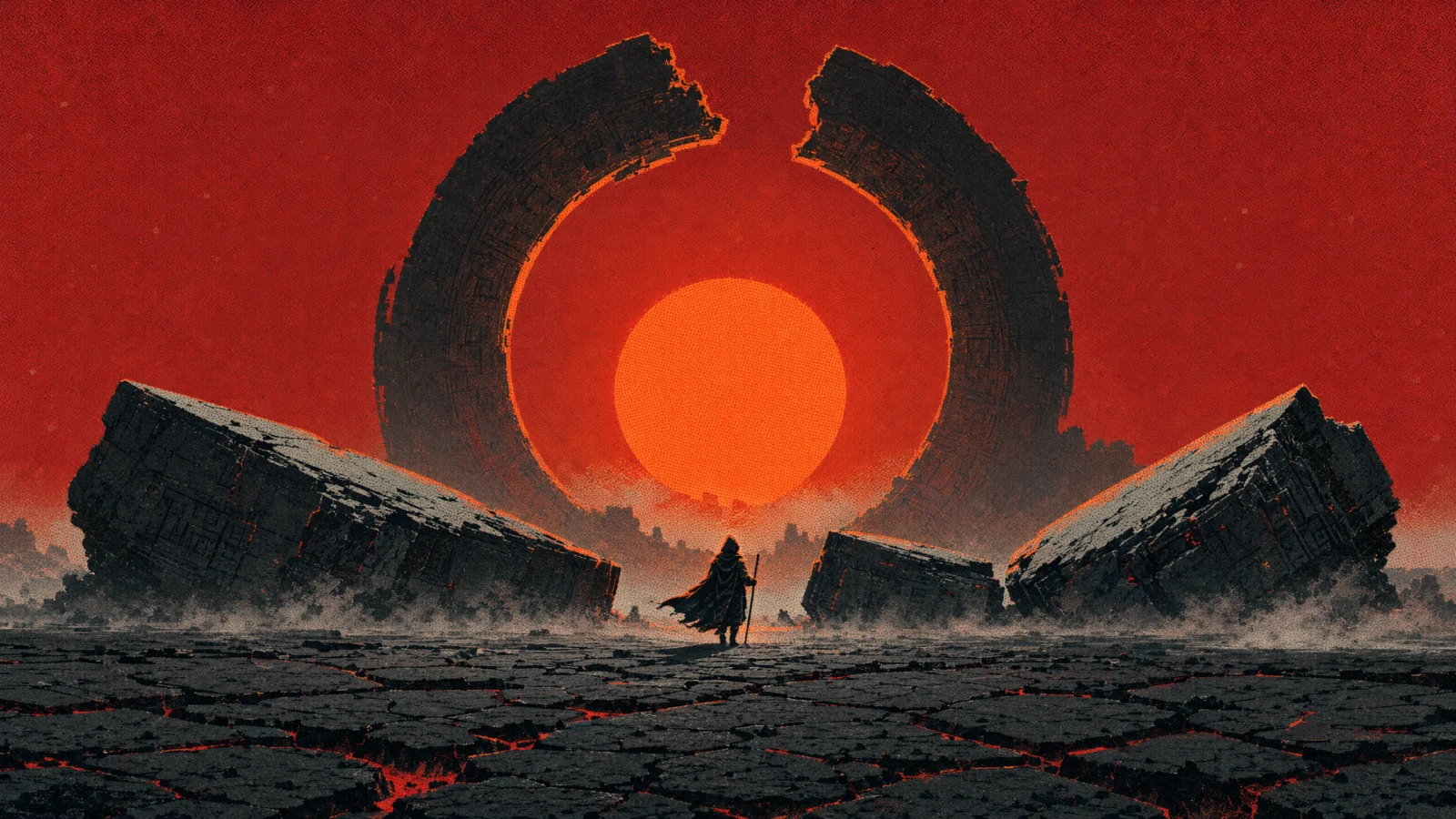
The Broken Ring frame from Vol.17 Category 2 (or any print-style image with one dominant light source and plenty of shadow-casting elements). Upload to Seedance 2.0 on OpenArt, one image, composition and style reference, 15 seconds, 16:9.
The Full Prompt
Block By Block: What Is New In This One
The style lock, composition-reference choice, and DO NOT skeleton carry over from Episodes 1 and 2. Here is what this episode teaches on top.
The Shot Declaration: Naming The Event Type
Episode 1 declared a tempo level. Episode 2 declared a tempo shape. This declaration goes one further: it tells the model what kind of event this is. Without this line, Seedance reads a prompt full of a sun, a traveller, and fragments and guesses that the traveller is the subject, you would get a walking clip with pretty lighting. This line reassigns the lead role before any block is read: the light is the protagonist, and its arc is named in three verbs.
Steal the pattern: whenever your clip’s real subject is not the obvious object in frame, say so in the declaration. "The water is the event." "The shadow is the event." One sentence of casting saves five failed generations.
WHAT HAPPENS: Writing Change Instead Of Motion
Read the three phases again and notice something: almost nothing travels. The sun stays seated in the ring. The fragments never move (banned in DO NOT, in fact). The traveller walks, but slowly, as a witness. Everything else changes state: dim to bright, cold to ignited, short shadows to long, rising sparks to falling flecks. This is the core craft of a light clip, you write transitions of state, not paths of motion.
The smolder: promise the eruption. "PULSING slowly brighter" is the whole first phase in two words. A pulse is a promise, the audience reads a brightening light as something about to happen, which buys you five calm seconds of pure tension. Never open a light clip at full blaze; a peak with no build is just a bright picture.
The blaze: spend every light meter at once. Count the consequences in phase two: rays burst through the opening, ring edges ignite, shadows swing and stretch, ash becomes sparks, the silhouette burns at its edges, the hand rises to shield the hood. Six physical reactions to one event. At the peak of a light clip, every meter in your inventory fires together, that simultaneous agreement is what makes the surge feel enormous in a style that cannot do realistic glow.
The hand to the hood. The smallest line in the phase and the most important. One human gesture confirming the light is real, the traveller feels it, so we believe it. Every light event needs one body reacting to it. Without the shield gesture, the blaze is a screensaver.
The ember: reverse the meters. Phase three is phase two played backward: rays RETRACTING, shadows fading, the same ash that rose now RAINING back dark, the silhouette merging with dusk. Symmetry is the cheapest beauty available, the audience watched everything ignite, so watching it all quench in order feels composed, not just faded. And the last line, "only the ring’s inner edge still holding a thin line of fire," is the stillness-alive ending: one element keeps burning so the final frame breathes instead of stopping.
WHO REACTS: Shadows Are The Truth Test
Of all the light meters, the shadows are the one that decides whether this clip convinces. Here is why: everything else (glow, sparks, haze) can brighten as a surface effect, but moving shadows require the model to understand that the light causes the scene. A shadow that swings when the sun surges is proof of a connected world. A shadow that sits painted while the light changes is the instant fake tell, the exact same class of failure as the floating gallop in Episode 2’s origin story: a physics contradiction no beauty can cover.
That is why shadows get their own explicit line in WHO REACTS and why "static shadows" sits in the DO NOT. If your test render comes back with everything working except the shadows, do not accept the take. Promote the shadows to actors: give them phase-by-phase directions inside WHAT HAPPENS ("in the blaze, the fragment shadows stretch to triple length across the plain"). Named positions per phase is the nuclear fix, and it works.
The plates line. "The cracked volcanic plates FLICKER with reflected fire at the blaze then dim plate by plate." Note "plate by plate", the dimming travels across the ground in steps rather than as one global fade. Sequenced reactions read as light physically leaving; global fades read as someone turning down a slider. Whenever something dims, brightens, or freezes across a surface, make it travel.
CAMERA: The Camera Defers
Episodes 1 and 2 taught camera energy matching event energy. This episode teaches the exception: when light is the event, the camera defers at the peak. It pushes in through the smolder, then holds absolutely steady through the blaze. The reason: a light surge reads as change in the frame’s own values, and if the camera is moving at that moment, the brightness change and the motion blur together and the surge loses its edge. The camera moves when things move; it holds when things transform. Then it resumes its gentle push in the ember, and it is given its named final frame: the burning inner edge and the small silhouette together.
The DO NOT: Pinning What Must Not Move
Two bans unique to this episode, both about stillness:
"The sun moving position across the sky." The sun brightens and dims but never slides. The entire composition is the disc seated inside the broken arc, if the model animates a sunset path, the framing collapses. Rule: when a light source changes intensity, explicitly pin its position, because Seedance associates "sun plus time passing" with movement across the sky.
"The ring fragments moving or crumbling." The blaze language (igniting, burning edges) tempts the model to make the structure react physically, crumbling, shifting. The fragments are stone; only their light changes. And "lens flare" guards the peak: white-hot intensity is exactly where Seedance reaches for photoreal glow bloom and flares, which would break the flat print style at the clip’s most visible moment.
The Method Update
Everything from Episodes 1 and 2 holds. This episode adds four:
- Cast the event in the declaration when the subject is not the obvious object: "the light itself is the event."
- Write light clips as state changes, not motion paths, and show every change through physical light meters: shadows, particles, edges, surfaces, one human gesture.
- Shadows are the truth test. If they do not move with the light, the clip is not done.
- Pin what must not move. Light sources hold position while changing intensity; structures hold shape while their lighting transforms.
Variations To Try
The reverse arc. Ember, blaze, smolder becomes night, eruption, dawn: start at the thin line of fire, surge to the full blaze, and settle into a steady morning sun. Same meters, opposite emotional read, from ending to beginning.
A different source, same skeleton. The Hanging City frame: the scattered teal windows are the light. Phase one, a few flicker. Phase two, the whole city ignites window by window (travelling, not global). Phase three, they go out in waves, leaving one. Light-as-event with a hundred tiny sources instead of one giant.
The eclipse version. The Category 6 eclipse frame is this exact prompt inverted: the light dies first (the disc goes black), holds in corona darkness, then returns. Smolder, blaze, ember becomes fade, dark, dawn.
Common Issues And Fixes
Shadows stay painted while the light changes. The number one failure and the one you must not ship. Promote shadows into WHAT HAPPENS with named lengths per phase: "shadows stretch to triple length at the blaze, shrink back through the ember."
The sun drifts across the sky. The position pin lost to the model’s sunset instinct. Reinforce inside phase three: "the sun dims in place, seated in the ring, without moving."
The peak goes photoreal, glow bloom, flares, realistic rays. The blaze is the style’s stress point. Cap the intensity language: "full white-hot intensity" becomes "full pale-cream intensity, still flat print colour," and confirm lens flare is in the DO NOT.
The ash only rises and never falls. The loop broke and the ember phase lost its rain. Pin it: "the same ash that rose now falls as dark flecks."
The whole clip reads as a slow brightness fade. The phases blurred into one dimmer-switch ramp. Sharpen the peak: give the blaze a trigger moment, "the sun SNAPS to full intensity in one breath", so the surge arrives instead of oozing.
The traveller stops or turns to face the camera. The witness broke role. Add "the traveller never stops walking, seen from behind throughout" to WHAT HAPPENS.
Next Step
Episode 4: The River of Lights. Hundreds of flame boats streaming past a motionless crowd and over the cliff into drifting embers, the vault’s mass-particle episode, where the challenge flips again: one continuous current made of countless small lights, and the emotion carried entirely by things that never stop moving past the people who cannot follow them.
Section 04
Episode 4: The Leviathan
Retro Print Cinema, The Living Print Style
A whale the size of a mountain ridge, swimming through an ocean of golden cloud. It passes, it breaches in one immense backlit surge, and it dives, the cloud sea erupting in slow glowing spray, wake rings rolling out beneath a lone watcher on a ledge. This is the vault’s living colossus episode: one enormous body in continuous motion, and a cloud sea that behaves like water.
This page carries two lessons. The first is the one this episode nearly failed: how to recognise an image that will fight animation before you spend a single credit. The second is new: how to direct a giant creature without ever showing its face, and how to make a surface confirm every move it makes.
The Lesson Before The Prompt: The Statue Trap
This episode was originally a different clip entirely: the River of Lights, hundreds of flame boats streaming past a mourning crowd. We built it, tested it, and the boats moved beautifully, while every human on the banks stood like a statue. Forty frozen figures around a living river. Rejected.
Here is the mechanism, because it will save you from the same trap. A video model has a limited motion budget per generation, and it spends it on whatever the prompt and the image make easiest. A dense crowd of standing figures is the most expensive thing you can ask it to keep alive: every body needs breath, sway, and micro-movement, or it reads dead, and the model quietly gives up on most of them. This is the second time an image choice decided an episode in this vault (Episode 2 swapped a floating gallop for the lantern herd), and together they give you the full image-selection rule:
Before animating, audit the image for two things. One: contact, does everything touch what it should touch? Two: population, how many bodies must stay alive for the clip to work? One colossus and one watcher is cheap. Thirty mourners is a debt the model will not pay.
The Leviathan frame passes both audits perfectly. One giant subject whose motion is the whole image. One witness. And a cloud sea that is supposed to behave like water, so every impossible thing in the frame is impossible on purpose, the same logic that made the lantern herd work. When you shortlist your own frames for animation, shortlist like this: native physics, minimal population, one big event waiting to happen.
What You Need

The Leviathan frame from Vol.17 Category 3 (or any print-style image with one large creature partly hidden in a surface, cloud, water, sand, fog). Upload to Seedance 2.0 on OpenArt, one image, composition and style reference, 15 seconds, 16:9.
The Full Prompt
Block By Block: What Is New In This One
The style lock, three-phase arc, environment inventory, and DO NOT skeleton are established in Episodes 1 to 3. Here is what this episode adds to the method.
The Style Block: Declaring A Physics Contract
This sentence is doing something no earlier episode needed: it declares a physics contract for an impossible material. The cloud sea is the co-star of the clip, and it sits exactly between two failure states. Treat it as ordinary cloud and it will not splash, wake, or erupt, the dive lands in fog and nothing happens. Treat it as ordinary water and Seedance renders literal liquid, droplets, foam, realism, and the print style and the dream logic both die.
The contract solves it by naming the borrowed behaviour and the native material in one line: behaves like an ocean, made of cloud. One sentence, stated as law, up in the style block before any action is described, so every splash and wake through all three phases inherits it. The DO NOT then guards the far edge: "the cloud sea becoming realistic water."
This is a general tool. Any impossible material gets its contract declared before its action: sand that flows like a river, light that pools like liquid, ash that falls like snow. Behaviour borrowed, material kept, stated as standing law at the top.
WHAT HAPPENS: Directing A Body You Never Fully Show
The leviathan is directed for fifteen seconds and the prompt never once describes its face, its eyes, or most of its body. Everything is edges and consequences: the back cutting the surface, the tail fin rising and arcing, vapour cascading off flanks, a silhouette hanging backlit. This is the Vol.17 hidden-mass rule carried into motion, and in video it works even harder: what stays hidden never gets ruined, and the surface tells you everything the hidden part is doing.
The pass: establish with the wake. Phase one is deliberately the calmest phase, the whale simply crosses, but look where the description spends its words: the V-shaped wake, the spray off the flanks, the streamers. The creature is introduced through what it does to the surface. By the time it breaches, the audience already believes its weight, because the sea has been answering it for five seconds.
The breach: the hang. "Hanging at the top of the surge for one breath, backlit." That written pause is the money frame of the whole episode, the full silhouette against the gold, held. Note it is a beat inside continuous motion, not a freeze: the surge slows to its apex and turns, which is the same never-fully-stopping discipline as a speed ramp. If you write "freezes at the top," you will get a stuck frame; "hanging for one breath" gets you the apex.
The dive: end with the tail. The dive is sequenced body-part by body-part: head first, the surface erupting, the tail fin rising last, arcing over, sliding under. Ordered exits read as one continuous body passing through; unordered ones read as a shape sinking. And the phase closes on the settle: rings rolling outward, the surface easing to a swell, "one dark shadow sinking deeper inside it." That shadow is the stillness-alive ending, the clip stops, the creature does not.
WHO REACTS: The Surface Is The Witness
Episode 2 taught that reflections confirm position. This episode generalises it: any surface can be the contact system. The swell ahead and trough behind, the wake bending around the ridge, the rings passing beneath the ledge, every one of these is the cloud sea confirming where the invisible mass is and how it moves. If the leviathan ever glides without disturbing the surface, the floating-fake failure from the gallop returns instantly, which is why the surface reactions are directed as thoroughly as the creature itself.
The wind line matters too: "the traveller’s cloak and hood press back in the wash of wind that follows the breach." The event reaches the witness physically, one dune later than the event itself, cause travelling across the frame. Same principle as Episode 1’s shockwave hitting the traveller: scale is proven by what arrives at the small figure.
CAMERA: The Float
The camera arc follows the established rule (energy matches event: track the pass, rise with the breach, tilt down with the dive, ease to the wide hold), with one new move: the float at the apex. As the leviathan hangs, the camera goes weightless with it, a barely-moving suspension that makes the hang feel shared rather than observed. One float per clip, only at the single weightless moment, the same discipline as the one shudder per impact.
And the ending is the named final frame again, now a full composition: settling sea, spreading rings, small traveller, "held one long breath." Every episode in this vault ends on a held frame the prompt chose. That hold is also your thumbnail harvest, the last two seconds of each episode are built to be paused.
The Method Update
Everything from Episodes 1 to 3 holds. This episode adds four:
- Audit population before animating. Contact plus body count. One colossus and one witness is cheap to keep alive; a standing crowd is the statue trap.
- Declare a physics contract for any impossible material: borrowed behaviour, native material, one line, stated as law in the style block.
- Direct giants by edges and consequences. The hidden mass stays hidden; the surface performs everything it does. Sequence body parts in and out (head first, tail last) so the creature reads as one continuous body.
- One float per clip, at the single weightless apex, the airborne sibling of the one shudder per impact.
Variations To Try
The night crossing. Same prompt at deep night: the cloud sea lit from below by a buried moon glow, the leviathan a pure black mass crossing pale silver, the breach an eclipse. Swap the palette in the style block, keep every motion line.
The pod. Two smaller companions flanking the giant, breaching in staggered sequence, one before, one after. Population audit says three creatures is affordable when they share one motion pattern, direct them like the herd: group verbs plus one hero.
Your own hidden mass. Any Vol.17 frame with something mostly submerged works on this skeleton: a serpent through dunes (sand contract: flows like water, made of sand), a wreck rising from fog, the sleeper statue if you dare wake a second colossus. Contract first, edges and consequences, surface as witness.
Common Issues And Fixes
The breach anatomy invents, legs, arms, a face. Full-body exposure is maximum anatomy risk. Fall back to the half-breach: "head and forebody rise" instead of the whole silhouette. Half the exposure, nearly all the spectacle.
An eye appears on the head. The close-up breach is maximum temptation. It is banned in DO NOT; if it lands anyway, name the head in phase two: "smooth featureless dark head."
The spray goes liquid, droplets, foam, realistic water. The physics contract lost to realism. Push the contract into WHO REACTS as well: "every splash is cloud vapour, soft-edged, glowing," and confirm "becoming realistic water" is in the DO NOT.
The whale moves without a wake. The contact system failed and the floating-fake tell is back. Pin it as law: "the leviathan always disturbs the surface it touches" at the top of WHAT HAPPENS.
The hang freezes into a stuck frame. "One breath" got read as a stop. Rewrite the apex as turning motion: "the surge slows to its highest point and folds into the dive without ever stopping."
The creature multiplies. Long bodies sometimes split across a 15 second generation. It is banned; if it persists, add "one single creature, the same continuous body throughout" to the style block.
Next Step
Episode 5: The Storm Wall. The vault turns hostile: a colossal dust wall advances, the last beam of light narrows and dies, and one traveller plants a staff and refuses to move. The episode where the environment stops being a stage and becomes the attacker, and where you learn to direct light geometry so a beam behaves like it comes from somewhere real.
Section 05
Episode 5: The Storm Wall
Retro Print Cinema, The Living Print Style
A wall of storm the height of the sky, one beam of light, and one traveller who refuses to move. The dust wall rolls forward, the amber beam narrows as the storm closes its only gap, the light dies, and the wall arrives in darkness and swallows the frame, with the traveller’s braced silhouette holding its shape to the last visible moment.
This is the vault’s hostile episode: the first clip where the environment is not a stage or a witness but the attacker. And it carries the lesson that got this episode rejected once and rebuilt: light has to come from somewhere. If you cannot answer where a light originates, the model cannot either, and it will invent an answer that breaks your scene.
The Lesson Before The Prompt: Light Has A Geometry
The first render of this episode failed in a way worth studying closely. The animation was strong, the storm advanced beautifully, and the amber beam on the traveller looked completely fake. It hung in the middle of the frame like a theatre spotlight shining from the top of the sky, while the sun it was supposed to come from sat hidden behind the storm. Two light behaviours in one frame, contradicting each other.
Here is what actually happened. The original prompt described the beam’s effect (a beam of light lands on the traveller) but never its origin and path (from where, at what angle, through what). Video models resolve light ambiguity with their most common training pattern, and the most common pattern for "beam onto a figure" is a vertical spotlight from above. The model did not make an error; it filled a gap we left open.
The fix is a block this vault had not needed before: a LIGHT GEOMETRY declaration, stated as law in the style section before any action. It answers four questions in one passage: where the source is (the low sun hidden behind the storm), what the light passes through (one gap high in the storm’s face), what angle it travels (slanted down across the plain), and, the masterstroke, what the light belongs to: "the beam belongs to the gap: it exists only while the gap is open."
That ownership line is the deepest trick on this page. It chains the light to a physical cause, which does two things at once: it kills the floating-spotlight reading permanently, and it hands the story a weapon, because now the storm can kill the light by closing the gap. The lighting error, fixed properly, became the emotional engine of the whole clip.
The rule to keep: any time a clip has a visible beam, shaft, pool, or ray, declare its geometry, source, path, angle, owner, before you direct anything else. Effects without origins get spotlights.
What You Need
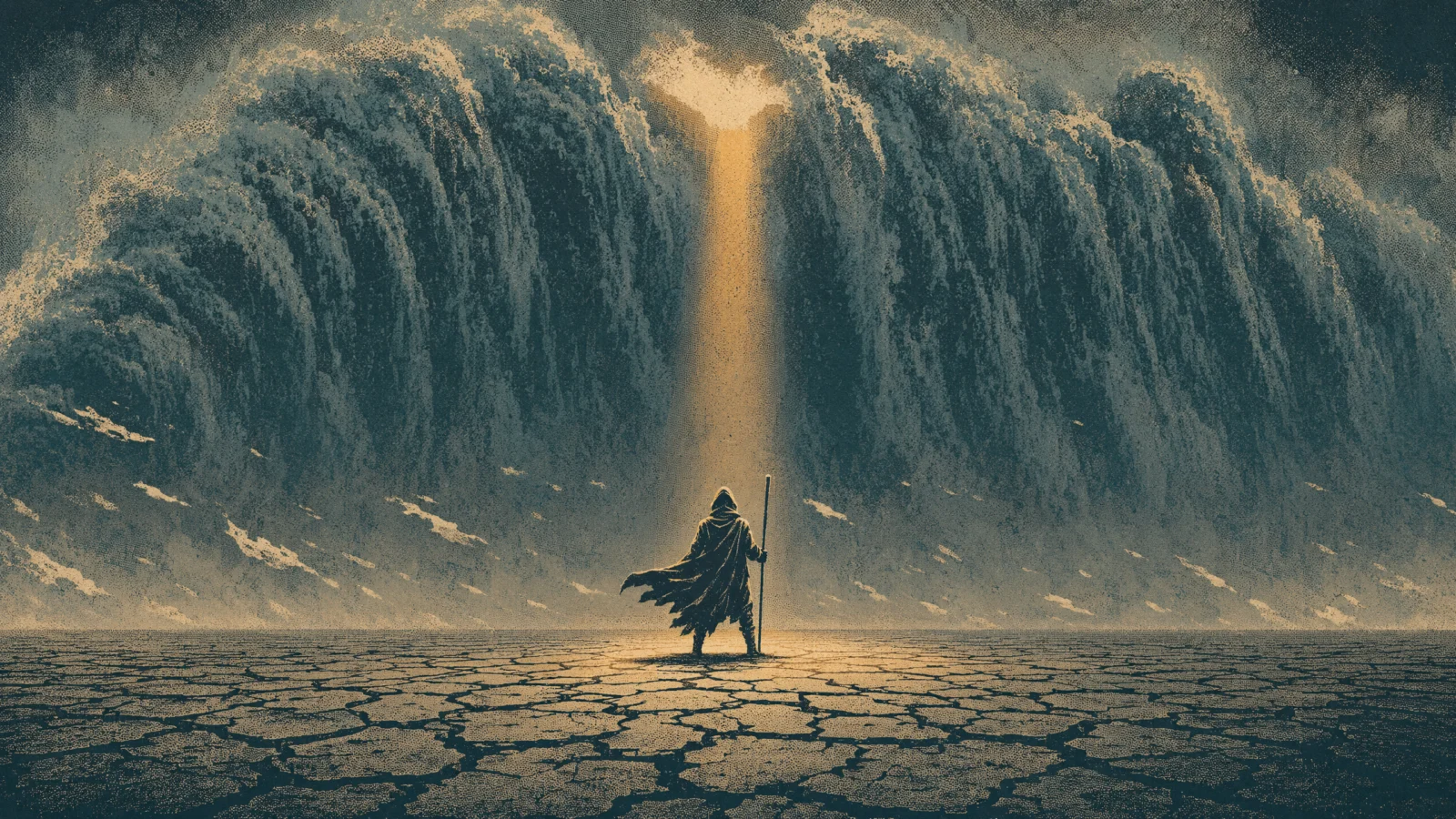
The Storm Wall frame from Vol.17 Category 1 (or any print-style image with an advancing threat and a single directional light). Upload to Seedance 2.0 on OpenArt, one image, composition and style reference, 15 seconds, 16:9.
The Full Prompt
Block By Block: What Is New In This One
The core skeleton is established across Episodes 1 to 4. Here is what this episode adds.
The LIGHT GEOMETRY Block
Covered in depth above, but three construction details are worth noticing in the block itself. First, "the only light source": exclusivity stated up front, so the model cannot add a helpful second light when the plain darkens. Second, the capitalised prepositions, BEHIND, THROUGH: the geometry words carry the whole meaning, and the caps bias attention onto exactly them. Third, the block ends with the two negative shapes ("never a vertical spotlight, never from overhead") inside the style section, not just in the DO NOT. When a failure mode is fatal to the clip, ban it twice: once at the top as law, once at the bottom as the safety net. That double-ban pattern is the same one that protects the print style itself.
WHAT HAPPENS: The Villain Gets The Verbs
Read the three phases and watch who owns the action: the storm ROLLS, CHURNS, GROWS, CLOSES, SEALS, ARRIVES, SLAMS, SWALLOWS. The traveller’s verbs are all resistance: LEANING, DRIVEN, dropping, holding. This is deliberate role assignment through grammar, the attacker acts, the hero endures. If you gave the traveller event verbs (dodges, sprints, battles), you would have an action clip. Keeping every traveller verb passive-strong makes it a defiance clip, which is a far rarer and stronger emotion. When you build hostile-environment clips of your own, decide who owns the event verbs before writing a line; that single decision sets the genre.
The closing: dying by steps. The beam does not switch off. It NARROWS, TILTS steeper, its pool SHRINKS "dimming step by step," and then the gap SEALS and it dies. Sequenced decline, the same travelling-change principle as Episode 3’s plates dimming "plate by plate." A light that fades globally reads as a render setting; a light that dies in stages reads as something being killed. And notice the tilt: as the gap closes, the beam angle steepens, because the geometry says the opening is shrinking upward. That detail exists purely because the LIGHT GEOMETRY block exists, once the light has a real origin, even its death obeys physics.
The swallowing: losing the world in order. "The cracked plates VANISHING row by row into the grey" toward the camera. The storm eats the plain in sequence, so its advance stays measurable even after the light is gone. In the final seconds, the clip has almost nothing left to show, grey, a silhouette, a staff, and the row-by-row erasure is what keeps those seconds moving instead of fogging out. Whenever your clip ends in obscurity (fog, dark, white-out), script the order in which things disappear.
The last image. "Only the faintest outline of the unbowed figure remains." The episode ends on the vault’s darkest held frame, and the word "unbowed" is doing the emotional work: the storm wins the frame, the traveller wins the story. One adjective, placed on the final visible thing.
WHO REACTS: The Beam Is The Clock
Every episode gives the environment a reaction layer; this one gives it a before and after. The beam’s pool is named as the plain’s only colour, so its death is not just a story beat, it is a palette event: the whole frame’s colour values change state at one defined moment. This is the Living Print advantage working for us, in a flat four-colour style, removing the single warm colour is a seismic visible change that realism would need heavy grading to match. If you build your own hostile clip, find the one element whose death changes every surface, and write both states.
CAMERA: Locked, Shuddered, Held
The camera does almost nothing in this episode, and that is the direction. Locked low behind the traveller (we face the storm with them, the wall grows past the frame because we do not retreat either), one hard shudder at the strike (the single-impact rule from Episode 1), then holding inside the grey to the end. The temptation in a swallowing scene is to pull the camera out to safety. Refusing that, staying locked while visibility collapses, is what makes the ending claustrophobic instead of scenic. Camera loyalty is a storytelling tool: where the camera refuses to go tells the audience whose side it is on.
SFX And BGM: The Sound Obeys The Light
The boldest audio direction in the vault: the music is killed mid-clip, at the exact frame the light dies, and never returns. Sound and light share one death moment, which fuses them into a single event in the viewer’s body. "No music, only the storm" for the final third is a silence choice very few AI videos ever make, and it is exactly why the swallowing feels real. The general rule: your audio arc should keep one anchor synced to your visual arc’s biggest moment, and sometimes the strongest musical move is stopping.
The Method Update
Everything from Episodes 1 to 4 holds. This episode adds four:
- Declare light geometry before directing light. Source, path, angle, and owner ("the beam belongs to the gap"). Effects without origins become spotlights.
- Double-ban fatal failure modes: once as law in the style block, once in the DO NOT.
- Assign the event verbs to choose your genre. Attacker acts, hero endures, is defiance. Distribute the verbs differently and the same scene becomes action, escape, or tragedy.
- Script decline in stages. Lights die by steps, worlds vanish in order, and the sound can die with the light.
Variations To Try
The survival cut. Same clip, opposite ending: in phase three the gap TEARS back open, the beam stabs through the churning grey, and the storm passes, leaving the traveller lit and standing in settling dust. Same geometry, the light wins. Render both and you have a two-part story for the community.
The night tide. Swap the dust wall for a colossal dark flood tide, the physics contract from Episode 4 applies ("the flood behaves like slow heavy water made of night"), the gap becomes a break in the clouds, the beam becomes moonlight. Same skeleton, new world.
Your own attacker. Any advancing mass works: avalanche, ash cloud, wall of rain, swarm. The checklist: attacker owns the event verbs, one light with declared geometry, the light’s death as the midpoint, ordered erasure at the end.
Common Issues And Fixes
The beam still reads as a spotlight from above. The geometry block lost. Escalate inside phase one: "the beam enters the frame from behind the storm at a low slant, crossing the plain diagonally," naming the path as an on-screen direction, not just a description.
The light survives into the swallowing. The ownership chain broke. Reinforce at the seal moment: "the instant the gap seals, the beam is gone, no trace of amber anywhere after."
A glow appears inside the storm. Seedance dislikes fully dark interiors and sneaks in illumination. "Glow inside the storm" is banned; if it persists, add "the storm interior holds no light of its own, storm-grey values only."
The traveller gets knocked down or runs. The defiance broke. Both are banned; if they land anyway, harden the resistance verbs: "feet never leave their stance, the staff never leaves the ground."
The storm stalls before arriving. The model protected the subject. "The storm stopping short" is banned; escalate with arrival language in phase three: "the wall reaches and passes over the traveller’s position."
The final seconds fog out into nothing moving. The ordered erasure got skipped. Restore "the cracked plates vanish row by row toward camera" and give the last visible beat a motion: "the silhouette’s cloak still thrashing as the grey closes."
Next Step
Episode 6: The Falling Star. The series finale: a burning object crosses the entire sky, strikes beyond the horizon in a dome of fire, and its shockwave races dune by dune across the desert to slam past the one figure who does not run. The episode where everything the vault taught, phases, geometry, sequenced cause, the held ending, lands in a single closing shot, and the journey walks on.
Section 06
Episode 6: The Falling Star
Retro Print Cinema, The Living Print Style, Series Finale
A burning object crosses the whole sky, strikes beyond the horizon, and the desert answers. A silent white flash, a dome of fire swelling over the far dunes, and then a shockwave you can watch coming, tearing sand off every ridge in sequence, racing dune by dune toward the one figure who does not run, slamming past, and passing. And when it has passed, the traveller straightens, and walks on.
This is the series finale, and it is built like one: the biggest event in the vault, the most physics in a single clip, and an ending that closes six episodes with one unhurried walk. The page teaches three final lessons: why an element got cut from this clip and what that teaches about video storytelling, how to stage an explosion in three honest beats, and how to make cause visibly travel across a frame, the technique that makes this shockwave the best moment in the whole vault.
The Lesson Before The Prompt: Video Has No Footnotes
The first version of this episode had a companion in it: the four-legged creature from the Vol.17 image vault stepped up beside the traveller to watch the sky. In the image vault, that creature carries a whole arc across thirty-six frames, follower to friend, and members who read the pages know it. In the rendered clip, it was an animal appearing out of nowhere next to the main character. It looked like a generation error. It got cut.
The lesson is bigger than one creature: a video clip carries only what it shows. A still image in a captioned vault can lean on lore, page text, and the frames around it. A 15 second clip explains nothing outside its own frames, there are no footnotes, no captions, no "as you know from Category 4." Any element that needs outside context to make sense reads as a mistake. So when you adapt vault stills into clips, audit for imported meaning: characters, objects, or details whose significance lives on the page and not on the screen. Cut them, or give them an on-screen introduction that earns their place inside the clip’s own fifteen seconds.
The cut also bought something. With the companion gone, the finale’s subject sharpened to the purest version of the whole series: one small figure, one enormous sky, and the choice to keep walking. The series ends the way it began, and that is not a loss, it is the shape of the story.
What You Need
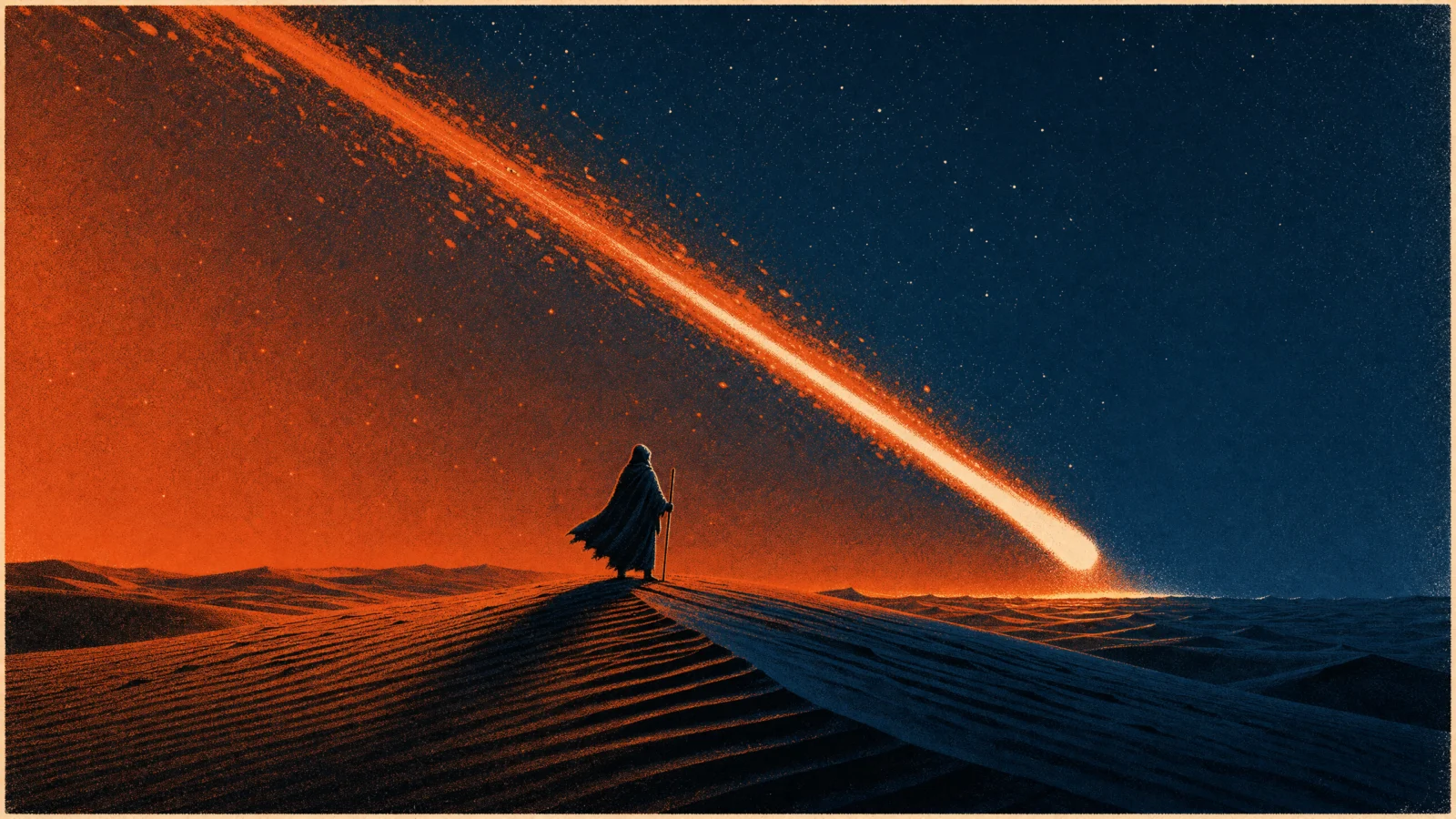
The Falling Star frame from Vol.17 Category 3 (or any print-style image with a sky-scale event and a single witness). Upload to Seedance 2.0 on OpenArt, one image, composition and style reference, 15 seconds, 16:9.
The Full Prompt
Block By Block: What Is New In This One
Everything from Episodes 1 to 5 is load-bearing here. This page covers what the finale adds.
The Style Block: The Cast Lock
The imported-meaning cut, enforced as law. Notice it lives in the style block AND the DO NOT lists it again in four forms (animals, creatures, second figures, anyone appearing beside the traveller), the double-ban pattern from Episode 5, applied to population. Fifteen-second generations love to add company to lone figures, especially near the emotional ending; the cast lock keeps the finale’s subject pure. Whenever a clip’s meaning depends on solitude, lock the cast explicitly, "one figure only" is a sentence the model respects.
WHAT HAPPENS: The Explosion In Three Honest Beats
The strike is the biggest single event in the vault, and it works because it refuses to be one event. It is three, in real physical order:
Beat one, the silent flash. "A massive silent flash WHITES the horizon line." Light arrives first, and arrives silent. That silence is real physics, light outruns sound, and it is also the finale’s boldest audio direction: the SFX line scripts "a beat of total silence at the flash." A silent flash after fifteen episodes’ worth of roars is the loudest thing this series ever does.
Beat two, the dome. "A colossal dome of fire and dust ERUPTS above the distant dunes, RISING and SWELLING." Note the shape: a dome, not a mushroom cloud. The mushroom is banned in the DO NOT for two reasons, it drags realistic fire rendering with it (a style killer at the clip’s brightest moment, same trap as Episode 3’s blaze), and it imports imagery the story does not want. A swelling dome of glow stays inside the print language and reads mythic instead of military.
Beat three, the delayed boom. The sound arrives WITH the shockwave, seconds after the flash. Flash, silence, then boom-plus-impact together: three beats the audience’s body recognises as true even if they cannot name why. The general rule for any big event: find its real physical sequence and honour it. Honest physics is the cheapest spectacle there is, one line of silence bought this clip more scale than any extra fire could.
The shadow tells the strike. Track the traveller’s shadow across the phases: it SPLITS in two directions during the fall (two light sources, trail and dusk), then SNAPS around and stretches sharp toward camera at the flash (one new overwhelming source behind the horizon). The shadow is Episode 3’s truth test working as narrative: the whole strike is legible in what happens at the traveller’s feet. When your event happens off-frame or at distance, let a shadow report it.
WHO REACTS: Cause That Visibly Travels
This is the finale’s masterpiece technique and the reason the shockwave feels physical: the wave is rendered by its consequences, in spatial order. You cannot see a pressure wave, so the prompt gives it a body made of sequence: sand rips off ridge one, then ridge two, then ridge three, approaching, and the phrase "so the wave’s approach is visible" states the purpose right inside the instruction, telling the model what the sequence is FOR.
This is the vault’s travelling-change principle (plates dimming plate by plate, the storm eating rows, blast light flooding "in sequence") at maximum: an invisible force given a visible journey across the whole frame, arriving at the one figure we care about. And when it arrives: "cloak BLASTING sideways, staff arm braced, sand EXPLODING off the crest", the Episode 1 rule that scale is proven by what reaches the small witness, now as the climax of the entire series. Distant spectacle plus travelling cause plus arrival at the witness: that chain is how you make an off-screen explosion land on-screen.
The calm lock. "Never knocked down, and never stops being the calmest thing in the frame." The traveller bends but holds, six episodes of defiance kept intact through the biggest hit. One line of character armour, sitting in WHO REACTS where the model applies it during the impact itself.
CAMERA: Holding For The Strike, Following For The End
The camera runs the full vault playbook one last time: rising drift (Episode 4’s register), holding steady for the strike (Episode 3’s rule, when light is the event the camera defers), one hard shudder exactly at the shockwave (the single-impact law from Episode 1), then the new move: it follows the traveller. Gently, along the crest, as they walk on. For five episodes the camera watched the traveller from fixed loyalty; in the final seconds of the series it walks with them. Then the held final frame, named in full: fire glow on the horizon, small silhouette walking on, one long breath. That frame is the series’ last image and its thumbnail, built into the prompt like every episode before it.
SFX And BGM: The Series Gets Its Ending
Episode 5 ended by killing the music. The finale does the opposite: the music dies at the flash, returns "low and resolute" after the boom, and resolves into a named closing melody, with footsteps returning underneath. "Ending settled and complete" is a direction Seedance genuinely responds to, it shapes the final seconds’ energy downward into rest instead of a cut-off. Ask your last clip’s audio to end like an ending; the model knows what that means.
The Method, Complete
The finale’s additions, and with them the vault’s method is whole:
- Video has no footnotes. Cut imported meaning; a clip carries only what it shows. Lock the cast when solitude is the point.
- Stage big events in their real physical order. Flash, silence, delayed boom. Honest physics is free spectacle.
- Give invisible forces a visible journey. Sequenced consequences across the frame, arriving at the witness.
- Let shadows report off-screen events, and let the final clip’s camera and music do what they never did before: follow, and resolve.
Across six episodes, that method now reads end to end: composition reference so the world can react, the style lock and its double-bans, three phases claiming every second, environments that answer with what they own, tempo shapes and event casting, light with geometry, physics contracts for impossible materials, giants directed by edges and consequences, verbs assigned to choose the genre, sequenced cause, one shudder, one float, and a held final frame every time. That is the Living Print system. It came out of thirty-plus test renders and six rejected takes, and every scar is now a rule on these pages.
Variations To Try
The near miss. Same clip, the object passes overhead instead of striking: the trail crosses, the roar doppler-shifts, the desert flares and dims as it goes, and the traveller turns in place following it across the whole sky. No impact, pure passage, the gentler finale.
The witness at night. Full night version: the fall is the only light in the world, the desert visible only where the trail’s glow touches it, the flash turning night to day for one beat before the dark floods back. The palette event of Episode 5, inverted.
Your own finale. Take your favourite frame from your own work and give it the finale treatment: the biggest event its world allows, staged in honest physical order, cause travelling to a witness, and an ending that walks on. Every technique on these six pages stacks into that one clip.
Common Issues And Fixes
The object strikes on-screen or the blast reaches the dune. The scale collapses if the impact lands close. Both are banned; if the model lands it near anyway, push the distance into phase two: "the strike happens far beyond the horizon, only its light and dome visible, never the impact point."
The dome goes photoreal, fire detail, realistic smoke. The brightest moment is the style’s weakest, same as Episode 3’s blaze. Cap it: "a dome of flat glowing colour, print-style fire, no realistic flame detail," and confirm the mushroom ban held.
The shockwave teleports, hitting the traveller without crossing the dunes. The travelling sequence got skipped. Restore it as geometry: "the dust ring crosses dune one, then dune two, then dune three, then the crest," numbered stages force the journey.
No silence at the flash, the boom lands instantly. The audio staging flattened. Strengthen the beat: "at the flash, all sound stops completely for one full second, the boom arrives only when the shockwave reaches the crest."
A second figure or animal appears near the end. The cast lock lost to the model’s ending instincts. Reinforce in phase three: "the traveller walks on alone, the only figure in the frame from first second to last."
The ending cuts off instead of resolving. The held breath got trimmed. Give the hold a duration: "the final wide frame holds for the last two full seconds, nothing new entering."
The Vault, Complete
Six episodes, one journey, one style nobody else is making. The giant rose, the herd scattered and regathered, the light lived and died inside the ring, the leviathan crossed the cloud sea, the storm swallowed the unbowed, and the star fell, and the traveller walked on.
Every clip came from a Vol.17 still, and every technique is on these pages, taught through the takes that failed as much as the ones that shipped. Copy the prompts, then do the real thing: pick your own frame, audit its physics, write its three phases, and make your own print live.
That is Retro Print Cinema. See you in the next vault.
Next Step
Start at Episode 1 and build the series in order, the method stacks page by page. And when your first Living Print clip renders clean, post it in the community: the best member clip gets featured on the vault page.