Section 01
Start Here: The Angle Sheet
What you will have at the end
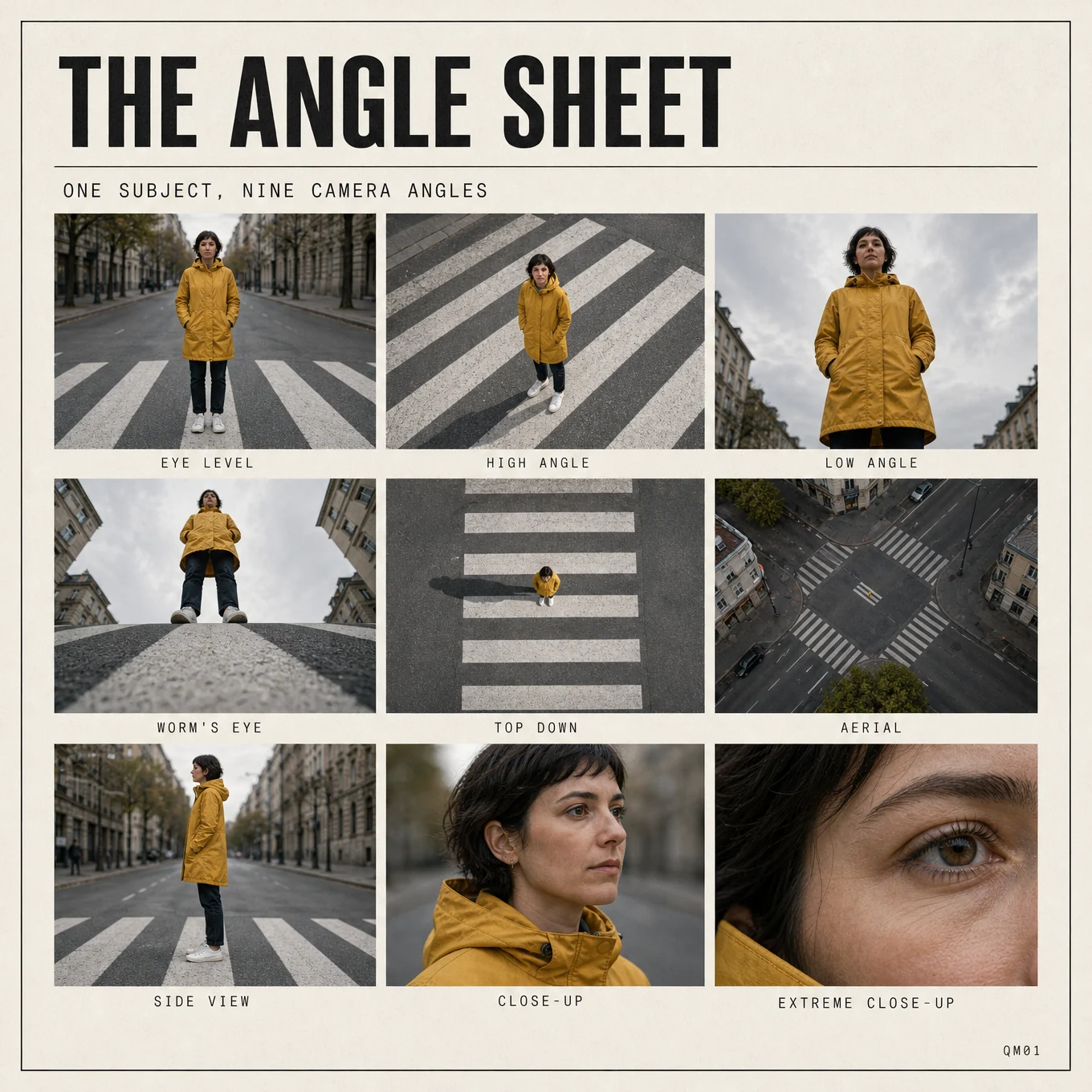
One sheet with your subject from nine camera angles, labelled, and nine short lines you can add to any image prompt to put the camera where you want it.
Why this matters
An image model left alone puts the camera at eye level, a few steps back, a little to one side. That is the average of every photograph it has seen. If you never name the angle, every picture you make has the same point of view, and it is the point of view of nobody in particular.
The angle is also the cheapest design decision you have. It changes who has power in the picture, how big the place feels and what the eye reads first, without touching the subject.
What you need
- GPT Image 2 on OpenArt, or any image model that follows a long prompt.
- One subject you can describe in two lines.
- Ten minutes.
The rule
Name the angle twice: once with its common name, once as a physical place for the camera. “Low angle” is a name. “The camera sits at knee height and looks up” is a place. The name helps a model that knows the word. The place works on every model.
Section 02
The Subject Lock
Before any angle, write the subject once and never change it. Every prompt on this page starts with the same lines. When only the camera line changes, you can compare the results.
A woman in her thirties with short dark hair, wearing a mustard-yellow raincoat, dark trousers and white trainers, stands still with her hands in her coat pockets on a black-and-white zebra crossing on a quiet city street. Soft overcast daylight. Photoreal, natural skin, no text, no logos.
Three things make a subject easy to read from any angle: one strong colour (the coat), a ground with a pattern (the stripes) and a still pose. The pattern is what shows the angle. On a plain floor a top down view and a high angle look almost the same.
Section 03
The Nine Angles
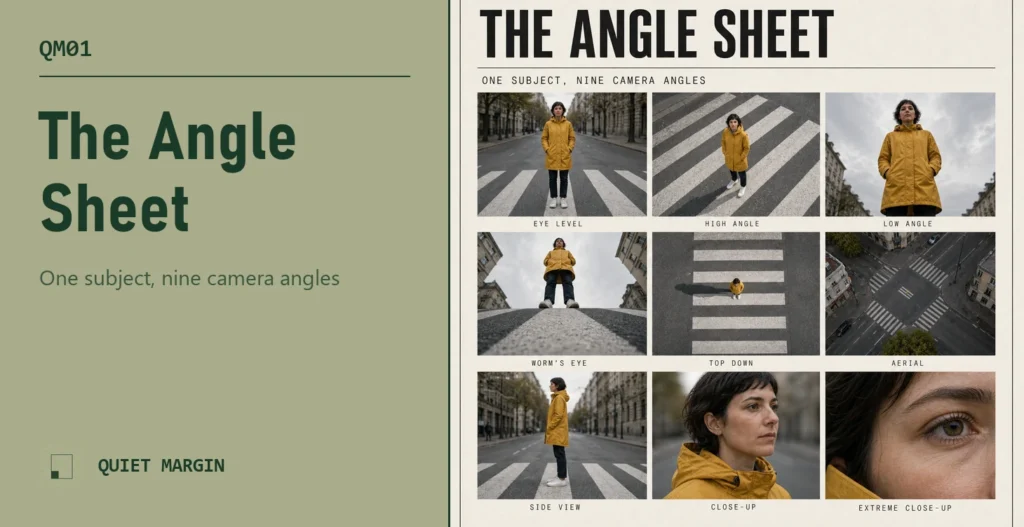
Add one camera line after the subject lock. Each line names the angle, places the camera, and says what the frame shows because of it.
Eye level: the camera is at her eye height, a few metres away, straight on. Her eyes sit on the upper third of the frame and the horizon runs behind her shoulders. 50mm lens.
High angle: the camera is above head height and looks down at her at about forty five degrees. We see the tops of her shoulders and the crossing stripes spread out around her feet. 35mm lens.
Low angle: the camera sits at knee height on the road and looks up at her. She rises tall in the frame with the sky behind her head and the tops of the buildings leaning in at the edges. 28mm lens.
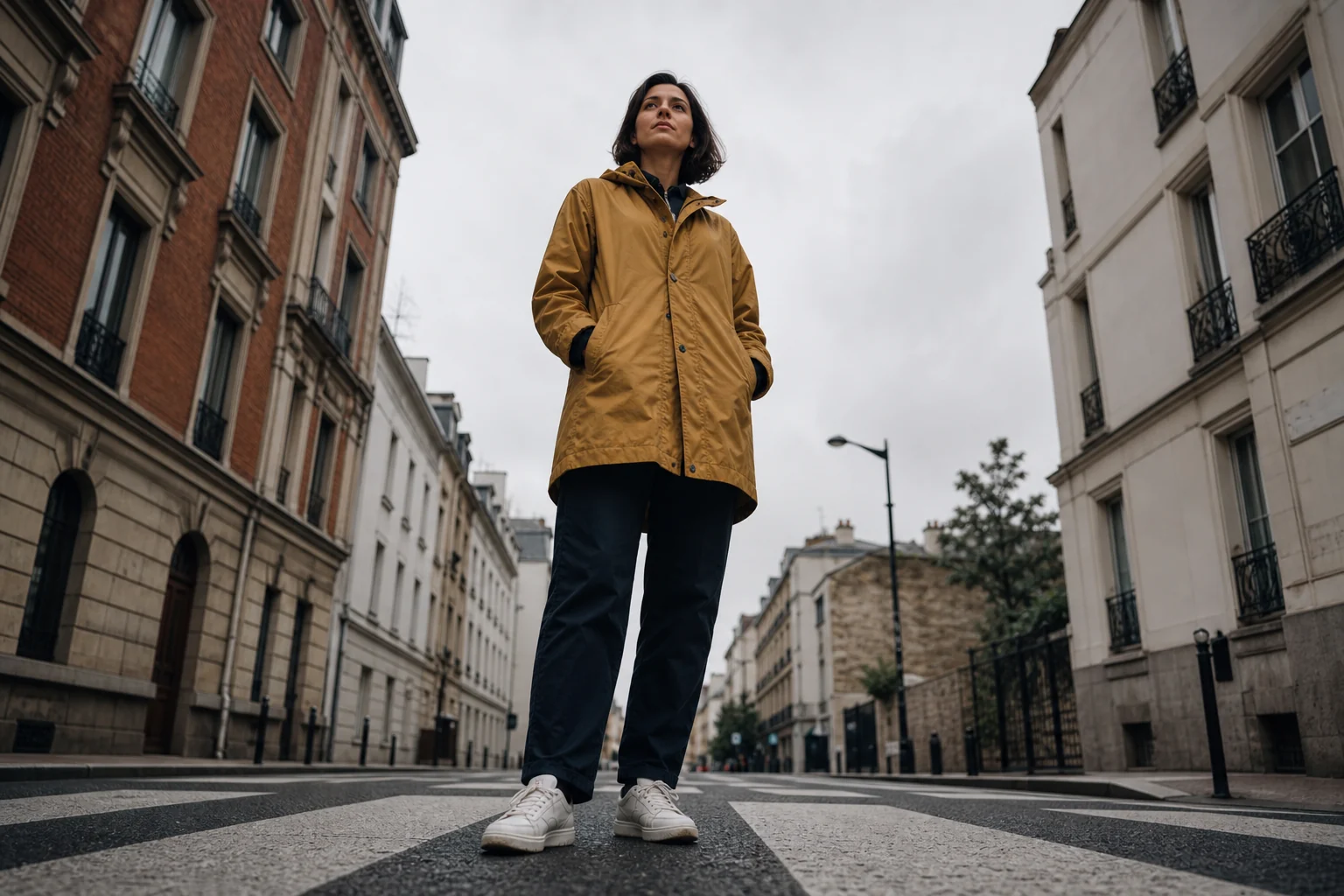
Worm's eye view: the camera lies on the road surface and looks almost straight up. The nearest stripe fills the bottom of the frame, her trainers are large in the foreground and her figure narrows steeply upward to her head against the sky. 16mm wide lens.

Top down: the camera hangs directly overhead and looks straight down. We see the top of her head, her shoulders and the round shape of the coat, with her shadow falling across the stripes, which run as parallel bands across the whole frame. 35mm lens from about eight metres up.

Aerial: the camera is very high above the whole junction, as from a drone at sixty metres. She is a tiny figure in a yellow coat and the crossing is a small striped rectangle among the roofs and the roads.
Side view: the camera is at her eye height exactly side on, at ninety degrees to the way she faces. We see her full profile from head to trainers, with the stripes running toward the camera. 50mm lens.
Close-up: head and shoulders only, the camera at eye height about one metre away. The raincoat collar frames her face and the street behind is soft. 85mm lens, shallow depth of field.
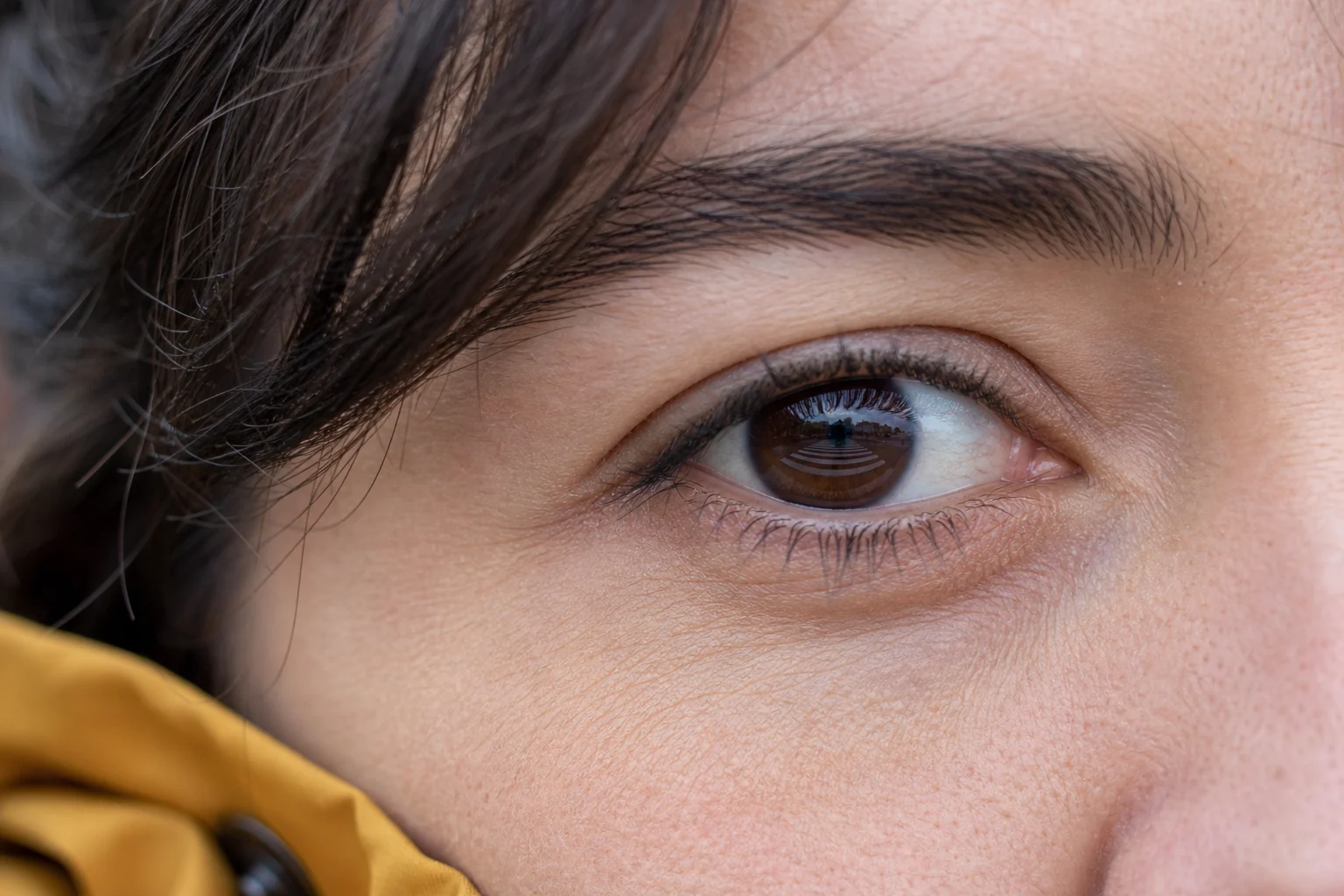
Extreme close-up: only one eye, the eyebrow and a few strands of dark hair fill the frame, with a thin sliver of the yellow collar soft in the lower corner. 100mm macro lens, very shallow depth of field.
Section 04
What Each Angle Is For
- Eye level is neutral. Use it when the subject should feel like an equal: portraits, interviews, a product at hand height.
- High angle makes the subject smaller and the place bigger. Use it to show a layout, a table, a crowd, or to make someone look alone.
- Low angle gives the subject weight and authority. Use it for heroes, buildings, vehicles and products that should feel large.
- Worm’s eye is low angle pushed to the limit. Use it rarely, for drama, and give it a ground worth looking at.
- Top down turns the scene into a pattern. Use it for food, desks, maps, crossings, anything with a strong ground.
- Aerial shows where the subject is in the world. Use it once, as an opening picture.
- Side view shows shape and movement. Use it for walking figures, vehicles and silhouettes.
- Close-up is about a face or one object. Use it when the feeling matters more than the place.
- Extreme close-up is about one detail. Use it as a cut-in, never as the only picture of a subject.
Section 05
The Sheet Prompt
One generation that prints all nine on a labelled sheet. Use it as a contact sheet before you spend on single pictures: pick the two angles that tell your story, then run those as full pictures with the lines above.
To use it for your own subject, replace the block THE SUBJECT and the plate number. Leave the rest as it is.
A designed reference sheet: one subject photographed from nine camera angles, arranged as a strict 3 by 3 grid of nine equal photographic panels with even gutters.

THE ART DIRECTION: Swiss International Style poster grid, generous structured whitespace, mathematical alignment. Plate anatomy: a hairline border inside the frame edge and a small plate number.

PALETTE LOCK: soft bone-white paper ground, warm gray undertone. Deep umber-black ink for all type and rules. The only colour intensity is inside the photographs: the mustard-yellow raincoat. No other colours introduced.

THE SUBJECT, identical in all nine panels: the same woman in her thirties with short dark hair, wearing a mustard-yellow raincoat, dark trousers and white trainers, standing still with her hands in her coat pockets on a black-and-white zebra crossing on a quiet city street under soft overcast daylight. Photoreal, unbranded, no printed text inside the photographs.

THE NINE PANELS, in reading order, each a different camera position on that same moment:
1. EYE LEVEL: camera at her eye height, a few metres away, straight on.
2. HIGH ANGLE: camera above head height looking down at her at about forty five degrees.
3. LOW ANGLE: camera at knee height looking up at her, sky behind her head.
4. WORM'S EYE: camera on the road surface looking almost straight up, her figure towering, the crossing stripes huge in the foreground.
5. TOP DOWN: camera directly overhead looking straight down, she is a small figure on the stripes, her shadow visible.
6. AERIAL: camera very high above the whole junction, she is tiny, the crossing is a small striped rectangle.
7. SIDE VIEW: camera at eye height exactly side on, her full profile.
8. CLOSE-UP: head and shoulders, the raincoat collar, soft background.
9. EXTREME CLOSE-UP: only her eye and brow with a few strands of dark hair and a sliver of yellow collar.

TYPE SYSTEM: condensed industrial grotesk for the title, engineering monospace for labels. Title reads exactly: THE ANGLE SHEET. Subtitle reads exactly: ONE SUBJECT, NINE CAMERA ANGLES. Under each panel one small caption in wide-tracked small caps reading exactly, in order: EYE LEVEL, HIGH ANGLE, LOW ANGLE, WORM'S EYE, TOP DOWN, AERIAL, SIDE VIEW, CLOSE-UP, EXTREME CLOSE-UP. In the lower right corner a micro plate number reading exactly: QM01. Three sizes: one huge, one small, one micro. One hairline rule under the title. Two typefaces total.

FINISH: archival matte print, soft paper tooth visible in the ground, square format.
Two notes. The captions are short on purpose: image models spell short labels well and long ones badly. And the person inside the sheet will not be exactly the same in every panel. The sheet is for choosing an angle; the single prompts are for the final picture.
Section 06
When It Goes Wrong
- Every picture is still at eye level: the angle is named but not placed. Add where the camera is and what it looks at.
- Top down looks like a high angle: write “directly overhead, looking straight down” and name a ground pattern that must run across the whole frame.
- Low angle shows no sky: say what is behind the head. “Sky behind her head” forces the tilt.
- The close-up crops the wrong thing: name what fills the frame and what is soft.
- The subject changes between pictures: keep the subject lock word for word and change only the camera line.
The angle decides where the camera stands. Where everything sits inside the frame is the next decision, and it has a full course: DES04 | Layout and Composition Systems.